Friday the 13th: A Halloween Journey

When I first made The Horror Doctor, I was fascinated with the idea of Strains and Mutations. By no means I have been particularly exhaustive when exploring what could have been in the horror genre – specifically the cinematic, which is where my Blog tends to go – but I feel that there is a somewhat healthy medium between looking at what happened, and speculating on what could have been in a genre as mutable as horror. 

Halloween has come and gone, both the holiday and the series. And yes, I know that the day and franchise themselves will return – like all undead creatures or slasher killers tend to do. But consider the following.

Most horror fans probably know that John Carpenter and Debra Hill wanted to expand the Halloween series beyond The Shape – beyond Michael Myers. In 1982, Halloween III: The Season of the Witch came out. Michael Myers and Dr. Loomis were both presumably dead, destroyed in a hospital fire a year before, leaving Laurie Strode to recover from her trauma, and the terror of Silver Shamrock and its Halloween products for children and adults alike would make humanity fear Samhain again. But audiences wanted their clear-cut avatar of darkness. They wanted Michael back.

But just as Halloween returns, so does Friday the 13th. Again, most fanatics know that Sean Cunningham wanted to emulate the story beats of Halloween, and after the story of The Shape was seemingly over, he and writer Victor Miller introduced the world to the idea of Jason Voorhees in 1980. Interestingly enough, both Halloween and Friday the 13th came as their third films in 1982, but what is fascinating is that after the first Friday the 13th, the film series gained another producer in the person of Frank Mancuso Jr.

And it seems as though the creators of the second Friday the 13th film, director Steven Miner and writer Ron Kurz, also wanted to make the film series an anthology and changed their minds, perhaps the decision also had something to do with Frank Mancuso Jr.  Mancuso Jr. not only produced Parts Two and Three of Friday the 13th, but he also helped create another series. Originally called The 13th Hour, this television series made by Mancuso Jr. and Larry B. Williams was renamed Friday the 13th because Mancuso Jr. believed it would attract more viewers. And while Mancuso Jr. said that it was still a play on the idea of a dark and unlucky day, it can’t be denied that the title itself would bring in fans of a certain other franchise of the same name. But Friday the 13th: The Series is a different beast from its film namesake. Jason Voorhees never appears, or is even referenced in the show, unlike Michael Myers who actually exists as a fictional character in his own first Halloween film shown in Season of the Witch.

Friday the 13th: The Series is a television series released in 1987, after Halloween III: Season of the Witch and Friday the 13th Part VI: Jason Lives, where two adolescents named Micki Foster and Ryan Dallion inherit an antique store filled with cursed artifacts given to their late, and aptly named, Uncle Lewis Vendredi by the Devil. This framework allows them to keep having some kind of new evil to combat every episode while also granting the opportunity to have antagonists, and allies that recur whenever the plot needs them. The series itself ran until 1990, and while it isn’t perfect – sometimes the various plot points grow contrived, awkward, and flat-out ridiculous – Friday the 13th: The Series functions as something of an assortment of different candies all wrapped up in the same grab-bag. I especially love the fact that the series not only starts off during Halloween, much like its how its spiritual namesake was inspired from another Halloween, the cousins even have the assistance of a former stage magician and occultist – a more benevolent Uncle Jack Marshak to help them deal with the cursed artifacts that they need to collect and from which to protect the lives of others.

Fittingly enough, at least from my perspective, what Halloween failed to do in film as an anthological series, Friday the 13th almost succeeded in accomplishing as a television serial. Perhaps if Laurie Strode had continued in other films unrelated to Michael Myers, or if The Shape had never truly been vanquished from the first film and recurred as a background character in others, or as a revenant that could potentially return in other settings even with Haddonfield as a determinator, both John Carpenter and Debra Hill might have almost achieved what they originally sought. It might also be possible that had Miner, Kurz, or even Mancuso Jr. kept Crystal Lake as a location, they could have built a larger world and referenced it in relation to another bit of folklore they could have built upon. I mean, look at Jason Voorhees himself and his transformation from a waterlogged deformed child, to an imitation of the Moonlight Killer, to the iconic hockey masked fiend we all know and fear.

Horror is a mythology and a process. Monstrosities, and their stories, do not come up ready made and whole. They are a messy process. And who knows if it might have been possible to lean into that development, into that dark and bloody journey of figuring out what something horrible is, and how it can be faced, and encourage audiences to want to follow along. Imagine it as another dark road not traveled. It’s awesome where we have already been, but these creative nightmares are always something fun on which to speculate. 

Horror Express to Killer B Cinema

I started The Horror Doctor three years ago at the height of Quarantine. It was during a time when most of us were staying indoors, hiding from the amorphous and ominous thing we were warned could be lurking within both strangers and loved ones, and for which there was no cure and many deaths. 

Three years later, the world has opened up again. The thing is still out there- we have since developed a vaccine and devised methods of detection, but the threat continues.  Life, in all of its forms, goes on. Before the Pandemic, I particularly enjoyed going to the Toronto After Dark Film Festival – an event that happens every October showcasing independent and open premieres of horror and all manner of weird films. I missed this event during the Pandemic, but found an online substitute in the form of The Last Drive-In on Shudder with Joe Bob Briggs, Darcy the Mailgirl, and crew. Unlike After Dark, this was a communal event that allowed me to engage with the hosts, as well as my fellow watchers. As another contrast to the festival, I got the opportunity to talk about the show in real time, and riff on the films along with others around the world. Some people I know had this experience with Mystery Science Theater 3000, but I never really got into that. For a few years, as the Pandemic loomed over us, for me and my fellow Mutants, as the show’s community is known, it was all about blood, breasts, and beasts.

Alongside other benefits, The Last Drive-In got me to appreciate B movies again- those low budget productions with equal parts cheese and charm. Then, one day, I ventured out again. I met new people, some of whom became very special to me. I slowly began to rebuild a public and private life that I had previously feared had been permanently overtaken by darkness. In the midst of reforming my life from the ashes of the Pandemic, I found out about Killer B Cinema. My partner stumbled across tickets for Zuma and immediately bought them to cheer me up, suspecting this would be exactly my kind of thing.

After seeing only a few select people for so long, I admit it took some time and encouragement to warm up to the idea of being in a public communal space again. But in the end, thankfully, we decided to go. Along with a strange and enjoyable film, we also discovered a niche event filled with an IRL community of weird movie aficionados adjacent in many ways to Joe Bob’s Mutant Fam. 

Nestled into Toronto’s Junction neighbourhood, the movie was held in a unique and cozy cyberpunk-themed bar known as See-Scape. Past the unassuming exterior, we entered to find a whole other world within. As Joe Bob Briggs has said, science-fiction – particularly the classics – and horror tended to go hand in hand. The cool and quirky See-Scape blends genres in both its aesthetic and purpose: the main floor has good food and drinks alongside board and video games, while the upper level features a patio, second bar, and versatile space that is intermittently a stage/dance floor as well as a theatre of the absurd.

This is, fittingly, where Killer B Cinema, a recurring film event running the first Friday of every month, resides. The B films selected, restored, subtitled, and shown by Lizzie Violet and Zoltan Du Lac run the gamut between strange international versions of familiar films like Cellat! (Turkish Death-Wish), Aysecik in the Land of the Magic Dwarves (AKA the Turkish Wizard of Oz), Pape Gudia (a Bollywood reinvention of Chucky), a North Korean propaganda film Hong Kil-dong, the vintage sci-fi spectacle Earth Vs. The Flying Saucers, and first for us, the strangely spliced and endlessly entertaining Filipino film Zuma. And then in October, 2023, we were treated to a classic: Eugenio Martin’s Horror Express.

I first heard about the film from a Creepshow episode called “Night of the Living Late Show,” in which a man recreates the 1972 horror movie in a virtual reality simulation so that he can live out his childhood interacting with facsimiles of Christopher Lee and Peter Cushing, and later sleep with the Countess. The episode, with the protagonist’s death within the Night of the Living Dead simulation due to the machinations of his jealous wife, was excellent, but that wasn’t good enough for me. I needed to see the film for myself. And I did. A few times. I’ve reviewed Horror Express before on Letterboxd. However, I gained a new appreciation and perspective of the film after seeing it at Killer B. 

So let me tell you how it goes. Before every film, we have the opportunity to order drinks and pub food, while Zoltan plays animated shorts in the form of a silly 1963 anime called 8th Man, or 8 Man. It is black and white with minimal frame rates, jerking wooden movements, and bad dubbing that nevertheless manages to be hilariously entertaining, particularly when watching it along with a live audience. It is based on the manga by Jiro Kuwata and Kazumasa Hirai in which a detective is injured and rebuilt into a humanesque android that functions as the sole member of the eighth division of the Tokyo Police, overseen by one Chief Bumble Thumbs.

But somehow, the episodes of 8 Man always foreshadow the main presentation, and this showing of Horror Express was no exception. So, after a strange episode with a child prodigy who invents an imagine-maker device that creates monsters from the psyches of its users – including dinosaurs – which 8 Man relentlessly strives to keep out of the wrong hands, leaving the poor boy with a train set to amuse himself, we get right into the feature film.

The best way to describe Horror Express is taking The Thing, but instead of a research station in Antarctica where American scientists succumb to infection and paranoia, we are on a Trans-Siberian Express from Shanghai to Moscow in 1906. However, this iteration of the being – which is also, albeit loosely, analogous to The Thing From Another World, and before The Thing, a creature adapted from Joseph W. Campbell Jr.’s novella Who Goes There? – is a fossil of an early hominid. This monster is really a creature suspended in ice, with the ability to absorb the knowledge of anyone it touches. As it makes contact with its victim, the cursed individual’s brain will essentially be erased, their eyes turned into unseeing white orbs with blood running down their sockets, and they will die.

It gets worse… Not only did this creature survive its deep freeze to steal the contents of people’s minds, it can also transfer its essence into the bodies of its victims, essentially hiding among the train’s passengers. In that sense, it seems to function not unlike a member of the Great Race of Yith from H.P. Lovecraft’s works, albeit without the switching of minds and bodies, just a simple possession of consciousness. The being has weaknesses, of course. It has a hairy hand that it needs to hide, likely the result of frequent astral masturbation. It can only use its power to mesmerize and absorb someone’s mind in complete darkness. At the same time, light allows the entity to pass as anyone else, and the darkness is a double-edged sword in that it both strengthens the being, while also revealing its red eyes, leaving it open to detection.

This entity, which we later find out is a being of pure energy that had been abandoned on Earth, manages to consume a thief (a spy who Peter Cushing’s character Dr. Wells has been heavily macking on – which actually surprised me as the man tends to portray sexless intellectuals like Sherlock Holmes, Grand Moff Tarkin, and The Doctor), and eventually a cast of suspicious characters including an engineer, a detective, and many others.

The friendly rivalry between Peter Cushing’s Wells from the Geology Society, and Christopher Lee’s Professor Sir Alexander Saxton is as entertaining as anything you might observe from these two real-life friends and consummate actors’ interactions. Saxton is nefariously hiding the creature’s remains in a crate for his great discovery, while the inquisitive Wells wants to know what he is holding, and isn’t above bribing a train employee to peer at this potentially groundbreaking discovery. 

There were a lot of things I didn’t remember from my first watches. I didn’t recall that there had been a voice-over narrative by Christopher Lee at the start foreshadowing the events to come, and the actual discovery of the creature in ice in Manchuria. I recalled the film starting on the bustling train station in Shanghai. While perhaps this initial scene added more “telling than showing,” it’s a narration from Christopher Lee, and who would turn that prospect down?

I think there are so many wonderful things about this film: the ornate setting of the train, the snowy landscape of the journey, the dark isolation juxtaposed with the warmth of camaraderie broken by mysterious murders. There are even hints of romance: chemistry with Helga Line’s Natasha, and even the Countess Irina Petrovsky, played by Silvia Torosa, who is seen flirting with Lee’s Professor Saxton despite her husband standing by. And last but not least, the mad Eastern Orthodox priest Father Purjardov, played by Roberto de Mendoza – who basically looks like Rasputin – somehow manages to steal the show just as much as Lee and Cushing. 

But what I think really struck me, both viewing it with others and seeing it again, is the turn of the century imperialism and patriarchal elements inherent within this film. Natasha and the Countess are clearly set up objects of desire to the predominantly male horror viewer-audience. Saxton, and to some extent Wells, blatantly look down on foreigners, even as they rely on their craft for transportation. Wells’ scientific assistant, the taciturn, capable, and pragmatic Miss Jones, played by Alice Reinheart, has her mind devoured by the creature- the only woman aside from Natasha the spy that it consumes. Wells ends up penetrating Natasha’s body (though perhaps not in the way he would have liked), when he conducts an autopsy after her demise. Eventually, he and Saxton perform surgery on the eyes of the creature, as well as its victims, and in the process see the last things the monster has seen, including beings from millions of years back. For me, this is reminiscent of the 8 Man’s imagine-machine, with its visions of dinosaurs fantastical creatures. Through this parallel, we spiral back thematically to the anime preceding the film.

The theme of penetration, driven by momentum of the male gaze, doesn’t stop there. There are frequent shots of the train pummeling down the track, a seemingly inexorable and blatantly phallic image which is central to the narrative. Purjardov the priest, desperately begs the creature, who he thinks is the Devil, to enter his mind and take his body. But I think the darkest embodiment of these ideals is the figure of the Cossack Captain Kazan. An imposing, large, bald man played by Telly Savalas, the captain chews up the scenery, intimidating the other passengers with his body language and crass manner, and proceeds – like the historic Cossacks of legend, a Slavic semi-nomadic militaristic people –  to get results in direct and brutal ways. When first introduced, the captain is pictured in bed with a woman, probably another in the latest, while he intimidates an old staff member providing him news about the latest troubles on the train. He comes in, and – mockingly giving respect to nobility, in the form of the Count and Countess – proceeds to beat up passengers and threaten their lives until someone gives up “the murderer” among them.

Even the creature, hiding in another body – having looked into the eyes and violated the bodies of so many – is terrified of this man; the monster itself couldn’t comprehend the inhumanity that humans display toward each other. For all of its atrocities, the being is simply attempting to steal the knowledge it needs to build a ship, to get its borrowed physical form home. Captain Kazan, while supposedly doing his duty, uses that as an excuse to exercise his sense of power and brutality. The inspection scene still stays with me; as a child I was told harrowing stories about the Cossacks and their role in pogroms by my Polish Jewish grandparents. In some ways, Kazan seems a larger monster to me than the creature. The contrast of the two begs the question: which being is worse, the alien entity itself, or the manner with which humans treat those deemed foreign and “other.” Amidst the classism and anti-foreigner sentiment, and entitled superiority displayed by the English and American contingents, there is a powerful, violent, hyper-masculine energy that emanates off Kazan, as he physically enacts what the creature is doing psychically. It is no coincidence, I’m sure, that he endures the thing’s onslaught longer than anyone else.

I will say, more people survive this film than they would in modern cinema. Wells and Saxton manage to get everyone to another car of the train, and detach the car containing the creature, who, as it transpires, can reanimate its victims into extensions of itself. Thankfully, the bodies all seem to be on the detached cars. The entity is seemingly destroyed because Kazan’s superiors gave orders to Russian soldiers in another station to change the track of the train, and ultimately send it off a cliff should there be no word back. Even the soldiers question this order, realizing it would potentially doom countless lives, but knowing they have to be sure, that they have to obey orders. And it works out, but it may not have done. The reanimated corpses could still be on the surviving cars with vestiges of the being’s mind. Even if they weren’t, the train could have crashed and killed everyone.

The most haunting thing about the film, is that after we see the rest of the train crash and burn, the camera pans out to show the Earth in space, as we had previously seen through the eyes of the creature, and we’re left to wonder if a being of pure energy can truly be destroyed by a train wreck. And if we are in fact seeing the Earth through the monster’s perspective, are we any better than it? Is the danger actually outside, or always lurking within?

These were some of the thoughts that swirled around my head as the B movie fans began to applaud. The perspective shifts once more. And for all the harrowing events of the movie as well as our reality, the fictional deaths and theatrical ridiculousness, for all the fear and anticipation it took to get us here, to this place where we can gather in a room with a like minded community, to talk and laugh and eat and drink in person again. It was a long dark journey that led us to a good night. And I look forward to the future, to more films at Killer B Cinema, and all the other live events now possible as we collectively reanimate from the perpetual fog of the last few years.  

The Case of The Haunted Palace

I’ve been watching the entire Corman-Poe cinematic cycle – a series of eight films mostly based on the nineteenth century writer of the macabre’s stories – for a while, and have continued on into this Halloween month. I went into Roger Corman and Charles Beaumount’s film The Haunted Palace cautiously thinking that it would only tangentially be related to Edgar Allan Poe’s works, with some adaptation from H.P. Lovecraft’s novella The Case of Charles Dexter Ward to a Lovecraftian, rather than a Cthulhu Mythos degree. 

What do I mean by that? 

More specifically, I thought it would be a loose adoption of Lovecraft’s plot focusing on the inherent malevolence and indifference of a reality based in cosmicism as opposed to specific elements of the Cthulhu Mythos- the Great Old Ones, Miskatonic University, and the like.

But I was wrong. And you know what? As an avid Mythos lover, and corresponding to the spirit of The Horror Doctor itself, I’m glad that the film adaptation wasn’t what I thought it would be. Of course, I’m not alone in this: Corman, the director, and possibly even the screenwriter, Beaumount, also didn’t believe this film would become what it did. Due to the intervention of American International Pictures (AIP), the film’s title was changed from The Case of Charles Dexter Ward to The Haunted Palace – forcing the addition of a few of Poe’s stanzas from the eponymous poem into the cinematic narrative. Corman wanted to try something new with his work. The result was different, but reminiscent of the horror-comedy experiment of The Raven – the film introducing Vincent Price and other classical horror actors, after the notable lack of them in Premature Burial, with its convoluted ending. However, AIP then made the decision to centre this work in the same continuity as Corman’s Poe Cycle, which, in my view, further obfuscated the film.

If anything, Poe’s The Haunted Palace poem is indeed more at home with something like “The Fall of the House of Usher.” The poem is incorporated into Roderick Usher’s song in Poe’s short story of that name, and could have easily been an epigraph or voiceover in Corman’s film adaptation. Nevertheless, the stanza “And travellers, now, within that valley/Through the red-litten windows see/Vast forms that move fantastically/To a discordant melody …” fits well with the preceding scene of Joseph Curwen conducting experiments- terrifying cosmic eugenics- on captive women who end up cursing the town of Arkham, somewhere in the eighteenth century. This fragment seems to hint at the Cthulhu Mythos creatures known as shoggoth: eldritch abominations and predominantly formless beings created by, and in servitude to the Elder Things; shape shifting beings that can form any organ or limb at will. These were the monstrosities contained under Joseph Curwen’s old estate in Lovecraft’s novella. Distinctively, in Corman’s film, there is one entity that is vaguely humanoid and wavering between realities, and whom Curwen and his followers utilized to forcibly impregnate young women from Arkham whom he had mesmerized. 

This might be a stretch, and indeed Poe’s “The Haunted Palace” is all about something that was once beautiful: the seat of a wise ruler was overthrown, the memory has become bitter and corrupted by the proceeding violence. You can see how that might fit “The Fall of the House of Usher” to an extent when you look at something beautiful becoming rotten through terrible acts, but Curwen’s estate is already a font of evil- taken from Europe, and transplanted there brick by brick to continue his family and coven’s work, into allowing the dark gods a way back to Earth’s reality through his mutants. 

It is generous to say that Corman’s The Haunted Palace is a fully faithful adaptation of “The Case of Charles Dexter Ward” or even Edgar Allan Poe’s poem. 

There are several other key ways in which the film adaptation departs from the source material. One such factor is that of setting. One could make the argument that the origin of Lovecraft’s Curwen did indeed come from the eighteenth century, but the main story took place in 1928 and not 1875. It may be that Corman’s film is set in the nineteenth century, complete with horse and buggies, to make it fall in line with the background and scenery of the Poe Cycle – it essentially being Poe’s time period – but it is fascinating to consider how the grafting of Charles Dexter Ward to the late nineteenth century as opposed to the early twentieth might pan out, and how that would change the telling of the story. Lovecraft’s story takes place in Providence, Rhode Island while Corman’s work occurs in Lovecraft’s creation of Arkham, Massachusetts. 

Charles Dexter Ward is a bachelor amateur antiquarian who lives with his parents. He is fascinated with the history of his home and family. Through his research, Ward discovered his ancestor Joseph Curwen’s ashes in his old residence, and with more investigation into his occultic practices, he resurrected his predecessor. Ages before his death, Joseph Curwen had created a space-time spell that affected the flows of fate. This had his descendant – who aside from a birthmark, and a lack of a forehead pit and witchmark, was practically his ancestor’s twin – find, and bring him out of his “essential Saltes.” In the context of the novella, these “Saltes” are the basic compounds left from a body that can be reanimated into a humanoid form- to be controlled, and interrogated by a necromancer. After that, Curwen – who still speaks an older dialect of English – disguises himself as Doctor Allen. You may recognize this surname to be an important one in the world of the Cthulhu Mythos. Wearing a fake beard and dark glasses to disguise himself, Curwen manipulates Charles into helping him continue his work.

“The Case of Charles Dexter Ward” novella begins with what seems to be Charles in a mental institution having physically and psychologically changed. The entire narrative is about family doctor Marinus Bicknell Willett attempting to figure out what is afflicting his young patient, which leads him to discovering secrets of the world that he really did not want to know. In the end, Doctor Willett discovers that Charles died a long time ago, having refused to do something truly heinous for his ancestor. In turn, Curwen killed Charles, hid his remains behind an old portrait of himself – which led Charles in his quest to find more information about him in the first place – and took his place, hoping to continue his experiments. However, the good doctor realizes what happened, and has studied just enough Mythos lore to not only unleash an ancient spirit of immense power on Curwen’s lich colleagues Jedediah/Simon Orne and Edward Hutchison, but to also undo Curwen’s own resurrection as he’s trapped in his cell in the asylum. In Lovecraft’s work, a young man’s benign but misguided focus on family genealogy takes a dark turn, and he is taken advantage of by forces he doesn’t understand; ultimately, reason, logic and kindness win out against the darkness, avenging his demise. 

Corman and Beaumount’s cinematic narrative begins with Curwen and his mistress Hester Tillinghast luring young women to his estate. The purpose of this is to implant what seems to be Great One-Human hybrids inside of these women. Again, there are some interesting references evoked from their choices in name for Curwen’s mistress, the etymology of which has likely been based in Lovecraftian lore. She shares the surname of the mad scientist Crawford Tillinghast in Lovecraft’s “From Beyond”, and Hester possibly mirrors the name of “Hastur,” a terrible deity adopted by Lovecraft from Ambrose Bierce and Robert W. Chambers.

In the film, we find a completely different practice from the Joseph Curwen in Lovecraft’s novella: while the man was involved in the slave trade, and experimented on countless human beings, he and his compatriots seemed more fascinated with reanimating and tormenting the dead through their essential salts in order to question them, and gain their powerful lore. Necromancy seemed the word of the day for Lovecraft’s Curwen, and forbidden knowledge his ultimate vice- at any cost. Further, we know that Curwen had fled one witch trial before, and was prolonging his life unnaturally. He took a wife, and gave to civic pride in Providence to keep up appearances before the citizens raided his lair after hearing rumours of his atrocities. 

Corman and Beaumount’s work posits that Curwen, in taking Hester as his mistress, infuriated her betrothed Ezra Weeden. This, combined with seeing countless young women go to their estate, brought the wrath of Arkham down on him. Curwen’s death in the film seems far more personal, compared to the relative civic duty that Lovecraft makes clear in his work. Yet this also sets the way for personal revenge, as Curwen, in being burned alive by a mob, curses the entire town for generations until – one day – he intends to return. 

One hundred and ten years later, in the film, we get a Charles Dexter Ward who isn’t a young twenty-six year old introverted bachelor who loves antiquity, but an older, more cynical and sarcastic man, accompanied by his wife Anne to Arkham. They have come to this town to check on some property that is in Charles’ family. Charles clearly doesn’t even want to be there, and it’s Anne who is fascinated with this dark and dreary town with its sullen, unfriendly people, as well as many afflicted with a terrible mutation. In this version Doctor Marinus Willet, the only person in the town who isn’t superstitious, doesn’t even know them, but he guides them to the estate, informing them of what occurred before. Further, it seems to be Joseph Curwen’s portrait on the mantle in the estate that begins to affect Charles’ mind, and he begins to struggle with the spirit of his ancestor. It is interesting to note that this Curwen doesn’t try to befriend or even manipulate Charles. Charles himself has almost no idea what is going on. In the end, a hapless but kind man is overcome by the soul of his ancestor. The idea of bad blood telling is both a Poe and Lovecraftian idea, or a Gothic one at least. There is some resonance to Lovecraft’s “The Thing on the Doorstep.” While in “Charles Dexter Ward”, Curwen is resurrected from his ancestor’s remains, here he switches minds with his descendant, and no longer has a body of his own.

In fact, there is a moment where I thought Curwen would get his original body: when he and Simon Orne and Jabez Hutchinson- in this iteration, as his followers, rather than his friends and equals as in the original story- robbed a graveyard. However, that is only to get the corpse of Hester Tillinghast back, to reanimate her. It is the only instance beyond Lovecraft’s novella where we see Curwen use necromancy to raise the dead, and there is no mention of “essential Saltes,” just a repetition of the Latin word for “live.” I do have to say, though, that given the cold and dark beauty that is Tillinghast’s actress Cathie Merchant, I can’t say I particularly blame him.

However, whereas Lovecraft’s Charles Dexter Ward had his father afraid for him, and his family doctor fighting for him, in Corman and Beaumount’s work it is his wife Anne, played by Debra Paget, who won’t leave him despite all of his terrible changes in behavior after coming to the estate. In the end, she calls on Doctor Willet – the descendant of one of the men who helped burn Curwen – to help her and her husband. It is interesting to see the character dynamics play out in this setting. Lovecraft’s Curwen uses blackmail, extortion, and murder to get his way in “Charles Dexter,” as a matter of course, whereas the Curwen in Corman’s film is petty and spiteful against the descendants of the people who killed him the first time, but strangely proud of the man whose life he has now possessed. He almost admires Charles in resisting him, though only because of that “Curwen blood,” which of course is an extension of him. He is an entity that ruins Charles’ life, consuming it into the void that is himself, and attempts to rape Anne. When he gets tired of doing all of that, he even gaslights her to Doctor Willet, trying to get the man to take her away, and let him continue his plans. Vincent Price plays both Charles and Curwen, and the mental dynamic and struggle between them pretty well, but that is no surprise when you look at his dual-roles in Corman’s The Pit and the Pendulum a few movies ago in the Cycle. 

And those plans are sinister as all get out, even as they are amazing to someone who is a fan of the Cthulhu Mythos. You have a man who possesses a copy of the Necronomicon, a book that has links to the powers of the “Elder Gods” – or as Lovecraft calls them Great Old Ones – such as Cthulhu himself, and Yog-Sothoth. You also have the fact that the afflicted villagers and their ever-worsening mutations are reminiscent of the Innsmouth Deep One-Human Hybrids, and the Dunwich Whateley sons of Yog-Sothoth in Lovecraft’s work. This is not just a Lovecraftian film, you realize at this point, but a Cthulhu Mythos adaptation. And it is exciting to see something like that occur in 1963, long before Stuart Gordon’s films, and other depictions. This may well be one of the first cinematic adaptations of Lovecraft, and you can witness it through so many of these themes.

But while many of those elements – the Necronomicon and Yog-Sothoth – are referenced from Lovecraft’s story, several plot point in Corman’s film are different. Curwen’s ultimate plan in making Anne the mate of the shoggoth, the demonic thing in the wavering green pit, is foiled when Charles seems to regain control of his body. The townspeople attack the estate after Curwen used fire to assassinate two of their number. This actually troubles his followers, as, after waiting for Curwen to return for over a century, they wanted to continue resurrecting their dark gods. This makes the viewer wonder if there was going to be a mutiny, though it never happens. Then, Orne, Hutchinson, and Hester Tillinghast disappear, as Willet goes back to rescue Charles from the fire. I can almost forgive this rush job given how awesome performances were by Price, and Lon Chaney Jr. – who plays Simon Orne – but it does feel a little rough. Even so, I do like the idea that however we got to that point, there is the strong implication that despite the destruction of the portrait, Joseph Curwen is still in possession of Charles Dexter Ward, and ending the film on that dark note finishes strong. There is no stalwart, elderly doctor that vanquishes evil here. No banishment into dust. No deus ex machina destroying Curwen’s peers off page or off camera. Curwen continues on. Evil survives. 

It makes you wonder who had a far worse end: Lovecraft’s Ward, who at least got to die after all of his suffering, (though he knew the terrible truths of the world and was forced to commit unspeakable acts before he did so), or Corman and Beaumount’s Ward, who didn’t know anything before being subsumed by his ancestor’s malignant soul. The film’s end, and the thoughts they conjure up, tend to linger long after their stories are over.

It’s mentioned by Willet – or perhaps it was the descendant of Weeden – that the estate, or “the Palace” of Curwen and his family was taken from somewhere in Europe in pieces, and reassembled in America. I feel, too, that this is the case in a more localized geographical, but literary way in North America. According to Corman in his interview with Chris Alexander in Corman/Poe: Interviews and Essays Exploring the Making of Roger Corman’s Edgar Allan Poe Films, 1960-1964 A.I.P. took fragments of Edgar Allan Poe’s poem and attempted to expand it, to mutate and build blocks from it as the Elder Things – and sorcerers after them like Curwen – would shoggoth. One can even argue that Curwen and his associates learned how to reanimate the dead through breaking down organic beings into their salt contents by studying – and feeding – shoggoth as basic building blocks of life. But more like Lovecraft’s Herbert West – and it’s hilarious as there is a Benjamin West as one of the townsfolk that killed Curwen ages ago – in that they attempted to regrow this reptilian skin loosely over a whole other kind of body of work in Lovecraft himself. “The Haunted Palace” stanza, at the end of the film, “While, like a ghastly rapid river, /Through the pale door /A hideous throng rush out forever, /And laugh—but smile no more,” just doesn’t quite … fit. 

I am a fan of stories and films that use epigraphs – fragments of literary passages and quotes from other works – and even include parts of them within the body of their narratives. Even Lovecraft and Poe utilized these devices. So if I were to change anything about The Haunted Palace, (aside from not having Orne, Hutchinson, and Tillinghast vanish for no reason, or Charles suddenly return again, or Curwen falsify that act), and I had to make this very clear specimen of the Cthulhu Mythos in the cinematic medium fit in with the thematics of the Corman-Poe Cycle, I wouldn’t have used “The Haunted Palace” at all.

Instead of “The Haunted Palace,” one could speculate on what might happen if the filmmakers took another tactic. What if we go back to right after Curwen’s burning, and have Vincent Price recite in his velvety sardonic voice:

That motley drama—oh, be sure
It shall not be forgot!
With its Phantom chased for evermore
By a crowd that seize it not,
Through a circle that ever returneth in
To the self-same spot,
And much of Madness, and more of Sin,
And Horror the soul of the plot.

And then end the entire film with the following lines on screen:

But see, amid the mimic rout,
A crawling shape intrude!
A blood-red thing that writhes from out
The scenic solitude!
It writhes!—it writhes!—with mortal pangs
The mimes become its food,
And seraphs sob at vermin fangs
In human gore imbued.

Just think about how these stanzas fit the themes, and the content of this film: the mob mentality, the plot of the film, the non-human elements in the form of the mutants and the thing in the pit, the desecration of the dead, and the ghouls that play with death and flesh. It goes back to the mutants, and the disease, and the curse. I mean, if you are going to name a Lovecraft Cthulhu Mythos story after Poe’s work, you might as well title it “The Conqueror Worm.”

But really, it should have just been The Case of Charles Dexter Ward, and if you look at “The Haunted Palace” as a genuine inspiration of this film, perhaps it is less a commentary on the film itself, and it more refers to its place in the Corman-Poe Cycle. It is placed in a continuity of lush and vibrant, startlingly colourful films, but it is twisted, dark, and cynical. Perhaps the poem talks about the beauty that once existed in the Corman-Poe Cycle, but is now consumed by Lovecraft’s indifference towards any concept of human life and  meaning, and the changing of a cinematic era: where all of that dark wonder has become shadows of what they once were. Chris Alexander, in his Corman/Poe, mentions that the change of writers – from Richard Matheson to Beaumount – represents a shift in the Cycle from an immersive experience of twists and turns to “the mechanics of plot.” He argues that the film is almost “pornographically direct” and he further calls Lovecraft the antithesis of Poe, and in his interview with Corman, the latter mentions how Lovecraft is darker and more overt: an approach that both he and Beaumount were looking for in trying something new.

And I think they did make something new, though not necessarily what they might – or might not – have been looking for. They made the first Cthulhu Mythos film for the general public. And while it might be awkward to place it into the Corman-Poe Cycle, as one of Lovecraft’s adaptations it is solid on its own merit for the most part. Like Lovecraft, while it might seem more blatant and steeped in realism, instead of the surrealism of the previous films, Corman’s film reaches into the supernatural and its inherent madness, leading to further grandiose and terrifying spectacles to come. 

Shaking On It: Danny and Michael Philippou’s Talk To Me

Fangoria co-owner Tara Ansley told us repeatedly on X (the platform formerly known as Twitter) to see Talk to Me in the theatre, and advised us to come into it as cold as we could. And that cold ceramic hand hits hard; this handshake with the dead is the stinging slap of gore and horror you know is coming, but yet can’t quite predict. Telegraphed to an almost ridiculous degree, the film’s initially slow momentum takes a concept that could be funny, trite, but ultimately forgettable, and transforms it into something genuinely dreadful, eliciting a range of feelings in the viewers. Neither a handshake nor a slap, Talk to Me closes its hand into a fist and delivers a solid punch to the gut that upends the very foundations of reality, ruthlessly blurring the lines between the worlds of the dead and the living.

It’s not that teenagers meddling with spirits of the dead for fun is a new idea. It isn’t, not at all. No. Directors Danny and Michael Philippou, and writer Bill Hinzman play with your basic horror tropes, and bring them to a terrifying but familiar place – an embalmed, porcelain-coated hand, reputedly belonging to a deceased medium is used casually and carelessly to interact with the dead, with serious repercussions. In place of a Ouija Board, the cursed artifact is passed around at parties; teenagers, spurred on by peer pressure and an obsessive fascination with the macabre display that ensues, call upon the hand to possess them, for the sheer hedonic rush of it. Following the horror precedent of a roadside harbinger of doom, reminiscent of the graphic death of Charlie in Hereditary, and the deer roadkill from Get Out, there is a pivotal moment at the beginning of the Australian Talk to Me in which the protagonists stumble upon a suffering kangaroo on the road, and Mia tries but can’t find it in herself to put it out of its misery with her car. These early scenes provide character introduction, but more importantly hint at the darkness to come; this film gets ugly, fast, as it is made clear that unanticipated consequences come from well-meaning actions.

The idea of a hand with powers beyond human comprehension is also nothing new, though this film offers a variation on previous models. Legend has it that a hanged murderer’s hand can create a Hand of Glory that renders people motionless when they see it. A Monkey’s Paw can grant three wishes- in the absolute worst ways possible. The hand in Talk to Me opens up a portal to the spirit world, allowing a tormented soul caught between life and death to possess a human host. Aside from the universal appeal of occult practices, holding hands with this cursed object has another draw as it simultaneously puts the user into an altered state of spiritual elation, as Mia — a protagonist mourning the second anniversary of her mother’s death — describes. Mia’s backstory is explored through memory and montage. Mia has an emptiness and longing for connection. She uses the hand to escape this, if only briefly- to not only feel better, but also find deeper meaning, and an understanding of the events that led to her mother’s death. The answers uncovered may be precious truths, or, more likely, malicious lies that will drag her toward actions that ultimately hurt her, and destroy her remaining relationships. After the initial ungodly high, she becomes fascinated with the hand primarily because it allows her, for a fleeting ninety seconds (the time it is deemed safe to be possessed by the hand before you lose yourself to the control of the spirits), to be reunited with her beloved mother, or at least, an entity reminiscent of her mother, to predictably horrific results.The draw to connect with her once more causes Mia to exceed the allotted time, jeopardizing her relationship with her only friend, and throwing the young boy she considers a brother into the tormented grasp of the spirit world.

Like all forms of media, there are many ways to read a horror film.The obvious metaphors are there. As mentioned, the hand is first a drug experimented with by irresponsible teenagers, before it gets, for lack of a more apt phrase, out of hand. Seen through some of the more graphic scenes in this film, the euphoria induced by the hand can also be interpreted as a symbol of sexual experimentation. It is portrayed as a pubescent rite of passage seeped in peer pressure, as one after another volunteers to touch the hand and invite the spirit into themselves, with dramatic consequences, and often accompanied by an orgasmic spectacle for the teenage crowd of onlookers. 

The hand, passed around among friend groups and brought out at parties, can be seen as symbolic of social media: the reference to viral trends and online spectacle-making platforms like TikTok come to mind as the teens record the possessions on their phones, traded around for popularity’s sake. Along with a total disregard of future consequences, the teens show a distressing lack of empathy towards the peers they manipulate and pressure to undergo the invasive ordeal. Cautionary tales of social media’s addictive, self-delusionary and sometimes destructive nature as demonstrated through the teen’s documented encounters with the hand are told through a lens of the unreliable narrative. 

There is also a commentary implicit in the narrative about the dangers of ignorant people meddling with powerful tools they do not understand until it is too late. Like Pandora’s jar, once opened, it becomes impossible to put the evils back inside. Further, this film critiques the human need to interact with perversity and death, to tempt fate and succumb to temptations, amid extensive backdrops of graphic horror porn. Fans of this genre go to movies in part for gratuitous gore, but we stay for explorations of our collective human tragedy, interspersed with ridiculous frivolousness. We enjoy vicarious experiences of fear as epic bloody scenes are splayed out on the screen, as well as the uncanny, such as a disembodied hand enthusiastically passed around among teenagers like a joint at a party. In this way, Talk to Me does not disappoint as it takes us along for a ninety minute journey, far longer than the altered state brought on by a ninety-second handshake, as we encounter vicarious trauma, and grapple with alienation and the drive for connection and belonging. The screen allows us this exploration of pressing existential questions from a safe distance, leaving us exhausted from a profoundly disturbing and cathartic experience. 

A Horror of Errors: Ari Aster’s Beau Is Afraid

So Fangoria sent me an email as part of my subscription. In it, it implored me to go see Ari Aster’s 2023 film Beau Is Afraid. It was the first film I’ve seen by myself in a long time, approximately three years. I took an Uber at practically the last minute to see it before opening day.

And let me start off by saying that Beau has a lot, and everything, to be afraid of.

When I was talking about Aster’s 2019 Midsommar, I was reminded of the fact that it came out the same year as Joker, and far before I decided to see Beau Is Afraid, I knew that Joaquin Phoenix – who played Arthur Fleck and eventually that iteration of the Joker, on his journey parallel to Florence Pugh’s Dani Ardor – would be the aforementioned Beau.

My initial thoughts, after describing Beau’s existence are the following. Imagine a nightmare maternal Jewish guilt-trip psychodrama set to the tone of Franz Kafka’s The Trial, and Brother Where Art Thou? and you might get something like Ari Aster’s latest film. Let that set in for a few moments. It’s so tempting for me to envision Beau Wassermann as something like what would happen if Fleck from Joker had never fully thrown off the narcissism of his mother, or killed her, aged and broke down under her manipulative care, and was left completely adrift. He even had one love interest, who does exist, that he held one innocent wish to be reunited with one day.

There is something incredibly surreal and almost magically real about this movie and its narrative, and like Joker or Taxi Driver you have to wonder if Beau’s mental illness is causing various truths and hallucinations of the Freudian, and Jungian kinds to intermix. I can definitely see there being many different interpretations of this movie going forward, complete with critics toting the “elevated horror” line, but also examining the strengths and limitations of A24’s arthouse film sensibility or ethos. Is this film something that pushes the envelope of genre, or storytelling? Or is it more artistic indulgence, and vanity?

We get glimpses of some concrete truths in Beau’s life, even if they are distorted, and necessarily limited by his own perspective. It feels like everything bad that can happen to him does, from the small and inconvenient to the utterly tragic: and all of these little things turn into a tide that threatens to drown the man, especially as he can’t find any water. It’s basically a Comedy of Errors, with little bits of Manners – tongue and cheek words of graffiti on the wall, and throwaway statements – that shape this poor man’s utter existence. For instance, Beau is prescribed medication by his psychiatrist that he has to drink with water, but after somehow losing his house keys and luggage while having slept in due to loud music and neighbour harassment in his apartment, he doesn’t get to the airport to get to his mother’s, and the apartment happens to have shut off all of the plumbing. This leads to him having to go outside into a dystopian neighbourhood filled with corpses, and fights, and orgies – and because he leaves the door open without his keys, the barbarians from outside invade his space and utterly destroy it.

And then, afterwards, he finds out his mother died.

Seriously, Ari Aster seems to be attempting a monopoly over grief and familial breakdowns in the horror genre: from Hereditary, to Midsommar, and even The Strange Thing About the Johnsons. I mean, I can firmly believe that his narcissistic businesswoman mother Mona Wassermann is a witch, a failed Ellen Taper Leigh, for various reasons I won’t go into, and some of her “love” for her son borders on the incestuous if only because her sense of self always trumps his every time: in life, and in death.

Beau’s tragedy isn’t just the death of his mother, and the low, awkward, uncomfortable paces of finding out this truth, and dealing with the cold, unfeeling, shallow, self-centered actions of everyone else around him. It’s that in her attempt to mould him into what she thought of as the perfect man, and make him love her the way she wanted him to express that affection – and only in that way – he has severe mental trauma that the world around him seems to exploit. It renders him nearly inarticulate, and passive: to the point of small things like not having enough change, or being able to renew his credit card utterly fuck him. Some people with mental illness or challenges have called this a difficulty executive dysfunction. Literally, you see Beau wrestling with one frustrating, infuriating thing, only to have to put the other aside and you really feel for him: if only because we have all been there in some way, or form.

It just doesn’t let up. It just doesn’t give him a break. Instead, the film proceeds to break Beau down with various twists and turns, and folds in reality, time, and belief that never give him relief. And some of these you can see coming a mile away. On risk of making a terrible extended pun, even sharing an orgasm with another person, someone he once loved, ends poetically and horrifically, and it only cascades from there after one false moment of peace. Even his mental retreat from the meta-fictional play in a play, whose mileage may vary for viewers, and the strange animation that would not have been out of place in Midsommar, only leads him into a deeper, dark forest of his mind, the feminine, maternal, voice-over telling his story and threatening to overcome and manipulate his first-person perspective, until eventually after not being able to find water at the start of the film, he finds all the water he could want …and very much cannot escape.

There is so much to say about this film, and how almost every agent in it wants to take away Beau’s sense of identity, and I feel like as I describe it I make a lot of other cinematic and even literary comparisons to other works in order to properly elucidate my feelings on how I’ve experienced it. Sometimes, as I followed the film for two hours and fifty-nine minutes, I felt like I was in a Jewish cautionary folktale hijacked by Art Spiegelman’s Prisoner on the Hell Planet comic. I don’t think this is a coincidence, at least in my mind. In the comic, Spiegelman attempts to communicate how his Jewish mother’s death, and her own mental illness before it – her suicide in that case – traps him. He struggled with her own behaviour while she lived, along with the rest of his family, and in her death and how people reacted callously to his grief – and supposed abandonment of her in life – she still imprisons him. Or perhaps it wasn’t Spiegelman’s mother who put him in that place, but the trauma that shaped their lives.

Beau’s mother came from a long line of cold, unfeeling women and she attempted to escape it by pouring toxic love all over Beau. She smothered him, and he rebelled in little ways that he castigated himself over. He doesn’t live with her, but her shadow looms over him. It threatens to consume him with her impossible expectations, and her projected disappointments. She’s become larger than life at the end of the film. Whether or not she’s dead is irrelevant. Whether or not the world is inherently flawed and unfair to Beau is also irrelevant. When Beau is sitting in that broken boat as judgment is proclaimed on him by the prosecution, and the defense is barely even heard: it is that childhood trauma winning over the adult sense of knowing none of this was his fault. It’s heartbreaking to watch especially as it eventually swallows the man, and the boy he was, whole.

And as the credits roll over that upended boat, as the criminal that is Beau is unfairly punished, as the shadows consume the anonymous and distant jury of his self-condemnation into darkness, you realize that Beau’s mother is only part of the terror in this ridiculous film. It’s the entire world. It’s Beau’s world that is the ultimate horror, where his answer to Kafka is that he is not helmsman, he is less than Gregor Samsa’s vermin – and you can recall the spiders in his apartment at the start of the film – and he does find his brother, and himself, and he doesn’t like what has seen. Nothing makes sense, but everything does, and it isn’t the answer he wants, but one to which he has resigned himself. 

If I were to give this maddening film a rating, I would give it three and half imagined family members out of five. I say check it out if you are lost, and want to find someone or something even more so. 

Taking Laughter Away From Slaughter: Sam Raimi’s Evil Dead

Imagine you got the Naturom Demonto, and use its pages of finely cured human flesh to go back in time to 1981. A year later, New Line Cinema acquires the distribution rights to Sam Raimi’s Evil Dead, but even as it makes the film successful, it denies him and his crew the rights to make a direct sequel: one Evil Dead and the Army of Darkness.

But the Book in your hands is a Monkey’s Paw, and the mere existence of you here at this time in history changes everything. Evil Dead is released in fifteen theatres, but all the people that saw it in the original timeline do not see it. Or Stephen King doesn’t write a review of the film, and someone else creates an article that attracts another distribution company. Or producer Irvin Shapiro didn’t help screen the movie at the Cannes Film Festival in 1982. Maybe the film goes underground and builds a large following over time. Or it becomes a rare oddity horror fans talk about in small viewings: pondering just how something that looked like The Exorcist piggybacking on The Night of the Living Dead just could not have caught on? Perhaps if you told these hypothetical film students and watchers that it might have been different had there been a sequel, and some Three Stooges elements – which is hilarious as Raimi directed a short film in 1978 called Shemp Eats the Moon – injected into the high energy, insanely paced cinematic monstrosity, with more of a callback to his proof of concept work of the same year Within the Woods

Yet there is a demonic force, a demented genius, in Evil Dead that could not be ignored. It wouldn’t just end with one weird, incredibly gory, disturbing high octane aberration. Certainly, the Necronomicon Ex Mortis, if it were called that, would not allow it to be so, and that Kandarian Demon is restless as fuck once you mess with that Book in general. Yet if that first film had a different set of reviewers or critics, another distributor, or if Raimi and his crew gained more capital in those early years, could the Evil Dead franchise have evolved differently?

I think about what would have happened if Evil Dead II: Dead by Dawn hadn’t existed and we simply gained a direct continuation from the first film. Maybe Raimi attained the fame and influence needed to convince New Line Cinema to let him make the film he planned, or simply produced and distributed it himself that early on. What would we have seen?

It’s more than possible that we might have gotten Army of Darkness almost immediately, placing Ash in a medieval era surrounded by Deadites. Whether or not Army of Darkness would have had different production scale, or practical effects in 1987 instead of 1992 is anyone’s guess as temporal manipulation goes, but perhaps Ash would be a different hero entirely. 

When you look at Ash Williams in Evil Dead, he is fairly toned down from the loud-mouthed ultra-masculine chainsaw wielding badass that we all know in popular culture. He genuinely seems to care about his friends, and especially his sister Cheryl and his girlfriend Linda. Ash isn’t the one that turns on the tape recorder in this movie, but it’s his obnoxious friend Scott that does it just out of some morbid curiosity, or to freak out the rest of his friends. Ash is a young man that wants to do right by his girlfriend, and his sister: and even after being forced to do horrible things to the bodies of his possessed friends and loved ones in order to survive, the magnifying glass necklace he gave Linda keeps him going. He destroys the Naturom Demonto and the Deadites boil, sizzle, and die away in putrefaction. Everything is horrifying in this film, and there is no respite: and even at the end, when everything seems finally put to rights, the Kandarian Demon – whose perspective we’ve seen as it violated Cheryl with the trees and attacked the others – lunges at Ash, and ambiguously kills him.

But what if the Kandarian Demon, without the anchor of the Book – which isn’t called the Necronomicon at this point, the name borrowed from H.P. Lovecraft’s Cthulhu Mythos, but rather the Sumerian version of the Egyptian Book of the Dead – uses the last of its waning power, which had been latent in the Knowby cabin and its grounds even before Scott played the recording along with the energies of the Book’s destruction to send Ash back in time to kill him, and therefore save the Book and continue its reign of terror on humankind?

What I’m trying to get at here is what if a serious Ash, without the Three Stooges comedy of Evil Dead II, went back to this medieval era in what might be a version of Kandar Castle? What would the characters look like? What would the franchise look like going forward from that?

I do not have the Necronomicon with me, sadly, to tell me about the dark pasts and futures that could have been. But it is possible that there could have only been two films as a result of this lack of comedy, or very little of it. On the other hand, this version of Evil Dead II might have been a major hit of a darker Ray Harryhausen variety, and inspired the need to make more of itself, and gain more profit. It is also possible that, like most popular horror franchises that start out with darker and grimmer tones, that so many sequels would have resulted in the work eventually parodying itself. You don’t have to look far when you consider Friday the 13th and A Nightmare on Elm Street. So it is possible that Raimi may have led the series to the camp and black comedy it was meant to go into itself, or someone else directing the future films would have begun that process with varying results of quality. 

Yet Raimi, when he did get Stephen King’s aid, along with Dino De Laurentiis, did something truly amazing. Not only did Raimi make a soft reboot of his original concept, removing or not mentioning the existences of Scott, Shelly, and Cheryl, and take a cue from Within the Woods where Ash actually gets possessed, he takes the comedy and ridiculous parody that might have happened to his franchise anyway, and institutes in the second movie. It’s almost as though he, and his crew, anticipated this change in tone, or mythology. Horror, more than a lot of cinematic genres, loves to reinvent its own continuity if only to create and propagate more of itself. Ash becomes more belligerent and arrogant, even absent-minded. There is an aggression there that is exaggerated as opposed to the PTSD-fuelled fight and flight of him and his companions in the other film iteration. The chainsaw arm, of course, its utter madness makes its appearance. The other companions that come in afterwards are all antagonistic until they work together, and then they don’t.

And Henrietta Knowby, played by Ted Raimi, changes the relation of the Deadites not only to Ash and his companions such as Annie Knowby, but to the audience as well. Before this, we saw a group of friends turn on each other as the invisible turned tangible and monstrous through their bodies. And while this does happen in Evil Dead II, we have the presence of the tangible malformed evil of Henrietta locked in that horrible cellar. The Book is now called the Necronomicon Ex-Mortis as well, and more about Kandar itself is revealed through missing pages, and the Dagger. After this, we see Ash sent through a portal into the medieval period: even though by the time we get to Army of Darkness, the beginning is different from the Evil Dead II ending. 

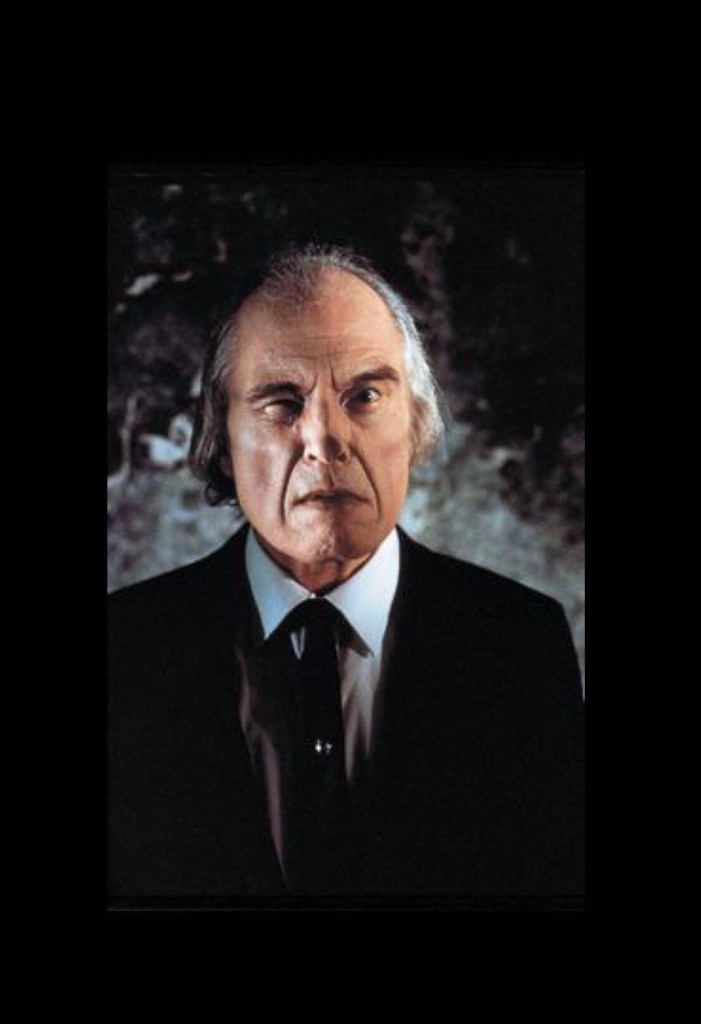
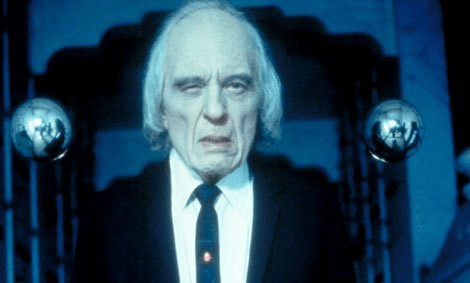
The change in continuity would not have phased Raimi and his crew either, or even the tone of the series. Raimi himself had background in comedy films, and it is more than possible that he not only paid attention to Friday the 13th and A Nightmare, but also Don Coscarelli’s Phantasm: a franchise that constantly reinvented its own mythology in hallucinogenic, dreamlike ways.

But I keep on thinking about what would have happened if Evil Dead II had been made the way Raimi originally intended, or if the comedy simply hadn’t entered into its sequels. I wonder about which film I like more: Evil Dead, or Evil Dead II. The second film does add a lot more to the Evil Dead Mythos: with the Book, the Dagger, the Pages, a terrifying being in Henrietta who we don’t see transform into a Deadite like the others but is well into her advanced stages, Ash facing his own dark self through possession and also his severed hand, the chainsaw prosthetic, the portal into the past, and the whole iconic insanity of this world.

Yet there is a simplicity in the first film that I greatly appreciate. It is straightforward horror with suspense, and tension. Evil Dead II has us laugh at the hijinks that happen, helping us with moments to release the tension that has been wound throughout every mad action and gore scene while wincing at the weirder moments, but the first Evil Dead makes us sympathize more with the people in that cabin. The sequel lets Ash survive, while the first one seems to kill him off, and it just hits harder in my opinion. 

But if the franchise continued without the comedy, what would it look like? The closest thing I can think about, when I consider alternative paths, is The Evil Dead remake directed by Fede Álvarez, but also produced by Sam Raimi, Bruce Campbell, and Robert Tapert. It is, arguably, another soft reboot of the original but there is no comedy in it whatsoever, or tongue in cheek references – popular-cultural or otherwise – and it is genuinely unsettling, and upsetting. David Allen is an Ash Williams analogue, a throwback from the first Evil Dead film, who actually dies at the end. And Mia Allen, a drug-addicted artist, is like a darker version of Cheryl Williams who actually survives and is freed from her possession in a ridiculous but clever way, as well as some mutilation on her part. The other characters are almost different versions of the ones from the first film, and the Book is called The Naturom Demonto again. Mia does take that chainsaw, but she doesn’t make it into a prosthetic, and I can’t help but wonder that even with the Ash Williams cameo at the end, what a sequel to this film would have been with that evil Book of the Dead still in existence. In some ways, I think a sequel to this 2013 remake would have answered a lot of my speculative questions.

As it is, Evil Dead Rising, written and directed by Lee Cronin, with our usual suspects as producers might provide another possibility: with a girl named Beth going back to her sister Ellie and her family, and finding that damned Book. The funny thing is: Ash’s love interest in Within the Woods was called Ellen. And maybe Mia Allen’s journey, this Cheryl Williams analogue that survives, is continued at least spiritually by Beth in a world of Deadites and Kandarian Demons without laughter for humans, but plenty of slaughter for their enemies. 

Annie, Ok: Rob Savage’s DASHCAM

This is one film that I’m actually glad I went into cold. In fact, I ended up watching the wrong movie by accident, Christian Nilsson’s Dashcam, also released in 2021: which is also a product of the Screenlife (computer screen) film subgenre, and a good film, which I write a little bit more about elsewhere. As it was, when I was reviewing the former, I’d come across a summary of a movie that didn’t match the one I initially watched. Luckily, I turned away from it just in time: only knowing about the main character Annie, her political leanings, and that she is a traveling musician that goes to Britain. And that was it.

Then, I found Rob Savage, Gemma Hurley, and Jed Shepherd’s DASHCAM. I’d known about, and looked forward to, it for some time after reviewing their previous film Host two years ago during the height of the Pandemic and Quarantine: created during this new golden age of fear and paranoia. But while Host is a short movie filmed and put together to emulate a Zoom séance gone horrifically wrong and very much an artifact of its time of terror – not unlike a contemporary Orson Welles’ War of the Worlds radio broadcast, or Stephen Volk’s BBC special GhostwatchDASHCAM is another creature entirely, albeit related. 

DASHCAM’s format, just like Nilsson’s otherwise unrelated film of the same name, and Host, is a piece of Screenlife – or computer screen art – except unlike it being conveyed to the viewer from an actual screen, a messenger program, files shared, or the Zoom platform, it is something being live-streamed to us through a camera and a phone through some kind of undisclosed generic looking platform.

As such, we have two elements at play here: the protagonist, and her own viewers. Please turn your metaphorical wifi signal off as there are going to be Spoilers. You know, you would think that based on these past couple of years DASHCAM – both Savage’s and Nilsson’s films of the same name – would refer to the surveillance equipment police are forced to carry to record their dealings, and racial profiling and hate crimes. But while Nilsson’s movie does deal with a police officer’s footage of his interaction with a former political white appointee, Savage’s movie focuses on a female, live-streaming, right-wing, Trump-loving, anti-vaxxer American song artist. The way Annie Hardy portrays herself in DASHCAM is something that, frankly, might happen if Eric Cartman from South Park had a lovechild with Robot Chicken’s Bitch Pudding: with an entire childhood of learning how to use an indoor voice from the fun figure of Jar Jar Binks. Oh yes. In DASHCOM, she is this obnoxious.

And the thing is, everything that happens in the film is her fault. All of it. She violates Quarantine to travel from America to Britain because she hates the restrictions in her country, breaks into her friend and former bandmate Stretch’s home, proceeds to make his girlfriend Gemma incredibly uncomfortable with crude remarks, insults, and not even wearing a mask. She even licks her hand and slaps the man in what she calls “a Silverlake Handshake” to wake him up after coming into his place unannounced, and creating a major Fight or Flight reaction in him and his partner. And this isn’t even going into disrupting his Uber delivery work by not wearing a mask at one of his pickups and getting into an altercation with the proprietor, and then stealing his car to take some food from a pickup call. But it’s when she takes on a passenger for a large amount of British notes, a confused and seriously ill elderly woman named Angela, that we finally see the results of what happens when Annie ultimately fucks around, and finds out.

It feels as though, as the film – already carried by Annie’s frenetic energy – descends into pure, blurry, almost ridiculous levels of chaos: with death, destruction, sickness, and madness that can only be the result of the unholy force of nature that is the human disaster called Annie Hardy. Oh, and Angela is possessed by an entity referred to in the credits as the Parasite that kills two other people as well.

DASHCAM is a spectacle of special effects, gore, feces, vomit, and grossness with constant action, and so many events happening all at once: making Host look sedate and insidious by comparison even when you consider the destruction that happened in that film. But every spectacle needs spectators. Remember how this is supposed to be a live-streamed situation? Well, if you suspend enough disbelief in considering that Annie still has her head-camera and phone recording her throughout everything going to hell even when she loses her wifi connection – and somehow Stretch has a recording device as well as we follow his perspective for a time as he tries to help Annie clean up the mess she’s picked up – and not just the excrement that Angela’s left in his car – we see on the left-side of the screen legions of users offering advice, demands, swearing, making political statements, sexual come-ons, anti-Vaxx conspiracies, and all of the sundries. These people, voyeuristic, anonymous entities themselves, don’t try to alert the authorities as to what is going on, and only one or a few attempt to figure out where Annie, Stretch, and Angela even are. On the contrary, for the most part these fans are either egging Annie on or condemning her, making slurs at Angela, or doing about the same to Stretch.

Basically, the users watching Annie’s livestream enable her behaviour and want to see how everything unfolds. In a lot of ways, they are the stand-ins for the viewer-audience – for us – with their cries to leave Angela alone, to run, to rescue her, ascending from the lower left hand part of the screen to the ether. We see emojis: of praise, sickness, terror, and love rise from the lower right hand on the screen as a form of positive or negative feedback. And you’d better believe the viewer count on the upper right hand side of the screen increases as things become even more extreme. This isn’t a few friends getting together to talk to a spirit that was a joke gone wrong, but an entire Internet of faceless people contributing to, but ultimately watching and gaining entertainment from the suffering brought about by one person’s thoughtless hubris.

However, as I talk about the structure of this film, it does make me think about how it has been presented: or aesthetic considerations. DASHCAM is supposed to be a livestream. There is a part of me that adores not only Host, but also the Internet phenomena of Kris Straub’s Candle Cove archival discussion thread creepypasta, his Local58 web analog horror work, and even Martin Walls’ The Walton Files YouTube videos. The electronic epistolary format of all of these works, in how they present themselves as other media, is something I truly appreciate. In fact, I think Host was stronger than DASHCAM in a lot of ways because despite being on Shudder, it could easily be seen as a legitimate Zoom conversation.

Just imagine this, as a special viewing. Consider if Blumhouse Productions had allowed DASHCAM to be viewed on a livestreaming platform: and when Annie or Stretch’s wifi connections fail, we could have gotten an entire gap of time where we could have seen the chat explode into speculation. This is not a perfect idea, you understand. If we could only see what gets streamed to us, there are many scenes and beautiful effects that would be missing. At the same time, this also isn’t a perfect movie. Between the suspension of disbelief that Stretch is also streaming for the audience at times, and the blatant supernatural effects of Angela, it can get a bit much. Still, considering the twenty-five minute gap that one of the users in the chat mentions between Annie running away into the woods after Angela kills her mother, and then her in a car soaked in demon ichor without Stretch, as realistic as it would be not to see anything it’s just as well we still got to view the entire length of time between the abandoned amusement park, the house, and the basement. Otherwise it wouldn’t be as entertaining.

As such, despite how you might see Annie, as a viewer you are also one of her spectators to her exhibitionism. Even if she annoys you, infuriates the hell out of your existence, you do get invested in what is going to happen to her: if only because, as an outwardly unlikeable protagonist, you want to see her reap what she’s sowed. But there is genuine comradery between her and Stretch. After they accidentally crash into a car from a wedding, setting the groom on fire and killing the bride instantly due to Angela attacking them, Annie holds the groom’s hand as he dies. She puts her Anti-Liberal T-Shirt over the face of the deceased bride, apologizing to her. Annie gets Stretch to beat-box or rap with her as he is distraught by deaths his car caused, and the terror of dealing with the possessed woman that is Angela. And when Annie slams the arm of Angela’s psychotic mother with the car door after she hunts after them with a shotgun and abuses Stretch, you feel a certain sense of satisfaction as Annie gets revenge on the person that attempted to kill them: as petty, and spiteful, and as human as it is.

It doesn’t take away from the fact that because Annie took on Angela, to drive to that house from the restaurant, that two people lost their lives as she crashed Stretch’s stolen car, or that Stretch ultimately dies due to Angela herself: lasting longer than I actually thought he would, to be honest. And even her killing of the Parasite itself, which is wisely obscured for the most part – though out of the corner of one’s eye resembling a refugee from Pan’s Labyrinth – doesn’t absolve Annie. DASHCAM makes it fairly clear that this iteration of Annie Hardy at least is the true monster of this film: this selfish, raging, being that destroys everything in her path simply because she can’t, or won’t, control her own self-centred impulses. I’d posit that the true horror of DASHCAM is that Annie survives when everyone else around her doesn’t: a reckless force that doesn’t suffer the consequences of her own actions. If that isn’t a metaphor for Anti-Vaxxing, or fascism, I don’t know what is. And even that isn’t entirely accurate, as she does begin to cough at the end of the movie. It’s poetic: that Annie manages to live through several car crashes, drowning, being psychokinetically thrown, death cultists, the death of her best friend, and a demon only to contract COVID-19. 

Of course, the figure of Annie can’t have it end like that. No. Annie Hardy actually goes as far as to shunt aside the fourth wall, to interrupt the generic credits to bring herself back to the spotlight. As the names of DASHCAM’s creators stream down the left side of the screen, she proceeds to make a scatological, seemingly improvised rap for each and everyone of them as she drives around to the very end. And you know what: the song is excellent. You truly get an appreciation for Annie Hardy’s skill, and talent as she keeps up the pace and her own sense of rhythm. There is something admirable about her extreme confidence, and passion. It shines through: burning madly, defiant, childlike, playful, and with obvious love. 

I read up on Annie Hardy after watching DASHCAM, and I wondered if she was anything like the personality she portrayed. As I did so, I came across an interview with Rob Savage and DASHCAM’s producer Douglas Cox by Perri Nemiroff of Collider where he defends using Annie Hardy as the film protagonist. Savage explains they had seen Hardy’s performances, especially her Band Car show where she improvised music and talked about topics while driving around, and considered finding an actor that could imitate it: even help them adapt it to the found footage model to which they were going for. What Savage and Cox both realized was that not only did her level of creativity mesh well with theirs in a manner reminiscent of the collaborative effort behind Host, her personality shone through. She was, and is, literally the persona they were looking for turned up to an eleven.

And I can see why this choice is controversial. Promoting someone who has Anti-Vaxxer views during a Pandemic, amongst other sympathies, is not good optics. I can see that some people might view this as legitimizing perspectives that could be harmful to vulnerable people. At the same time, the film doesn’t lionize Annie Hardy’s depiction. It doesn’t make her, her views, or her actions to be good things. Even if her persona doesn’t die at the end of the movie, even if she survived her own disasters, this isn’t a good thing. I think this is a case of showing someone, a personality, taken to the nth degree, and how it leads to terrible consequences. At the same time, we also see that there is a legitimate humanity behind all of these instants, and that what we are looking at – and who we are looking at – is real, or as close to that idea as possible. Annie Hardy exists, and the people and forces she represents and these aspects are not celebrated, but acknowledged, and used to tell the mad-cap, brutal story that the creators set out to do. And whatever else, I feel this decision creates art and horror has often gone to this place of transgression: with Cannibal Holocaust’s story, and production, coming to mind for starters. 

But while there is a mythology behind this film, even for the monster or Parasite foreshadowed in Stretch and Gemma’s apartment as Rob Savage discusses with Rosie Fletcher of Den of Geek, Annie Hardy makes the soul of this DASHCAM, and I don’t know if it could have been as effective with anyone else. DASHCAM has been an experience. I give it three and a half crabs out of five. I say check it out. 

At a Fork Between Space and Time: Phantasm and Doctor Who

It took me the longest time to realize where Ghostwatch came from.

In Russell T. Davies’ era of Doctor Who, during the time of the Tenth Doctor, the term was used by the British media to refer to the manifestation of strangely humanoid apparitions that appeared everywhere in the 2006 episode “Army of Ghosts.” Of course, these “ghosts” were actually Cybermen from an alternate reality attempting to come into this world: or that of the show itself. What I didn’t know, then, was that “Ghostwatch” was a reference to the BBC 1992 pseudo-documentary that terrified British television watchers everywhere by using their actual media spokespeople and staff to stage an elaborate tongue-and-cheek televised haunting turned bad. 

I could write a lot about Stephen Volk’s Ghostwatch in its own right, as it falls into my whole found footage and epistolary cinematic fiction kick, but it was another reminder of that intersection not just between fantasy and comedy with horror, but science-fiction – especially weird science-fiction – and the horror genre. And when you have something like Doctor Who, a particularly weird science-fiction series running from 1963 and onward, stopping for a time in 1989 and 1996 respectively, only to be resurrected in 2005, it is a bizarre and zany patchwork that has covered a few genres, and stories, and story concepts in its time. I used to talk about this series a lot. Hell, I once spent years at an online magazine covering entire episodes of the show, and speculating on all of its elements before truly digging into the horror genre full time in these latter years. 

And then, one day, I encountered Phantasm.

It wasn’t a direct path. It never is, with me. A lot of my interests, and discussions, result from a series of geeky tangents, kind of like my Horror Doctor Blog: which bears no relation to Doctor Who in any way, just to be clear. But one day, I was on the Angry Video Game Nerd’s channel, and James Rolfe and Mike Matei were playing an unofficial game called Terrordrome: Rise of the Boogeymen: a Mortal Kombat-like simulation where you could fight as your favourite characters. And they were all there, these horror icons from the late seventies to eighties and nineties: Michael Myers, Jason, Freddy, Chucky, Candyman, the different Ghostfaces, goddamn Herbert West, and of course freaking Ash Williams. But there were some others too. I’d only known of Leatherface in passing back when I first watched this, and Pumpkinhead. I had no clue that Maniac Cop was a thing.

And then, I saw him.

I saw this giant of an old man in a formal black suit. And he was strong. Insanely strong. He could use telekinesis as well, but he also summoned creatures that looked mysteriously like Jawas from Star Wars to do his bidding in battle.

And he also summoned silver spheres. 

I had no idea who this gentleman was, and it bothered me. It especially concerned me whenever he got hit and, instead of bleeding red blood, yellow fluid came out of him instead. This wasn’t right. How could I not know who this fascinating, terrifying character was? I read up on him after the fact and saw that he was just called The Tall Man. 

And that was it. But this is where I also found out that there was a horror series called Phantasm: created by the architect of Bubba Ho-Tep – coincidentally one of my favourite films – Don Coscarelli. And yet, this wasn’t enough to get me to watch them, or i didn’t have access to them at the time before I encountered The Last Drive-In, again through James Rolfe and Diana Prince – or Darcy the Mailgirl – and found out there had been an entire Christmas event where most of the films had been shown. 

Why did I watch these films, and hunt down the illusive Phantasm II regardless of being a completionist? It’s because not only did this Tall Man, who as it turns out also inspired the creation of the memetic Slender Man, intrigue me as it looked like an extremely unlikely iconic villain, and one I didn’t know about, it’s that something about him vaguely nagged at my senses like Slender Man would people’s collective nightmares. I had seen him, or something like him, before – and not Angus Scrimm, the actor that portrays him. 

It started with the silver spheres, I know that much now. In 2007, still under Davies’ tenure as showrunner, the Doctor Who episode “The Sound of Drums,” has The Master – The Doctor’s Time Lord archnemesis – working with, or possibly having engineered the Toclafane: a race of silvery sphered aliens that are supposed to help humanity, but actually serve him in decimating it in an event called The Year That Never Was. And, as it turns out, these creatures used to be human beings from a far distant dark future that all but had their brains regressed and changed to fit into their metal carapaces that possess blades capable of cutting many people apart. They are said to also be mostly ruled by their baser instincts, and to attack from those impulses. 

Now, Phantasm watchers, what else has blades that come out of them and attack people directly and have human brains inside them obeying – or working with – a terrifying potential alien antagonist? Of course, the Silver Sentinels are more direct and will drill into a victim’s skull, and they are removed from the skulls of the transformed dead by the Tall Man to serve him directly and, as far as I know, only the Giant Sentinels from Phantasm V are capable of firing lasers instead of the Toclafane with their own energy weapons, and their hive mind, but the parallels are hard to ignore: to the point where I wonder if Davies had been inspired by Coscarelli’s films. However, science-fiction has its own share of strange and bizarre creatures, especially cybernetic humans gone wrong, and Doctor Who itself from which Davies could have more than easily been inspired. 

Of course, now that I’ve seen the Phantasm films I’m also thinking again about the Lurkers: those Jawa-like beings I mentioned earlier. These particularly strange and outlandish things are the result of the Tall Man mutating dead bodies, those he is supposed to be caring for in his guise as a mortician, into his own mindless servants: their brains taken specifically to power and pilot his Sentinels. They, like the Tall Man, have yellow blood: an ichor that slightly resembles the reagent used by Herbert West in the later Re-Animator films, except that solution is a light neon green instead. It is fascinating to note that, at one point in Phantasm IV: Oblivion, the Tall Man exists in the American Civil War injecting fallen soldiers with needles filled with the yellow substance in a manner not unlike something the good Doctor West would do.

But then there is the idea that the Tall Man attempted to access the realm of the dead, or a mortal incarnation of him tried to do so, that resulted in his creation, and the creations of the Lurkers, the Sentinels, and his other undead monstrosities. Years later, in Steve Moffat’s run as showrunner in Doctor Who, he introduces the concept of the Nethersphere where, as it turns out again, Missy – the female incarnation of The Master, having survived death once – downloaded the consciousnesses of all the recently dead into a Gallifreyan Matrix data slice, or hard-drive to upload into Cybermen obedient to her will. Essentially, she hijacks the deaths of countless humans to make her army of the dead: engineering an afterlife in the form of the Nethersphere to do so. It is reminiscent of something The Tall Man says to the priest in Phantasm II: ““You think that when you die, you go to Heaven? You come to us!” The Tall Man’s afterlife, or homeworld or dimension, is a dark place of endless storms in a black desert and binary sun mocking the landscape of the Jundland Wastes of Tatooine, and more like a purgatory or hell in itself of his own creation accessed through his Dimensional Fork Gates much like Missy’s Nethersphere is accessible through her own jury-rigged Gallifreyan technology. Could Moffat have been inspired by Coscarelli’s films as well? Who knows.


Yet one interesting parallel remains in my mind, or from my sense of aesthetics. Look at William Hartnell’s depiction of the First Doctor. Consider his suit, and his hair colour and style. Now think about the fact that whenever he is grievously injured, he Regenerates. He shapeshifts. Doctor Who was made in 1963, and by 1979 – when the first Phantasm film was released – we are all the way at the Fourth Doctor who has a device called a sonic screwdriver that allows him to access and manipulate certain elements. He is also an inventor and he can create things almost on a whim from pre-existing materials, and he travels through space and time. None of this is news to those who follow the series.


Now look at Angus Scrimm’s Tall Man. He is a lengthier old man with a similar suit, but whereas Hartnell’s Doctor is flippant and snappish, The Tall Man is grimmer and far more menacing, his voice rough and brusque. He was derived from the nineteenth century mortician Jebediah Morningside: a man was also something of an inventor or a scientist. Both seem to have less patience for the young. The Doctor himself is surprisingly strong, as Gallifreyans are made to be sturdy and do not have the same physiology as humans. The Doctor uses his TARDIS to explore, and The Tall Man utilizes his Gates to move around: the former primarily through Time and Space, and the other through what seems to be alternate dimensions of reality, and sometimes different time periods. However, The Tall Man also shapeshifts but not always when he dies, and even his limbs – when severed – can change into other creatures entirely. Fascinatingly enough, Davies does create a clone of the Tenth Doctor from a severed limb of his later in the series, but that is just coincidence as I feel that was an accident when it was combined with human DNA whereas The Tall Man’s mutations are all purposeful and malicious. And while The Doctor has a sonic screwdriver to help him, it seems a tuning fork in the hands of the protagonists often disrupt The Tall Man’s Fork Gates, his technology, and sometimes even himself. The Doctor does have aspects of telepathy too, whereas The Tall Man has telekinesis. The Doctor is able to Regenerate into different genders, and The Tall Man can change his shape to match different genders. The Doctor is impatient with his human Companions and the species in general but over time warms up to them, whereas The Tall Man sees them as resources, though he has a draw towards and wants to capture Michael Pearson – who he always calls “Boy” – and Reggie, who he loves to torment like some kind of multiversal pet of spite.


Interestingly enough The Doctor once said he was half-human, and as a Gallifreyan he has two hearts, and The Tall Man seems to have come from a human at one time. Also of note, The Master – who has the Toclafane and their version of the Cybermen – is seen as the antithesis of The Doctor, while The Tall Man with his Sentinels and creations, his own resurrections in the form of duplicates and even gender changing as well can be seen as another. I can go on, I’m sure, and I want to make it clear that I am not saying that Phantasm was inspired by Doctor Who, or that various eras of Doctor Who were clearly inspired by Phantasm, but the parallels are striking and I feel that creative “cyber-pollination ” is a thing.


I feel like I might have managed to offend two fanbases in two different genres in writing this piece such as it is, but it all comes back to horror and science-fiction: especially weird science fiction again. Things like Doctor Who are almost ridiculous. In a few other writings, I’ve talked about how The Doctor is the sublime and silly answer to the malevolence and apathy of a Lovecraftian universe: a dream that delves into nightmare to emerge, sometimes with some loss, triumphantly to face alien bees, vampires, and B-List foes like Cybermen, and Daleks once again. But Phantasm, with the Tall Man? He is on that other road. He represents that place where reality is never fixed, always changing, always shifting, a dream from which you can’t awaken, and yet the fight and the struggle keeps going. Doctor Who is the madcap insanity that laughs in the face of cosmic madness. Phantasm is the horror that keeps coming back throwing dwarves, mutants, robots, and undead in your face. Neither should work, these chimerical juxtapositions, but they do because in the end, both are strange stories that constantly reinvent themselves. And both are different sides of the Weird. 

Mamuwalde, Screaming: The Two Films of Blacula

I’d watched Shudder’s Horror Noire documentary back in 2019, and it introduced me to many films I’d heard about, and some that I did not. 

For instance, Ganja & Hess was one of the movies I’d never heard about: this experimental, almost lyrical dreamlike piece about vampires made by the Black filmmaker Bill Gunn and starring Duane Jones from Night of the Living Dead fame. And then I also got around to watching Candyman, and while I still love Clive Barker’s “The Forbidden,” Tony Todd brought him to life in a whole other way that I’m glad I got myself to see. I was never a true horror fanatic, and all the permutations, and so I came into looking at some of these films starring Black actors, and created by Black filmmakers from a fresh perspective: looking at art that I wouldn’t have considered back when I was younger. Certainly Jordan Peele’s Get Out and Us helped me along the way to this fascination, with both the dread of seeing how racism would be incorporated into horror – especially from the relationship dynamic of the former film – and the pacing and fine social commentary inherent in both. 

And then, you have Blacula.

I admit: I would have slept on it in my old, dark, subterranean coffin if it hadn’t been for Horror Noire. I’d heard of it in passing, along with a ton of other Blaxploitation films of the seventies, and had my preconceptions about what they – and it – would be like. Just as I feared Get Out and watching someone from outside a family background get his humanity and freedom taken away – the notion guest-friendship turned into a thin veneer to cover a distrust and injury of the outsider and knowing he will always be so in certain places, which has overlap with me on a personal level that I might go into in another post – I was thought something by the name of Blacula would take that racism to the nth degree and make a spectacle of it.

A little while back, I was saying to someone that if Get Out had been created by anyone other than Jordan Peele with his understanding of pacing and punchlines, the brain transplant element would have been what it’s always been portrayed as in popular culture: a B movie curiosity at best, with little contemporary fear, or resonance, involved. But Get Out had Jordan Peele and his crew, and Blacula had William Crain, and William Marshall. 

Imagine a man and his consort sent by their elders to stop the slave trade in their land, perhaps even on the entire African continent, and they go to a powerful European statesman: who happens to be Dracula. Consider the man, a prince of his people, urbane and educated watching as this fiend turns him into a monster – infecting him with his own systemic imperialist and white supremacist curse – and locking him into a coffin for over two centuries while his consort starves to death helplessly next to him. He is named by this elder monstrosity, derisively, Blacula. Perhaps that’s a bit of a stretch given that they are in Transylvania and they would be speaking in Romanian, or possibly Latin as nobility, but this is entertainment and English is the accessible language of most films from America. But with that aside, just think about this prince waking up, having only the hunger, being in an alien land and world, finding the person who seems to be the reincarnation of the woman who died separated from him by a box, creating other monsters from needing to feed, losing her again, and then taking his own life when he realizes he’s pretty much done. 

That is Blacula. And it is a good movie. I like that William Marshall, who plays him, named the vampire Mamuwalde and gave him the entire backstory of having come from the Abani Tribe – while smacking of some exoticism – making him his own character independent of Dracula, and giving him a whole other world as his foundation. It isn’t perfect. Certainly the homophobia directed towards the gay couple – Bobby McCoy and Billy Schaffer – by both Mamuwalde in casually killing them when they release him, and even his eventual hunter the L.A. Police Scientific Division specialist Dr. Gordon Thomas calling them a derogatory term is something other reviewers, such as Kevelis Matthews-Alvarado in her guest post on Horror Homeroom Blacula (1972): Flawed But Important, have pointed out, and criticized. Those sentiments were a part of the seventies, of course, especially amongst the higher echelons of that society and the police that guard it. 

I read a few articles on Blacula after I saw the first film, and there were a few in particular that focused on how he became a vessel for the racist white heterosexual hegemony’s or kyriarchy’s demonization of women, and other minorities.  Daisy Howarth, in her essay Monster to Hero: Evolving Perceptions of Black Characterization within the Horror Genre, focuses both on Get Out and Blacula: and particularly on Mamuwalde embodying a “black hypermasculinity” to compensate for being enslaved or having racist white European prejudices internalized into his very being. Howarth also makes a comment about Mamuwalde reflecting a critique of a facet of Black 1970s counter-culture when she states that his “victims tend to be those that compromise his masculinity, which seems to be an advertence towards an effort to regain a form of power, whether that be over women in dominant positions or homosexual black males. The expectation of macho masculinity is also reflected through the Black Panther movement of the 1970’s that sought for a ‘discourse of recovering Black manhood’, and thus Blacula’s choice of victims emphasises his pursuit to become less of a monster and more of a man.” The fact that a powerful movement like the Black Panthers had issues with the white-controlled police, but also dealt with internal politics and gender issues is an interesting parallel with how Mamuwalde deals with the first gay couple – the first interracial couple defying the patriarchal system to which is implicit in his blood now, as kinkedsista points out in their Blog post “Blacula”: A Commentary on Vampirism, Slavery and Black Male Identity

Kinkedsista’s article, specifically, is one of the first works I’d read on Blacula immediately after watching it the first time. She examines further how Mamuwalde was already affected by European biases when she looks at how he is European-educated and dressed in a Western style, compared to his consort Luva who is dressed in the aesthetics of their people the Abani, or the Ibani Tribe. Matthews-Alvarado mentions in her article that the Africa – or African group – described in Blacula is fairly exoticized, even perhaps Orientalized: and that by telling Tina Williams that they had come from a Tribe of hunters, along with his bestial appearane when he needs to feed, it hearkens back to some “primitive” imagery. So again, we have Mamuwalde as embodying a force of European imperialism, and the racist stereotype of “the beast or the savage.” 

At the same time, as Howarth explains with regards to Tina Williams’ – the seemingly reincarnated Luva – struggles, Mamuwalde represents an idealized link back to a culture from which Black Americans had been separately from – by force, and time. She states “In this sense, the duality of being living and dead or monster and lover, forms a disparity that reflects on the greater issue of being black and American. Therefore, if Tina chooses to pursue her love for Blacula she must also choose between existing in ‘a compromised contemporary black community’ and ‘an African idealised civilisation of the past’. In order to obtain a sense of her lost heritage Tina must enslave herself to Blacula and thus ideologically she can no longer be both contemporary woman and inherently black, highlighting a struggle to obtain black pride in 1970’s America.” 

It is an interesting counterpoint to the vampires that Mamuwalde creates as a result of simply feeding on victims – not even purposefully creating them – perhaps another subversive look at racist views, sometimes internalized, of male Black virility or hypersexuality. They are ashen, discoloured, and twisted. Chris Alexander, in his article The Beauty of Blacula, states that William Crain “gives his black vampires a powder white sheen that makes them look authentically ghost-like but also adds an odd, disturbing reverse-minstrel aesthetic, as if the characters have to turn into “whitey” to exemplify their evil. This device is likely accidental, but that’s irrelevant. It’s there. And when those ghouls go for their prey, they run screaming in slow-motion. their fangs bared, like banshees from the pits of Hell.” In retrospect, their aesthetic is reminiscent to that of the undead in Sisworo Gautama Putra’s 1980 film Pengabdi Setan, or Satan’s Slave, which have ties to Indonesia’s pontianak myth: making me wonder if there was some creative influence, or if this is a case people drawing on their own folklore, or stereotypes to take “internalized evil” and make it overt for the sake of creating a statement: or using what they have in their cultural consciousness. 

Mamuwalde’s vampires are more earthly and far less ethereal or ghostly than they appear. They can eat food, and drink wine. They can even have sex. By the film sequel Scream, Blacula Scream, directed by Bob Kelljan, it’s also possible they can make themselves look more human by drinking a large amount of human blood. They can’t see themselves on a reflective surface. Crosses seem to repel them. And they can be killed by a stake through the heart, or exposure to sunlight: that doesn’t so much turn them into ashes, as it just renders them deceased, with the exception of Mamuwalde himself possibly due to his advanced age. Mamuwalde is the only one who can shapeshift into a bat, and from what we see in both films he has the power to compel his creations to do what he wants and, when doesn’t, they generally go on a mindless feeding spree and multiply. But what is also interesting is that he has the power of mesmerism or fixation: and some of his creations do as well, mainly the friend of Lisa Fortier in the sequel from which he feeds. Yet Mamuwalde himself can communicate telepathically with Tina, though it might have something to do with her being Luva’s reincarnation, and a possible bond between them.

Mamuwalde’s vampires are more earthly and far less ethereal or ghostly than they appear. They can eat food, and drink wine. They can even have sex. By the film sequel Scream, Blacula Scream, directed by Bob Kelljan, it’s also possible they can make themselves look more human by drinking a large amount of human blood. They can’t see themselves on a reflective surface. Crosses seem to repel them. And they can be killed by a stake through the heart, or exposure to sunlight: that doesn’t so much turn them into ashes, as it just renders them deceased, with the exception of Mamuwalde himself possibly due to his advanced age. Mamuwalde is the only one who can shapeshift into a bat, and from what we see in both films he has the power to compel his creations to do what he wants and, when doesn’t, they generally go on a mindless feeding spree and multiply. But what is also interesting is that he has the power of mesmerism or fixation: and some of his creations do as well, mainly the friend of Lisa Fortier in the sequel from which he feeds. Yet Mamuwalde himself can communicate telepathically with Tina, though it might have something to do with her being Luva’s reincarnation, and a possible bond between them.

So now we are the crux of it. I was surprised at how good, and compact, Blacula actually is as a film. The heroes, or hunters, are refreshingly intelligent. When Dr. Thomas wants to prove that vampires exist, after researching them extensively first, to his girlfriend and coworker Michelle Williams, and then his colleague Police Lieutenant Jack Peters, he uncovers Mamuwalde’s corpses: to let their actions speak for themselves. Mamuwalde himself outsmarts the LAPD and Thomas by luring them to his hideout, only to have his vampires waiting for them: including one who is on the police force, and hiding in plain sight. We’ve mentioned the aesthetics of the vampires as well, and honestly? Mamuwalde’s charm as portrayed by Marshall Williams: his intelligence, gravitas, and tormented state go a long way to selling this character with such a ridiculous and exploitatively insulting moniker like Blacula. His relationship with Tina, that ephemeral, beautiful, unexplained bond is portrayed well and how he reconnects with her after initially terrifying the hell out of her is clever. And that ending: where he loses her again, and he decides to go meet the sunrise is haunting and poignant. The hunters don’t kill him. The white-owned police don’t destroy him. It’s only at the end, when his reason to seriously exist, is gone – when his own arrogance and violence from the curse on himself thwarts his ambitions in addition to the death of Tina, that he decides he’s finished, and he faces his fear in the sun: to die.

And there is the sequel I mentioned, Scream, Blacula Scream.

I almost didn’t watch this one, given how well the first film ended. But it had elements that intrigued me. So imagine the plot beats to the first film by Crain, except Bob Kelljan and the writers Joan Torres, Raymond Koenig, and Maurice Jules add a voodoo element and a coven family rivalry into the mix. You have Lisa Fortier, played by the amazing Pam Grier, who seems to be the love interest of this film. And then you have her boyfriend Justin Carter – a former LA policeman and African antiquities collector – who starts investigating vampires after Mamuwalde comes back into the scene, and he has to convince his former white colleague, or boss, Lieutenant Harley Dunlop, that they are dealing with vampires. 

Lisa’s foster brother, Willis Daniels, is passed over as head of the voodoo coven after his mother – the previous leader and voodoo queen – dies. He tries to get revenge, and take power from Lisa by using a dark ritual to resurrect Mamuwalde from the bones he’s left behind from the previous movie when he committed enthunasia on himself. It doesn’t go well for Willis because, although we never see Mamuwalde reform or come back, he comes out of the room and converts Willis to one of his undead servants. And for all of Willis’ and his girlfriend’s seeming humanity even after all of that, Mamuwalde has no chill, and he immediately can take control of them whenever he wants, and is not above threatening their existences.

Mamuwalde also hunts some of Lisa’s friends, as he did Tina’s. He has a bond with Lisa, but she isn’t Luva’s reincarnation as these events seemingly happen a year after the first film. However, because she is a natural practitioner of her art, he hopes she can use sympathetic magic to “purge the curse” from inside him, and let him become mortal again so he can return to his people … somehow. Of course, despite all the vampire minions he has, Lisa’s boyfriend and his police friends interfere, the ritual is interrupted, and Mamuwalde finally loses it. He embraces his vampire slave name Blacula out of pure spite, giving up on his humanity, kills a lot of people by throwing them awkwardly into walls, and Lisa stops him with a voodoo doll she made of him: though what ultimately happens to Mamuwalde after this remains ambiguous as it doesn’t seem to have died … again.

So what it comes down to, for me, is which is the stronger film?

Right. I prefer the first one. Blacula is tight. It has a premise, an engaging fixation for Mamuwalde, a fascinating series of interactions, some terrifying sequences, and a tragic but fitting end where Mamuwalde finally realizes that his actions are almost as culpable as those of his foes, and ends himself. Scream, Blacula, Scream is a bit more disjointed, repeating quite a few plot points of the first film, somehow set in the same city with different characters and no one remembering what happened a year ago, and skimping on some special effects like Mamuwalde reforming from some charred bones in an arcane ritual. 

However …

The fact that Mamuwalde is far more vicious makes sense when you realize the peace of death was stolen from him by some young, idiot upstart. His torment of Willis is so much clearer in that light when you consider what he took from him. His disgust over his creations is a projection of his own self-hatred, and it is the thing of which he wants Lisa to help him be rid. I do think the whole Lisa and Willis rivalry element should have been played out more, or at least have Willis and Justin – who hate each other – have one last fight. But rendering that boastful, arrogant, overcompensating Willis into a broken slave has its own resonance too. And seeing Mamuwalde’s own evil come back to roost does have some beats on its own. How can he redeem himself, or be redeemed, if he took so many lives, and controlled them for his own benefit? What ritual could rid him of that? Even so, as Gregory Day points out amongst other elements in his article Blaxploitation Cinema: ‘Blacula’ / ‘Scream, Blacula, Scream’

I love how Maumwalde confronts some pimps about using their “sisters” as slaves in imitation of “their masters,”  and doesn’t – or perhaps doesn’t want to – see the mirror image of himself in them as he makes his own thralls. I do really wish they’d kept his silver-inlined cloak as opposed to simply giving him the whole red lining of Dracula. I mean, we know he has ties to Dracula. If the flashback sequences weren’t enough, we saw this in the first film. Calm down, merchandising department. 

But I think it’s his relation to Lisa Fortier that does it. Pam Grier is a popular actress in and of herself, but her character represents something interesting in everything about which we’ve been talking. Voodoo, or perhaps elements of it, has West African traditions combined with Catholicism – or Christianity – due to the slaves being taken from that region and being forced to convert by their enslavers. Voodoo, or vodoun, isn’t always Christian-influenced but the fact that both Lisa and Willis speak French when performing their rituals seems to illustrate that some Creole or other influence came into these rites: either from colonized West Africa, or in America itself. And the way that Lisa starts to seemingly purge the evil out of Mamuwalde is reminiscent, and we go back to the start here, of Ganja & Hess: where the vampires of that world can only find peace – in this case death – through prayer, and sitting under the shadow of a cross. Ganja & Hess had been released in 1973, while Blacula and Scream Blacula Scream had come out in 1972 and 1973 again respectively. I also, though, like the idea that voodoo in this world is its own power, and affects vampires and people differently despite any links it may or may not have to other religions or spiritual systems. 

Yet here is what gets me. In light of Matthews-Alvarado, Howarth and kinkedsista’s articles, and their observations of black hypermasculinity, and European influences, and a Black woman’s place in those dynamics, we find a complete opposite to what finally stops Mamuwalde: as, you know, it is the last film in the series so far since the 1970s. Lisa Fortier is a Black woman in touch with her spirituality — her roots — just like her boyfriend. The police target her group specifically, especially, the racist Dunlop who is far less sympathetic than Blacula’s Jack Peters, and defies them when they try to pin Mamuwalde’s murders of her coven. And unlike Tina who is killed because she let herself get drawn into Mamuwalde’s cycle, and the female cab driver Juanita Jones who dies because she insullts him by calling him “boy” and has no choice at all in what she becomes, Lisa is a powerful Black woman who chooses her contemporary world over Mamuwalde’s exoticized past and the infection of European racist slavery that he offers. It pains her to do it, to hurt this wounded man, a great man made a slave and part of a vicious cycle of subjugation and a treasure trove of Black history and culture – who came to her for help before giving up, and into his worst nature. He is literally going to punish Justin the way that Dracula did him: perpetuating the cycle by infecting another intelligent and educated Black man with systemic racism. And Lisa stops that in its tracks with her ties to the traditions of the past, and the power of the present: of her own mindfulness and love for a better future. She does what she does allow herself, her loved ones, and her own life to survive.

In the end, I think Blacula was a better movie but Scream Blacula Scream, while as Chris Alexander put it, was about his victims, had a better message. Even so, Pam Grier’s quiet but fierce performance notwithstanding, Blacula is my favourite of the two. As of this writing, there is currently work on a reboot to the series. And I’d like it to focus more on Mamuwalde’s character development, and that of the other characters: perhaps in a retelling in the ‘70s or ‘90s, or even in the aughts. I can only hope that whatever they make, it will capture the grandiosity of Marshall’s character, and apply the message of both films to this time because, like poor Mamuwalde, suspended between life and death, motion and stillness, hunger and despair, the enemies outside and the ones they put within, it is timeless.

Made Family: Clive Barker’s Nightbreed

I bought the Director’s Cut of Clive Barker’s Nightbreed in the latter days of Suspect Video’s existence: a unique Toronto movie store, and cultural landmark. 

You know, to this very day, I don’t know why I bought it. It wasn’t the discount, at least not completely. It wasn’t even because it had been directed by Clive Barker. As it was, I’d only read Barker’s Books of Blood, and I am almost ashamed to say that I’d not watched any of his mainline films: not Hellraiser, nor even something based on his work like Candyman. Seriously, I’d only watched The Midnight Meat Train, and Dread

But I bought Nightbreed, long after I read about a contest in which fans of that world were to write stories set in Midian. And I had no idea what any of it was about. All I can remember, like a half-unmade dream, is that the title, and the premise of a community of monsters against humanity stood out at me. Or maybe this is only what I remember in retrospect. I know that there were a few cuts of this film, and that its initial release had been compromised by many studio decisions, and that “Occupy Midian” was all about restoring Barker’s original vision of the film to its audience. 

I’m not going to talk about that, except for the fact that I am glad I got this DIrector’s Cut, and watched only this version. What I will tell you is that it was only far after I watched the first Hellraiser, and before Candyman, during the height of the 2020 Quarantine that I opened up my copy of Nightbreed, put it in my portable DVD player, and saw it in its infinitely dark and glittering world-building glory. 

I saw a protagonist suffering mental trauma, never really quite finding his place in the world, and getting gaslit by someone he trusted, and then slowly realizing after running from the woman he loves that his delusions about a city of monsters free in the night, hiding underground, were all true. Madmen became his allies, and his brothers. Humans reveal themselves to be the ignorant monstrosities they really are. And the monsters that the main character always feared kinship with, yet secretly yearned to be a part, were complex, beautiful, terrifying, and so very vital and alive. And there were so many different creature designs, and mysteries, and a story that felt like both an ending, and the beginning to another. I think what really got me was that throughout all of it, as the protagonist progressed, it wasn’t all about him, even as he navigated his way between two worlds the woman he thought he had to leave never abandoned him. Not once. 

And I watched this film all the way from the late insomniac night to the wee hours of the sunlit summer morning during a time of earthly purgatory. Yet, somewhere, I knew the monsters — the Nightbreed — were still dancing their labyrinthine, Dionysian dances of which no mortal could ever truly be a part. 

Monsters. Creatures. Outcasts. Dreamers. Beings of the night. All of them live in the city of Midian. Just think about it for a few moments. This film was released, such as it was, in 1990 and had antecedent in the late 80s. This was a movie about monsters where humans invade them, where the greatest murderer is a man, and the man who becomes one of the Breed is the hero: or at least, an exemplar of sympathetic beings that just want to maintain, and then be reunited with their home. During a time when markets were inundated with generations of films about evil monstrosities, things not human, things being different as threats to the humans that eventually destroy them — or are destroyed by them — I can see why executives couldn’t deal with that concept: even if they had read Barker’s 1988 novella Cabal from which it was based. 

I’ve read Cabal recently. And it read like an expanded story from The Books of Blood, all tight third person limited thoughts, otherworldly descriptions of monstrosity, sex, fear, and desire, and the petty parts of people warring with the melodrama, and the messy, hopeful life inside of them to show what they really are. I recognized Boone in this story, and his girlfriend Lori, and the tormented Narcisse, and the sadism of Decker. Certainly, the perspective on Decker himself — the psychologist who is both Boone’s gaslighter, and a secret serial killer with his “murder-hard” — was disturbing, and fascinating in turns. And it was particularly intriguing to see the psychic link that the young Nightbreed Babette made with Lori, and what they shared together. 

But honestly? I prefer the film version of this story: Nightbreed itself. Much of the plot is the same between both novella, and film. But there are differences. Lori has many more doubts about reality in the novella and has a distinct and instinctual revulsion of the Breed that she encounters when looking for Boone. We never see the strangely alluring spined beauty that is Shuna Sassi which we are introduced to in the beginning of the film. Rachel is more reticent and distant from Boone and Lori, even when the latter had saved her daughter Babette from being killed by sunlight. The priest Ashbury, who is a crossdresser blackmailed by the small-town Albertan police captain Eigerman, isn’t rendered into a mutilated, maddened torso by the scattering of Midian’s god Baphomet, but becomes a twisted version of Cecil B. DeMille’s Moses: killing the bigoted police officer to pursue his obsession on the Breed. Eigerman doesn’t survive to get petty revenge. In the novella, we see that Midian is a ghost town, but that the real Midian is established under the town’s cemetery, and Boone is first shot down in an abandoned house by Decker, getting the police to follow suit instead of claiming Boone is going to shoot him in the woods.

We see the brutality of human systems in the film, and their joy in it. Boone is brutalized by the police after they capture him when Decker frames him for another serial killing. And for a small Canadian town, we see that the police have a large armoury of weapons that would make some soldiers in the military envious when Decker mobilizes them to exterminate the people of Midian. This fervour reminds me so much of Barker’s  “Skins of the Fathers,” it hurts. And we see that this isn’t the first time. Indeed, in the film Rachel telepathically shows Lori the systematic genocide of the Nightbreed over the millennia by various human holy crusades that couldn’t bear their physical differences, and practices. It is graphic and upsetting, especially when you see how humanized they are, when you look at the Breed living their lives in the catacombs of Midian. It is the moment where you see the mural on the wall showing their history, and their underground markets, and rendez-vous that you realize what is at stake with this coming purge. 

And, like in the novella, Boone decides to save Lori’s life over the vows he made to keep Midian a secret: and it not only costs him the home he long sought, but even that place and people’s safety. However, when he returns and accepts what he is, and what he has done — like a more active Robert Olmstead trying to save the people of Innsmouth — he helps create a defense for his people. He even encourages Lylesburg to release the Berserkers: terrifying Breed not in the novella that are contained by their fellows because of their violence, just to allow women and children a chance to escape. 

But what gets me is that Boone isn’t alone. Lori never leaves him, and indeed goes back to save him from the jail, but unlike the novella it isn’t just Narcisse who aids her but both Rachel and Babette. There is this sense of comradery, this bond going deeper than a predatory bite turned into a supernatural rebirth, or baptism by the blood of a sundered, burning god. You see a disparate people, rejected by the world, or at least misunderstood by it, coming together to free one of their own: an outsider from even other outsiders, and they all return to where they belong: for as long as they have it. Narcisse’s death, after he sought Midian for so long and gained such power, to be killed by a psychopath like Decker is still heartbreaking, and there is something fearsome in Decker — in the film — having searched for Midian through the delusions of his other patients, just so the human monster can kill all other monsters that aren’t human. He is a counterpoint to Boone, especially in how he massacres families of both species, and I am for one glad that in the Director’s Cut Boone kills him for good. The tormented Boone dies with Decker, and after he encounters Baphomet one more time — with Lylesburg unfortunately dying in the film — he is re-baptized Cabal: to work towards gaining his people a new home that he lost them … no matter how long it takes. And meanwhile, Ashberry is a throwback to that terrifying Moses — chosen or marked by a deity beyond his understanding — to destroy these beings as so many so-called holy men had tried before: and all for a purpose beyond his understanding, and those of our own.

At the end of the film, we see the Breed did escape — though many also died — and they dwell in a farm. And the mural that we saw at the beginning shows both Cabal and Lori as Breed who will lead their people to a new home. 

When I think back to Nightbreed now, it reminds me of an older story I read years back. In Ray Bradbury’s “Homecoming,” we see a young boy named Timothy who is raised by the Elliotts — a family of ghosts and monsters — attending an All Hallow’s Eve family reunion. He keeps hoping that his powers will manifest, or he will start drinking blood but he never does. He ends up realizing that one day, he will grow old and die like an ordinary human by his monster family, and it breaks his heart. Yet the poetry of it is that this story is part of a larger one where the Elliotts themselves begin to decline as humans stop believing in them, as their homes are obliterated and appropriated, and Timothy — the human among them — helps them survive by carrying their stories onward: even recording them for the new world. I wonder, now, if Cliver Barker read Bradbury’s story at one point as it has a few beats with itL but while Timothy never becomes a monster, he is part of that family that took him in, just as Boone for all of his mistakes, becomes Nightbreed as more than merely being an outcast, or vampiric: but in continuing to wander, and help his family search for home.

There are a few subtexts here. It is no coincidence that Barker created this film in the 1990s given many LGBTQ+ events such as the AIDS activism, and anti-homophobia marches occurring for a vibrant people and subculture trying to survive a world that wanted them dead or buried. Also, the intersectional addition of Hugh Quarshie as Detective Joyce as a Black officer who sees the atrocities of the police on the people of Midian is no accident either: as you can see the evil of what happens when one diverse or historically discriminated group is silent the poor treatment of another. At the same time, I can see how many queer-adjacent spaces of kink, and polyamory, and geekery and — yes — horror fandom can relate to this film. We that glorify in watching blood, and sex but also justice, and the search for a new home, and even as we sometimes hurt and reject each other too, those that remain and remember what’s important will bust each other out of the jail cells of our personal despair, will band together, and celebrate what we love in macabre and beautiful dances in the night. It means a lot, to think of those late night revelries — dancing spirits — finding where you belong all the way past the twilight.

And some of these things are why Nightbreed is important. Many of them are why Nightbreed is important to me.