Dedicated to Guillermo del Toro.
Carter McMichael departs from his automobile, leaving it on the road down below, as he ascends the rest of the land.
He has no idea how his father managed this trek, at a much longer distance, up this mountain of clay, in a snow storm. But he had: otherwise neither his mother, nor Carter himself would be here. That had been the extent of it. Carter had known that his mother, Edith, had been married to another man before his father, and that she had suffered from an illness that precipitated him to come here, to England, to Cumberland, to the manse at its centre, and he had taken her away with the aid of the villagers once the weather cleared.
There had been some sort of scandal. Neither his mother, nor father elaborated on it — no one in fine society, neither American nor European, would do so — but whatever happened resulted in the deaths of the entire baronetcy of this territory: both the baronet himself, and his sister. It is a small rural territory, even now, well into the twentieth century after an entire World War the town is relatively isolated. Even so, news did get out.
Carter takes a few breaths, and a pause. He had always been a sickly child, something to do with his mother’s condition but his parents would never elaborate on it. The Spanish influenza had taken his mother on his seventeenth birthday. He couldn’t be at her bedside, couldn’t even say goodbye to her. His father had forbidden it, given how delicate his constitution had always been.
He coughs, letting the heaviness ease out of his lungs. His father hadn’t wanted him to take this trip. But he needed to know. He needed to see this place for himself.
The townspeople had given him directions, had even been friendly enough, but there had been a sense of reservation behind their politeness: a degree of caution. His father had let him go. He was well past the age where he could be told what to do, even though the man always told him he needed to settle down with a good woman, to eventually get his bachelor’s days behind him. Doctor Alan McMichael had been a large, gold-haired man of great curiosity, but the death of his wife had visibly aged him, bowed his shoulders, his blond hair turned grey.
He’s always delighted in showing Carter his “spirit photography” and the books of Sir Arthur Conan Doyle that he claimed he only gathered because of the man’s background in ophthalmology: but he fooled him as well as mother, which was not at all.
“She made me promise.” The old man had told him, clasping his hands. “She told me we would tell you when you were older. But the best …” He had a far away look on his face. “The best way is that you go there, and see for yourself. That is what she told me.”
“What is up there?” He asked his father. “Is it like Mother’s book?”
Alan McMichael had smiled at him. “Your Mother always took some creative liberties, Carter. The truth is … much more banal. You will just find dirt there. And ruins. But, if there is anything else to be found, she told me that you would find it. That you would see it. Whatever you do find, come back to me afterwards. We will have a proper talk. I promise.”
That was when his father handed him a letter. The envelope was old, and not addressed to anyone that Carter recognized until … he paid attention to the name.
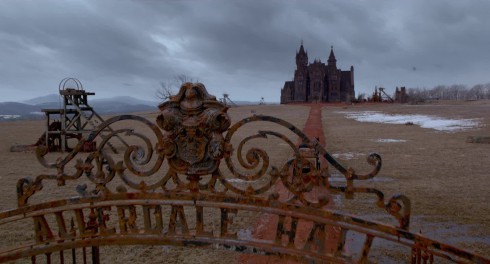
Now, catching his hitching breath, Carter has left the trail and come to the top of the land. The fence still stands, in the distance. And so does the structure behind it. Its sharp towers point up to the sky, and while some of them have broken away with time, he recognizes it from the photographs, from the descriptions.
Allerdale Hall.
Carter continues walking. This is the inspiration for his Mother’s novel. This place where she traveled to as a young woman, a girl, younger than he is now, and away when sickness or … worse afflicted her. The envelope with the letter acts as a bookmark in the book he carries in the crook of his arm as he strides forward, to take in this whole scene for himself.
In retrospect, Carter isn’t sure whether or not it had been a smart idea to reread Mr. Stoker’s novel on the journey to England, or to Cumberland proper. It is his favourite book, and it certainly captures the Gothic romance and horror genre in which his Mother worked, but its more modernist elements appeal to his sensibilities: as both a reader, and a writer himself.
As he approaches the mansion, he’s easily reminded of Castle Dracula or the Exham Priory of one of his favourite pulps. One of the towers has fallen, the other just a haphazard set of bricks and mortar. Only the central one remains whole and as it is, it approximates a slant reminiscent of the Leaning Tower of Pisa. His father hadn’t been exaggerating. The mansion is crumbling in on itself, upon closer inspection, sinking deep into the red clay. Even now, the soil looks like blood.
It squelches under his boots, trench boots that he never got to wear in their intended place as he had been exempt from Service. It’s less like blood now as he comes to the door of the gate, swinging it open on its rusted hinges, and more like gore. The air itself smells … metallic.
Carter notes that the pits on the property are still existent, but closed up. And all of Thomas Sharpe’s equipment, his machinery which he had designed himself, had been removed. Apparently, after the disaster that came to the baronet others began to see the potential for the late Sir Thomas’ inventions. As it had transpired, his mother had inherited the technology, along with the whole of Allerdale Hall itself as Sir Thomas’ widow.
According to his father, Carter’s mother had agreed to give both the patents and schematics of her former husband’s works to eager investors. Carter knows that red clay contains ultisol and can used for brick-making — which the Sharpes had done for the Crown before the fall of the Monarchy, and the rise of Cromwell’s Commonwealth. That is what he learned from an old British textbook by one Mr. Salisbury he purchased in London. But the iron ore rendering became more important in this era, especially on the eve of the Great War when the Allies were hurting for it. Hence the letter he carries with him now.
It’d been addressed to the Lady Sharpe, from 1914. And it had taken him a moment to realize that the lady it was written to was Edith. It’d been from the British government, requesting that the Lady Sharpe — who had done business with clay-mining equipment — release her late husband’s land for the War effort. His father hadn’t given him any copy of a reply letter.
Carter isn’t sure how a baronetcy works according to English law: if a baronet relinquishes all lands and titles upon remarriage after their spouse’s death, or if they retain these privileges. He also isn’t sure why they simply didn’t seize the land for the Crown, and take the resources for their own. All he knows is that no one in the village felt inclined to talk about the mansion, or the Sharpes. They didn’t even talk about his mother.
The newspapers, however, did the rest. And the legend as well. They are what led him here.
He walks towards the steps of the great mansion, as though sagging under the weight of its own unstable foundations, and the sins committed within it. Carter’s foot hits something. He looks down, and sees … a ball. Carter almost missed it. It’s a small, rubber, red ball. It rolls away into the dirt of a deeper crimson.
The door stands in front of him. The wood is frayed, the hinges on the frame askew. There is a key hole. Carter doesn’t have a set of keys, but he doesn’t need them. Not anymore.
Before he pushes the door in, he slowly breathes in, and out. Once he’d found about that his mother had been the Lady Sharpe, he’d looked into the truth about Allerdale Hall. How the Lady of the Hall had died. How her daughter had been locked up in a mental institution in Switzerland for a time. How Sir Thomas’ wives had disappeared over time: the wives he had before his mother.
His mother never told him about any of this. But he recalls his father’s words. He also remembers the legend of the Black Ghost.
The door protests, but Carter manages to go into the mansion. He realizes, only moments later, that he needn’t have bothered. Sections of the wall have already fallen away. The hall itself is strewn with debris, the carpet stained in mud and dust. What his father had explained as the decaying skeleton of something once so grand, was now almost in complete ruin. No one had bothered to repair or renovate the structure. No one had attempted to tear it down either.
It had just been left here. To be forgotten.
But even in its dilapidated state, he recognizes it. It’s the interior of the Great Hall in his mother’s work Crimson Peak. He can make out the Gothic architecture, the ornaments, the colour, and even the smell. The winding staircase has collapsed, the place where the lift used to be is empty and probably lost in Hades, and the hole in the ceiling has grown into a maw of a leviathan defying the heavens with its rotting grandeur. But this is the place. He wonders if there is a clockwork workshop above, or multiple suites, or the bathtub of blood, or even the nursery …
It’s real. It’s all real. The shattered windows of the estate seem to follow him as he looks around, like the eyes of some restless dead thing. Even as the wind blows, he can hear his footsteps on the cracked tiles. It’s perfect. The ambiance of this space speaks more than a thousand written words. Ghosts can easily live here. And, if he remembers the novel correctly, the library should be on this floor ….
Let the wind blow kindly …
Carter pauses. The air howls above. It’s strange. For a few moments, he wonders if he heard something. Perhaps he had just been too focused on the atmosphere here. On the story he’d heard from town. He sees the curvature of the hall, and turns left. The library should be that way.
In the sail of your dreams.
And the moonlight your journey …
The light is wan and pale as he enters the darkened room. It’s gloomy, but Carter can make out rows upon rows of mouldering books. It hurts his heart to see them like that. Each one of those books could have been first editions, Greek and Latin-translations gone to dust. Why had no one cleared them out? Why hadn’t his mother taken them? And it’s as almost as though his thoughts have become someone else’s words, those of the wind … Notes drifting in the air.
And bring you to me …
There is a keening in Carter’s chest. It’s not his lungs. It’s a growing sense of sadness, and disconnection. It feels as though there is a song in his head, and the sound of piano keys playing. He reaches the mantle piece and sees the inscription. His parents spared his Classical education no expense.
“I shall lift up mine eyes,” he whispers, his eyes squinting in the gloom, “onto the hills …”
We can’t live in the mountains …
Carter turns as the voice materializes, fully, into the room. He looks away from the mantle over the fireplace, and sees the piano.
We can’t live out at sea …
The piano is lopsided, dusty. Falling apart. But the seat is still there. And someone … someone is sitting there. It’s a shadow, in the darkness. Carter hears the voice. Her voice. A part of him remembers what the villager children said. He blinks. But the form is still there.
Where oh, where oh, my lover …
The song is unbearably sad. The piano keys and their strings, which should by all rights not even be functional, send the pang into him. It reminds him of the day his mother died. But it’s more than that. It’s of a time that’s over. Something that happened, and never should have been. A bittersweet poignancy. A love lost forever.
Shall I come to thee?
Carter’s brow furrows as the feelings threaten to overtake him. He can almost see two forms, in the darkness, in a lost room, holding each other, one rocking the other back and forth, spooning them, cradling them. But that was over. A long time ago. And it will never come back.
There is only silence. She doesn’t turn around. Slowly, as though his pain reaches out to hers. Her dress is black, almost gossamer. So is her skin, though her hair is darker. Carter can’t help himself. Something in him aches at the sight of this lonely figure. He reaches out a hand, as though to touch her shoulder.
“Thomas?” There is a whisper, in the wind. “Have you come back … to me?”
Carter’s hand stops. The realization of what this is, that this is not just a story he’s reading or hearing about around a campfire, that this isn’t one of his father’s slides, hits him like an icicle to the gut. His throat is suddenly very dry. He takes a step back. And another.
The room feels cold and not just because of the mountain’s high altitude. He turns, to run, to get away from …
She might have been beautiful once. He can see that. There is a wound in her chest, blacker than the rest of her. And her face … it’s caved in. As though something crushed her skull in, like they said his grandfather’s had been at the Gentleman’s Club one day. But it’s all of her. It’s as though she is a translucent, blackened version of ligaments and skin. She doesn’t move right, as she jerks towards him, but there is a smoothness to her facial features or what is left of them.
“Thomas.” She whispers, bringing a long, blackened hand towards him. For a few moments, Carter thinks he can see the bloodshine of a stone on her finger. She is like Allerdale Hall, made incarnate. “Tell me, when will she let me be free … Thomas …”
Then, her face warps and twists. Pure hatred and an endless sorrow from hell itself engulfs her gaze. It’s the most horrifying thing about this apparition as Carter staggers backwards, as she lifts a cleaver — glinting with midnight malice — above her head.
“Now you will see!”
Carter falls to the ground, screaming as black moths explode all around him, fluttering mindlessly. Then, he feels nothing. Just a frigid breeze. He can’t breathe. Carter is gasping for air, his heart pumping hard. He looks up, finally. There is nothing there. No one. His mind is detached from his body, viewing the entire situation, processing this impossible thing. That’s when he sees it.
It lies on the ground. A red stone glittering off a golden ring. A part of him wants to reach out, to touch it, to take it for himself. There is a part of him that thinks it belongs to him. The rest of him runs out of the room, down the hall, outside the ruined mansion, shouting incoherently.
He is on his knees in the red mud, trembling. Carter is numb. Empty. It’s like what they said about shell-shock from the trenches that he’d been thankfully too young, and too infirm, to be drafted. That’s when he begins to notice something else.
There is a man. He’s standing right in front of him. Carter stands up, his body freezing into place. The man looks at him. He’s pale. Incandescent. There are marks on his chest, and a cut under his eye. But he can’t deny it. He knows that face. It’s his own face, but without his mother’s eyes.
The man reaches forward. Pallid fingers seem to cup Carter’s face. Carter doesn’t feel anything, but he experiences everything. The man smiles at him, sadly, his gaze full of regret and resignation. Then, he’s gone.
Carter drops his book. He must have been holding it through the entire ordeal. He crouches down on the ground, his elbows on his red-stained knees, as he proceeds to cry into his hands. The letter to Lady Sharpe flies out of the pages of his book, and into the winds.
*
“Why didn’t she destroy the mansion?”
It’d been a month since Carter came back from Cumberland. He sits at home with his father, in his study. The books with their horror stories still manage to comfort him even after everything that’s happened; the medical specimens in jars no longer threatening given that they are actually dead.
Alan McMichael looks tired behind his spectacles. They are so much like Edith’s when she still lived. He sighs, looking at his son.
“She wanted to keep her there.”
There is nothing else said between them for several moments, just the sound of the grandfather clock marking time. Carter slowly shakes his head. “Why didn’t you tell me?”
“You were always a sickly boy, Carter.” His father says, sadly. “It was best you were just entertained by those stories, and not afraid of them. There is so much … I wish she and I could have told you.”
“You can tell me now.” He says to his father. “I … how did you know?”
Alan squints up at Carter, scrutinizing him. He doesn’t say anything for a few moments. Finally, he sighs. “Carter, you know your favourite novel?”
Carter tries to maintain his composure. “Yes. What … of it?”
“Do you remember the end of it? How Mr. Stoker ended the entire thing?”
Carter takes a moment. He looks down to sip of the glass beside him on the easy chair. His father had prepared brandy in advance. He now fully appreciates this fact. “It is a happily ever after, of sorts.”
“Your mother always loved stories that ended that way. Even if life didn’t always do so.”
“Everyone survived.” Carter murmurs to himself. “Except for … Quincey Morris. The American.”
Alan laughs. “The hunter. The one who stabbed Dracula with a Bowie knife.”
“He –” Carter pauses. “The Harkers. Mina, and Jonathan. They named their son after him. After Quincey. Quincey Harker.”
Alan doesn’t say anything as he sips at his own brandy, waiting with the decanter at the table next to him.
“I always wondered.” Carter says. “If Quincey was Jonathan’s or …” He closes his eyes, pinching the bridge of his nose.
In a low voice, Alan McMichael speaks. “Your mother loved me, Carter.” Then, the old man sighs. “But she had been in love with someone else.”
Out of the corner of his eye, for a few moments, Carter can almost see something bright. It isn’t from the hearth. A figure, in white. His mother. Paler. Wan. Her hair an unbearably bright gold. She’d been so sick. She seems to smile at the two of them. He can almost hear her voice, asking him as she had always done, if he had been inspired.
Tears well up in Carter’s eyes again. She could have told him, but perhaps this was her way … their method of telling him the greatest ghost story of all time: told in the most poignant manner possible. Carter smiles reaches out and takes his father’s hand in the space between them.
“Tell me everything.” He says, and he realizes that it is just the two of them now. “Father.”

 The Horror Doctor