Consuming the Sublime: Robin Hardy’s The Wicker Man

I almost didn’t watch The Wicker Man.

Unlike Cannibal Holocaust, which I thought would be too extreme even for me, I didn’t watch The Wicker Man for a long time because of not only my ambiguous place in horror media, but also because later I’d seen Ari Aster’s Midsommar — and I loved that film so much, that I was afraid that if I saw The Wicker Man I would end up seeing the former as something of a pretentious bastardization of the latter.

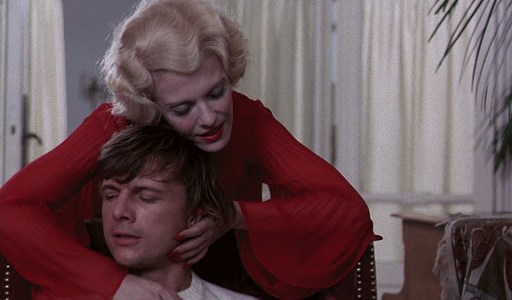
Luckily, my love for Midsommar remains intact as it that is a different story. And while Ari Aster’s movie revolves a remote choreographic Nordic communal culture in which the protagonist faces the demons of her grief and gains a twisted form of resolution, Robin Hardy’s The Wicker Man is ultimately a folk horror musical film about a man who finally gets the chance to become a contemporary Christian saint in on an island ruled by a form of Celtic paganism.

I think about this film on the surface. Imagine: a movie that utilizes musical tropes to complement and institute the philosophical quandaries, a murder mystery, and the final psychological horror of the entire thing. I don’t think I will ever be able to get any of it out of my mind: not the folk songs the children sing when talking about the cycles of reproduction and nature and the harvest, not Sergeant Howie literally being made a fool of — and unlike Punch, the costume he takes, the Devil didn’t make him do it, just his own sad sense of self-righteousness, not the brilliant Lord Summerisle’s (played by the towering Christopher Lee) monologues and observations of human nature, nor just the way that the entire story reaches its peak. And I can say, with certainty, that if the innkeeper’s daughter Willow sang to me like that, I would definitely have not been the sacrifice that the inhabitants of the Hebridean island of Summerisle would have been looking for.

So much can be forgiven, really, when you look at the quality and the build of the film that so many other critics and scholars, far better than I — a dabbler student in horror — have already dissected and spread across the world like a glorious, beautiful, terrifying harvest. Certainly, you have to suspend your disbelief to consider that anyone on that island would have known that Sergeant Howie was a virgin at all, and gone through the machinations through the “kidnapping” or “death” of a child of theirs to bring him there. But when you look at all those cheerful, awe-inspiring songs almost pulling you back into English folklore, the elemental rituals of dance, and music, and copulation also reminiscent of the free love spirit of 1973 in some parts of the world, and just watching Howie’s own Puritanism — which in the Final Girl trope would have saved her — become his complete, and utter undoing, it is a perfect bloody film.

Someone once pointed out that Howie could have saved himself if he had just given into Willow, into fornication, into living, into feeling beyond a set of ancient, strict, patriarchal guidelines. This is no Golden Calf, but a flesh and blood woman who actually offered him genuine connection and tenderness beyond the bounds of socially and religiously accepted marriage. But Howie just couldn’t do it. And, in a way, there is almost this tragedy there: that he had one moment where he could have had this, had this link to the earthly joys and the here and now, and it’s lost to him forever because of his sense of duty. In a Christian paradigm of some kind, he passed a test and resisted temporal sin, but fittingly enough he also passes the standards of the Summerisle villagers and their pagan roots by proving himself worthy to be sacrificed in The Wicker Man.

The Wicker Man itself makes me so tempted to make a bad pun of the strawman argument, where something is argued against but not properly represented. It is a scarecrow, made to scare off things that would devour it or refute it but is ultimately just empty clothes and bails of straw. In this sense, Lord Summerisle believes his people can make a harvest happen again through animal and human sacrifice based on their Celtic belief-system, believing the faith of Christianity and science and mainland civilization to have failed them. But another way of looking at it is Howie considering the ways of the villagers immoral and wrong because they abandoned Christianity, and believing that the death of a girl is clearly their fault because they are “heathens.” The straw man is the Wicker Man for both whereby it is an object ritualistically destroyed in order to prove one side, or the other right: a sacrifice to the gods, and an eventual martyrdom for Christianity.

It’s too simple, though, and perhaps not a great analogy in its own. The fact is, Howie is a terrified man being burned alive cursing the villagers for tricking him — the fool and the trickster, the outsider and the stranger — to this fate for dying for their “sins” while Lord Summerisle believes that the harvest will happen despite all logic, and that he will not one day be called on by his people and “volunteered” should it fail again.

Perhaps, again, the Wicker Man isn’t so much a strawman as it is the scarecrow I mentioned: created to placate the villagers’ fears of the harvest not happening, of starvation occurring, while allowing for the nominal civil and spiritual independence of the island. At least, this is what Lord Summerisle seems to believe.

When I look back on the film now, one issue I actually have with it has to do with Lord Summerisle. I just don’t see him as being afraid of the sacrifice. If the man had been raised through two or three generations on the culture, even with his education, he would see it as his own duty: as his own sense of noblesse oblige, to give his life to protect and better that of his people. To me, this faith — or fanaticism — should be bones deep and unshakable. Of course, there is the fact that by the paradigm of his people the man is also not a virgin — whatever that ultimately means — but that is almost irrelevant. I just don’t see someone as composed as Lord Summerisle being rattled by one setback, or the threat of his own life in the balance. He would understand the cycles of the world. He would know it was his time when the gods decreed it. It’s just that simple me, as real to me as Christopher Lee’s other character in Star Wars — Count Dooku — not begging for his life which ultimately doesn’t do in that film.

Lord Summerisle should be an ideologue with absolute conviction, and that should make him more horrifying than any blood-starved monster, that behind all the colourful pomp and circumstance is a man who is willing to serve the gods and the natural order at all costs: including murder. But, let’s play the Devil that doesn’t kill our Punch-wearing protagonist Howie, and say that perhaps it’s not an effrontery of his beliefs being insulted, but actual arrogance or pride masking a fear of failure and death motivating our friend Lord Summerisle. Aside from the fact that it makes him, and his belief as hollow as a straw man, consider what he tells Howie at the beginning of the film: that his Victorian grandfather revived the local pagan practices and rituals of the people of Summerisle to convince the people that his new strains of fruit trees would prosper in the climate.

But what if it was Lord Summerisle’s grandfather who was fooled, or ultimately fooled himself? What if, deep down, he did believe or it was the people he “led” that convinced him to reinstitute pagan elements that already existed in Summerisle, and just brought them to the surface again? What if these Lords of Summerisle really don’t lead using the name and acts of gods, but they are just figureheads for the people who are truly in charge? Lord Summerisle still operates from the monotheistic mainland order of rule, for appearances sakes, but what if the people just let him believe so long as he is useful? You know, until his role has to change? We see in Midsommar that there are a variety of different sacrificial rituals, so why couldn’t that be the case in The Wicker Man’s community of Summerisle? Lord Summerisle himself has, to an extent, realized that what began as a tool in his grandfather’s arsenal has become real, but what if it had always been real, and the Lords only deluded themselves into thinking that they could control it: this act of human sacrifice and growth and sex and primal renewal?

Howie believes this impulse needs to be denied, while Lord Summerisle thinks he can embrace it, but perhaps both want to control it: one through rejecting it entirely, and the other through indulging, and directing it. .But I don’t know if either particularly understands what it is they fight for or against: certainly not Howie who realizes he had been playing a whole other kind of game, and maybe not even Lord Summerisle or the villagers to think they will get what they want by following this belief and instinct to kill and burn to have their conception of Nature give them what they want.

In the end, the fire that burns through Howie consumes the hearts of the villagers and Summerisle, and there is something beautiful in that destruction and the all-too bright joys depicted in that place and site. What is it that Lao Tzu is supposed to have said: “The flame that burns Twice as bright burns half as long.”

Right now, as of this writing, Spring has just begun — however it will look — but when you look past the literal and go into the metaphor, at the nature of what happens when you release something from the constraints and strictures of security and fear, of a structure that fails its people, what do you have left to do with that passion? Does it go into a resurgence of spirituality, of land-based beliefs, into a renaissance of sensuality and sexuality? Does it challenge the status quo and grow into something else? Or does it run rampant, become chaotic, and self-destructive beyond the sight of those who first the light the fire, or carry the spark? It’s almost romantic: in the old eighteenth century terrifying and sublime sense of the word, but somehow still beautiful for it.

These are some of my thoughts as The Wicker Man continues to smoulder in my thoughts. Forever.

She Will Always Be There: Travis Stevens’ Girl On the Third Floor

A long time ago, I was at a man’s place that had seen a great many wild and passionate parties. At the same time, I also knew that there were some … less than savoury, sometimes even gross things that happened beneath the surface. Lingering hugs on women, someone watching people and being surreptitious about their activities, and a great deal of emphasis on a whole lot of feminine art throughout the entire place along with a great deal of … moisture that you could slip on, and break your neck. I always wondered, if places can record memories — or if people and actions can imprint energy into spaces — just what a building haunted by erotic energy, and intrusive or even predatory behaviour, would look like.

These weren’t just all negative thoughts, of course. At another time, after reading references to Wilhelm Reich’s concept of orgone energy — of a hypothetical universal life force generally generated or manifested by sex and erotic actions — I’d often muse about how that affected another favourite establishment: one that used to be a nineteenth century mansion before it was changed to an adult entertainment hub and night club. What would such a manifestation look like, especially when you consider how it would ride the gamut between lust, love, joy, despair, anger, anxiety, fear, excitement, and all the rest of it? And this was a place focusing specifically on making a comfortable space for women and LGBTQ+ individuals to explore while also making a profit, and still navigating a lot of the patriarchal land and social scape — with men’s desires and expectations — around it.

And this place also had a third floor. And there was always a girl on the third floor.

I was utterly fascinated when I found out about Travis Stevens’ Girl on the Third Floor, and its premise. The Girl on the Third Floor, directed by Travis Steven, and written by Stevens, Paul Johnstone and Ben Parker, is about less about a morally flawed man attempting to renovate an old house for him and his pregnant wife, and more about the house itself, what it has come to be, the forces that shape it, and the girl within it. At least, these last facts are what interest me more than anything else. I recall, when Fangoria #3 came out and I was greedily looking any information on this film before it had come out, wondering where I was going to see it at the time, with only little trails of marbles through an old house and the specifics of cinematography and filmmaking to tide me over before finding … the Girl.

I mean, a horror story that takes place in a house that used to be a brothel. Not only is that an awesome premise, but indeed: what could possibly go wrong?

Well, a lot goes wrong for our initial protagonist Don Koch (played by Phil “CM Punk” Brooks) — whose last name is more than suggestive about his personal traits and failings — and all of it is pretty much his own fault. It isn’t just the terrible things he did in his past, how he put his own personal advancement and desires ahead of the lives of others, and the constant transgressions against his long-suffering wife under the guise of claim to change, but what he does to the house. He comes into this place, with its pastels and pink interior, noticing the black secretions coming out of the wall and instead of asking around about its history, or talking with Ellie Mueller the pastor who actually seems to know more about this situation, he pounds holes and nails into the walls, not paying attention to all indicators that something is different about this place. Essentially, Koch doesn’t ask for help, his pride keeping him from even telling his wife what’s going on, and this toxic masculine attitude — of wanting to make a feminine place his own instead of recognizing it as something that is not what it seems — tells you everything you need to know about where this is going to end. .

Certainly, the house isn’t healthy of course. Aside from its black discharge, its marbles appearing like mobile little growths, this house used to be a high-class brothel for some upper-class society men that viewed women like their playthings. On the third floor, bricked up and concealed, is a viewing platform looking into what is now the bedroom. But it wasn’t always a bedroom. Instead, it used to overlook a platform or a stage where the sex workers involved — all young women — were used in kink and BDSM scenes where an bird-headed man would sadistically whip them, among other things, for the viewing pleasure of other men. It is heavily implied that these women, from the nineteenth or turn of the century, are there under duress or were trafficked as well, and the presence of a little girl there who constantly draws pictures, and plays with marbles — that the bird man gave her — is not reassuring in the slightest as to what this place had been really like. Eventually, at least one sex worker is murdered there, followed by a missing body, and the place is closed down, and passed on to several different generations of families with varying results.

Koch is warned, by some men at the bar he’s not supposed to be at as he is an alcoholic, that the house despises “straight men” and will actively attempt to do terrible things to them. And when you look at the history of the house, you can probably see why that might be the case. Koch is a man who has an affair with a woman named Sarah Yates (played by Sarah Brooks) and then coldly attempts to brush her off and pretend it never happened. He also drinks when he’s not supposed to do so, and when all else fails he will resort to violence to get his way. He is pretty much a spiritual descendant of the men that ruled this town and society, and an extension of patriarchy. It’s not going to end well for him.

But strangely enough, as far as malicious female ghosts go, these are surprisingly fair in that they only react to what is brought to them. They’re not fair to his dog, of course, who did nothing wrong but there is a point where any empathy or discernment is erased by the pure rage that is left behind. But it’s more complicated than that, as it always is. We find out that Sarah is actually the ghost of the woman that was killed in the brothel, and that she reacts to people — as an extension of the house — depending on how they treat it, and anyone in it. Sarah kills Koch’s dog to hurt him for rejecting her and treating her like an object. She kills Koch’s former coworker and friend Milo because despite the fact that he is the friend of both Koch and his wife Liz (played by Trieste Kelly Dunn), he goes along with hiding the affair the other man had due to some sense of reluctant homosociality, essentially being complicit in all men’s behaviour.

And then there is the spectre of what is called, outside the film, the Nymph (played by Tonya Kay): a being that resembles a deformed blond-haired woman with a ruined face that is constantly leaving, and shooting marbles throughout the house. At one point, towards the end of the first part of the film, she manages to insert marbles under Koch’s skin that writhe around and, ultimately, seem to possess and kill him.

I’ve thought about Sarah and the Nymph a great deal since I watched this film a while ago. I also read an article that I can only barely recall was on Fangoria’s online site, when it was owned by Cinestate, that focused on the critique of the patriarchal elements of this film, and the nature of the Nymph herself. Unfortunately, I can’t find the article now but I do have my own conclusions and elements that I want to focus on which might not have been completely discussed to death by many other pre-existing reviews.

It is fascinating that Sarah can manifest physically, and be seen by those she chooses. Her being able to manipulate people’s perceptions isn’t as surprisingly, but being capable of materially interacting with the living is impressive, and quite possibly the result of all that tormented, oppressed, sexual energy and anger inside the house itself giving her that strength. Sarah is a result of what happens to a woman used by men, degraded, and killed by men. What’s worse is that she seems to have been the mother of that little girl, Sadie, who had been making all of the drawings throughout the house. So it’s possible that something happened to her daughter, or herself by the brothel owner.

But it’s the Nymph that gets to me. It isn’t clear what she is. I think I read somewhere that she’s essentially the spirit of the house itself: of all those broken desires, and brutalized women by the brothel-owners, and society manifested into some kind of composite entity. Think of her as some kind of twisted genius loci that guards the place where she was generated by the sexual energy of exploited women, and twisted men’s fantasies. I originally pondered over her being a brutalized sexual sacrifice or experiment of a lodge or cabal of male magicians and occultists — especially with the almost ritualistic practices in that place, and the bird-masked man — but I think it is more effective that she and Sarah have become manifestations of rich men’s debased desires of women.

Of course, there is another interpretation of the Nymph that is equally horrifying, if not more so. While Sarah does utilize the marbles as well to lure the dog and distract Koch and his friend, it’s the Nymph that uses them more. She acts skittish, awkward, and almost childlike: like the effigy of a person, or a doll. Victorians used to call a woman the “angel in the house:” like they are some kind of delicate ornament, or a pretty toy. But angels can fall, along with pedestals, in the dichotomy of female virgin-whore. It is as though she is, or was, almost innocent until something changed her into a parody of what men want. If you watch the film, her body is that of an young adult woman, but her face is warped: as though it had suffered repeated blunt trauma … or it had been drawn by a child.

Think about a little girl being in a place built to contain women for rich society men’s pleasure. Perhaps she died in there, or maybe it was just a part of her soul that died when her mother didn’t come back, and the bird man who gave her the marble bag. It doesn’t take a lot of imagination to consider that she was being groomed, or that the loss of her innocence created this apparition. Maybe it is Sadie’s spirit, or Sarah’s lost innocence made incarnate and corrupted over time, or just an entity that represents a woman abused to the point of inhumanity, not allowed to grow or rest, and wanting to play in the horrible ways she’d seen in that place, and in how she sees the world around her.

And it all comes back to those marbles, doesn’t it. Not only do they have a phallic resonance, in terms of gonads, but there is the idea of them being pretty little baubles: just like women, and women’s bodies. In some aspects of Islamic culture, feathers left behind in a space denotes a haunting by restless spirits or demons. But I think that the marbles go well with the imagery of the house being the interior of a vagina: made unhealthy by sexual abuse. Maybe they are like ovum, especially in how they implant themselves into Koch, but they can also be seen as lesions or lumps: as disease. Something natural can also become sick. I can definitely see a sexually-transmitted disease metaphor in there, but also I think what’s important to consider beyond the literal is that Koch sees the house as a distortion of how patriarchy views female sexuality: as something dirty, unclean, even disgusting. It is his perspective that determines the house and how it treats him. Of course, there is also the fact that marbles — as small reflective spheres — can stand-ins for eyes, for intrusive looks that can be anywhere, where not even the sanctity of personal space or the body is safe.

They are like extensions of the mirrors with their over-ornate frames in the house, making Virginia Woolf come to mind when she mentions that to men women are mirrors that show themselves written large. Yet the house’s mirrors turns the male gaze against itself, and shows it what it really is: a wall with a dark hole stuffed with paper.

Indeed, Ellie Mueller — who Liz actually talks with when Koch disappears in the second half of the film — tells her that the house isn’t always malicious. Sometimes it just tests someone, or it doesn’t bother them at all. Couples had lived there, even straight ones, their entire lives without incident. It’s only when someone brings with them these power imbalances and hypocrisies, self-entitlement and forcefulness without facing them, that the house seems to react badly. Of course, it also challenges Liz. But Liz pays attention to details. Liz sees the newspaper article — from the scrunched up papers in the wall socket behind the central mirror no less — about the origins of the house, and she consults with the pastor about it. She knows Koch’s toxic masculine behaviour all too well and is, frankly, tired of his macho and emotionally-stunted excuses. But she is not intimidated by Sarah’s presence, and the ghost and the house seem to want to show her what happened: while testing her the entire time. It gets into her head, or tries to, while it succeeds with Koch: who is just a skin-suit for Sarah now. He got inside of her, and she — and the house — are now in him, as he is also trapped in it. Liz doesn’t forgive him, or his actions that have endangered her and their unborn child. Like a man having an affair and potentially getting his spouse infected by something he caught, Koch has brought Liz to this point but she confronts this distortion of the feminine on her terms.

Liz ends up being let go by Sarah, told she passed the test for not forgiving her cheating and terrible husband again, rejecting a man’s control over her with his false promises, saving herself and her child. But she does more than that. She ends up confronting, and killing, the Nymph. This act actually hurts Sarah. It hurts Sarah more than seemingly being killed by Koch. She ends up holding the Nymph’s broken body, this being that could have been her daughter, or part of the person she used to be, or a representation of Woman twisted and used by men to point of being unrecognizable, or even as a symbol of the house’s hate: of a form of internalized misogyny. And she’s genuinely crying over it: this thing that she loved, that she despised, that was her friend, and her jailor. And now, she’s gone.

Perhaps both Sarah and the Nymph began from a tremendous sense of injustice, but eventually this anger — however justified — turned into something that caused pain for not only those related to their tormentors and murderers, but became collateral damage for everything else in their way. In the end, Liz — after being told by the pastor that each person that enters the house needs to choose to go in and face their own actions — goes further. She ends up going back into the house, finding Sarah’s body, and giving it a proper burial. Liz claims the house for her and her daughter. It is now a place without Koch, and has seemingly made into her own space. And yet … at the end, Koch is still there. Or the house now uses Koch as its new host. It is offering their daughter a marble, a beautiful promise, a terrible lie, a thing to ensnare, a toy to play with, a lesson perhaps to learn, or the hint of the cycle of exploitation and recrimination happening all over again for the next generation.

Like I said, I think about Sarah. I think about the Nymph. I consider the women, and girls, damaged by society around them, its microaggressions, and the weight of a history of trauma influencing who and what they are. I remember that some ghosts are seen in the places they’ve been long after they’ve died. Sometimes you know it. Sometimes, you don’t. So many forces shape them. And sometimes, they come to you. They approach you, and take you to the third floor, like the one at the club I loved. Sometimes, they will offer you something. And you should always pay attention to what is offered, how you accept it, and where you stand.

For What It Is: Steven Kostanski’s Manborg

They say that when you dissect a joke, it just isn’t funny anymore. And in my mind, “funny” comes from “fun.” That is the best adjective I would ascribe to Steven Kostanski’s 2011 film Manborg.

I’ve taken on the guise of a mad, false doctor and scientist as a writer of this Blog. And in the vein, if you will pardon the pun considering that the movie is all about rendering infernal, fascist vampires into pulp, of such — and in remembrance of the late and lamented Doctor Scorpius — I would like to put this cinematic creation on the table, and look at it in the following manner.

Imagine a pulp film utilizing a combination of early Mortal Kombat digitization and Ray Harryhausen claymated monstrosities created by Troma Productions, and you might get something like Manborg. Maybe. You can also make a compelling argument that it also feels like a spiritual bootleg version of the id software Doom game universe. Seriously, I almost wrote this entire article just to have an excuse to make that sentence, but there is more to it than that.

The main protagonists themselves look like they can belong in a Mortal Kombat game: the awkwardly cybernetic Manborg himself, the sassy Aussie-accented Justice, the incongruously voice-dubbed #1 Man, and the short-tempered Mina (and clearly no relation to Mina Harker) are all fighters in an arena where Hell’s minions — having conquered the Earth — force humans to fight one another, and their technologically-augmented demons. You can even, loosely, argue that this film is a Dracula-based creation in that the leader of the forces of Hell is a monstrosity named Count Draculon who kills Manborg’s brother and himself as a human soldier at the beginning of the movie and during Earth’s War against Hell: which it loses. And hey, one of the female protagonists is Mina who is lured by the Count back to the arena to rescue a former friend or … sister of hers (totally not Lucy Westenra) who has been made into a demon-human hybrid, I guess?

Right. I am being very generous.

But I really like this film. The jerking, even janky movements of the camera and the figures against the Chroma key backdrops makes this world truly nightmarish, and unrealistic. It’s like watching someone dreaming various composites of characters and situations, and making it into a narrative. The sound effects sound like something from Power Rangers or the 8-bit era of video games. There are various skips in logic and character development, but the film knows that — and it knows how lampoonish and parodic it truly is.

The characters are all true to what they are. Manborg is a former soldier wanting to avenge his brother’s death, and has no idea how to survive in his altered state until a hologram of his creator — or his soul, or something — finally does so. #1 Man just wants to makeup for his cowardice in saving his own life and training the Count’s minions in martial arts to fight for something more. Justice wants to protect his sister Mina, and battles either illiteracy or dyslexia to do so, and Mina desires to fight, and save Shadow Mega from being a slave of the Count. Even the antagonists are straightforward: the Count wants a challenge in fighting Manborg, Shadow Mega desires to defeat Mina, Doctor Scorpius seeks to recant his past mistakes and aid Manborg, and the Baron — another vampire and general asshole — has a crush on Mina, his prisoner, and awkwardly attempts to flirt with her.

What you see is what you get, and yet those little touches show genuine love of the story and characters. A long time ago, I used to only want to read and watch serious works. I didn’t know what to think of something that was just strange, and campy, and over-the-top, and weird as all hell. But then I went to the Toronto After Dark and watched RoboGeisha for the first time, and even before that was Bubba Ho-Tep. And there is just something about watching these silly elements at play that still manage to manifest genuine feelings and a story that is just … inspiring. It’s like high school or college friends sitting down, and making a narrative they want to see and be as ridiculous as ever, and very clearly demonstrate a knowledge of the craft they parody even if it’s for the first time. It’s just … inspiring to see someone through stuff at that wall, like explosions, Nazi vampires, weird cyborgs, martial artists, arenas of doom, and just … ridiculous moments that makes things fun.

Manborg is fun. It is one of the things that I look at to see what is possible, and it’s something I genuinely enjoyed watching. I bought the comic back at the Toronto Comics Arts Festival years ago, and I always meant to watch this movie. In fact, as fun as the film is, I love the comic as it makes fun of its own nostalgia. Think Ninja Turtles comics that were adapted into cartoons and the films, or hellishly faded and septia-coloured dystopian G.I. Joe, He-Man, and She-Ra stories except Manborg‘s adventures are fleshed out, and actually continue with his group of friends.

Also, Bio-Cop, the “preview” Astron-6 has at the end of the film — whose quality is already made to look faded and grainy like it’s an old VHS tape rental — is utterly hilarious. Again, think The Toxic Avenger, but in chronic agony and body horror and seriously to die … in a buddy cop parody.

I mean, someone calling themselves the Horror Doctor has to have a twisted sense of humour.

A Cosmic Joke: Tor Mian and Andy Collier’s Sacrifice

I’ve thought about horror before: about what it is. Sometimes, I’ve considered it to be a throwback, or a continuation, of the old tragedies that invoke pity and fear in their audience. Other times, I looked at the genre as something that creates suspense and spectacle, and creates an adrenaline and endorphin rush in everyone that reads, or watches it. Horror, for me, had been twist endings, gruesome effects, strange creatures, and a love of being scared: of seeing that your life is better compared to those of the sufferings of fictitious people who might — or might not — be like real people.

These days, I think horror is elastic. Plastic. I’d argue that it has the most flexibility out of many of the genres in their different media. And, in this case, I’m reminded of a piece I wrote for Kris Straub’s horror comic Broodhollow where I focused on how horror is often similar to a joke.

Oh, we are all about dissection here with The Horror Doctor, and learning from what we take apart and put together in weird arrangements. But I think both the form of a joke — the idea of wordplay or the pacing of a story brought to a fitting end that makes fun of itself or laughs with, or at, its subject — and the ever-adapting form of a genre works when you look at the shoggoth build-blocks that are H.P. Lovecraft’s Cthulhu Mythos and its mutations that arise. In this vein, I thought I had some idea as to where Tor Mian and Andy Collier’s Sacrifice would go, and for the most part I wasn’t particularly surprised: even as the Devil — or entity — is in the details, and the punchline.

And in a vast School of Spoilers. Reader and dreamer’s discretions advised. 

For me, the details seemed simple enough. Isaac Pickman (played by Ludovic Hughes) and his wife Emma (Sophie Stevens) return to his family home on an island in Norway that he and his mother escaped from at least two decades before: trying to solve the mystery as to why they left at all. 

There are already a few details here. Isaac’s last name, for instance, is a callback to “Pickman’s Model” and the Salem family that exists in the Cthulhu Mythos in general. As Barbara Crampton, who plays the local police officer and community leader Renate would be familiar in another film that she produced — the remake of Castle Freak — like the Mythos surname Whateley in Romania, Pickman isn’t exactly a Norwegian or a Nordic last name: and what I love is the fact that the townspeople actually call Isaac on that when he attempts to tell them that he came from this place: something I felt needed addressed, or didn’t sit right in the otherwise brilliant and Mythos-loyal Castle Freak

But there seems to be no resonance with Richard Upton Pickman with Isaac, or his mother, save for the tiny little issue of the fact that she murdered her husband before fleeing with her child so many years ago. The name, however, is useful in showing a Lovecraft-familiar audience that this world does, indeed, take place in the Mythos. 

Isaac’s paternal last name is Jorstad. Jorstad has a few Nordic meanings. Mainly, the word refers to, apparently, seven common farmsteads, but is also derived from older Norse words for “battle,” “winner,” or “victor,” and “wild-boar helmet” or “wolf.” There are no Mythos meanings or interpretations, but the name tells you a lot about what Isaac sees himself as, or what he wants to be. He comes to this island, with his pregnant wife Emma, to claim the property of this lost house but you begin to see that he is profoundly unsatisfied with his life: with a middling desk job, and superficial relations of friends and family. There is something … missing inside of Isaac, a part of him that he can’t quite grasp, and he hopes for answers on this island. 

And he gets them. Renate, at first quite inquisitorial, asks him if he knows what happened to his father. And it becomes apparent, if it hadn’t been in the first scene of the film with its opening credits, that not only is Isaac’s father dead but his mother killed him. Later, we realize that Isaac had actually known many people in the community and partook in some of their rituals too. He is profoundly disturbed by this revelation, and it continues to affect everything he does thereafter. 

Emma comes to this island to help her husband find these ties, not knowing what their jurisdiction is here, very pregnant and morning sick, not liking the water — not at all — and wanting to settle the house’s affairs, get some money, and go back to America and their normal life. She is profoundly stubborn and clear about that, while Isaac himself is passionate and gets carried away by his temper even from the beginning of the whole film. Their arguments, in the beginning are playful banter, but this changes as the house and the whole land around them begins to affect them. 

I thought this would be straightforward, as I said before. I’ve written about Dagon, and The Deep Ones — films that adapt the Deep One Hybrids, and their god Dagon, and Lovecraft’s Innsmouth. And what I was anticipating, even hoping, was that what we would get was that Isaac’s family and community were Deep One-Hybrids that existed in Norway instead of America or the Pacific as they had in Lovecraft’s stories. Instead, we find ourselves in a cinematic narrative ruled by a murder house, an insular cult not unlike the one in The Deep Ones but with many families and children, lots of water — water everywhere — sea creatures, and the Slumbering One. 

The townspeople are, well think of them if you’ve seen Ari Aster’s Midsommar, as less friendly versions of the Hårga commune except they don’t seem to use drugs, they live on an island, and the couple have not been invited to their shores until they realize who they are. In fact, as the directors and even Paul Kane — whose short stories “Men of the Cloth” and, arguably also, “Thicker Than Water” inspired the creation of Sacrifice according to the Luna Press Publishing interview Paul Kane: Writing The Colour of Madness — were all, in turn, influenced by the folk horror elements of The Wicker Man. Interestingly enough, the film was moved from its original location from England in “Men of the Cloth” to Norway, not unlike Aster setting his film up in Sweden, to avoid too many comparisons to The Wicker Man according to an interview with the directors and Gig Patta from LRM Online. So you can see how all of these elements play off of one another. 

It is fascinating to see how they combine Cthulhu Mythos elements with Nordic culture. For instance, Renate has a mural that depicts “The Tree of the Shadow on the Shores of the House of the Dead,” which is called in short “The Slumbering One.” They have rites of baptism called Altarisganga, and they even have tentacle-themed curtains, and a whole lot of — let’s call them what they are — Cthulhu plushies. Yes. I chuckled at seeing them, thinking: “so this is where they are going to go with this.” The towns folk also wear white robes and green amulets not unlike aesthetics the Esoteric Order of Dagon in other Mythos films, but you can see that they could be Nordic pagan garb as well: not including the very clear fact that it’s not Dagon they are worshiping. 

They also claim that they “navigate well,” which aside from the Nordic Viking implications that some bar patrons go into quite crassly, also seemed to be a great Green Herring with regards to them being Deep Ones swimming in the water. But more than that, they use a phrase as a greeting and a farewell where they will tell someone to “Dream well.” Uh huh. It took me a moment, because while Neil Gaiman loves to sign his books with that phrase due to his Sandman series, we all know what those words actually mean in this particular context, when you consider who is dead and lies dreaming in his House under the sea. The community citizens think that their deity, or patron, guards their island and that his dreams affect them. Even a child is having a nightmare that is apparently their deity’s nightmare, but their mother passes it off as just commonplace and a matter of fact. 

But Renate is clever. As the town official, and head of their cult — or religion — she actually goes as far as to compare the Slumbering One to folktales of Iceland’s elves, Ireland’s leprechauns, and even mainland Norway’s trolls. It is a well placed series of dialogue that, with Barbara Crampton’s put-on Nordic accent is delivered well. 

But there is another symbol that pops up as well: that of the house. The generations-old Jorstad family home has mythical resonances for me, as well as personal ones. It looks like something the old Nordics would have made, with their sharp angles and almost bone-white insides. The family of one of my late partners of Finnish descent built, and used to own, a house like it a few generations ago in Canada, and I delighted in making horror story ideas about it when I visited once for Christmas and the New Year: with its fairytale, almost folkloric starkness, and austere beauty. It had even been in a mining town near a lake. You could sense the history of family in there, and see the lives lived in it. I could see the Jorstad home as once having been comforting in a similar way before everything came to a head. 

The house, aside from both the strange cramped angles of it reminiscent of the home in Lovecraft’s “The Dreams in the Witch-House” and the Jungian undertones as a symbol of a person’s psyche going deep into the basement of their collective unconscious, is both a dream house: and a murder house.

It is a dream house in that it symbolizes Isaac’s lost and nostalgic childhood, and a place to properly settle where he feels he can belong, and become a part of something more due to the … lack inside of him. It is also a murder house in that his father was killed by his mother in that very place, tainting it forever even as he wants to reclaim it for himself, and his new family. And, while find out later that this home, like many others, is a part of a land that does engage in human sacrifice: which is quite the extended metaphor for the house as an individual and cultural consciousness. Clearly, Emma has reservations about this. It isn’t just the ghost of the violence that happened here, in this place that can almost be a haunted house, or the fact that there are visions and occasional sounds of Cthulhu Mythos chanting, but it’s also the oppressive weight of its isolation with the island and the increasingly aberrant psychological behaviour of her husband.

I know that in their Convo X Fango interview with Angel Melanson, Barbara Crampton, Sophie Stevens, and Ludovic Hughes do talk about the latter’s character becoming more unhinged, and the strength of Stevens’ Emma as she deals with nightmares, and the other’s actions. But I think one issue with the film’s pacing is while we do see the interplay between husband and wife at the beginning, their transition into a frayed relationship sometimes seems uneven, and how they react and deal with trauma and revelations doesn’t always come across well. For instance, when Renate tells Isaac what happened to his father, for all that Emma was showing him support in remembering his childhood at the beginning, you don’t see her giving him comfort when he realizes his father was murdered his mother when he’s being interrogated for something that happened when he was a child. 

Hell, even the two of them seem to gloss over this when going to dinner with the woman who reveals all of this. This is a Hitchcock Fridge moment where, if I found out my mom killed my dad and took me away from this village, it would genuinely fuck me up. I mean, grief and loss are processed differently, and we see Isaac attempt to do that, but I just … I would imagine just wanting answers, and then really desiring to leave. This is not the only leap in logic that happens here, though in a world of the supernatural that doesn’t say much, but I just like a form of continuity. 

The conflict between Emma and Isaac makes sense to me in that they grow to want different things. It’s no coincidence that the bar patrons refer to Christopher Columbus not even having been born before their ancestors colonized America and then later Emma calling Isaac “as threatening as a gold fish” when he tries to act violent. The man seems to suffer from a kind of trauma even though he didn’t know, or remember what happened to him in that previous life: having been raised by his mother and the Pickman family, I assume. It reminds me of W.G. Sebald’s Austerlitz, where a British architectural historian named Jacques Austerlitz gradually looks into his past as a child having been adopted by a Welsh family from his parents that sent him away before he could be taken, like them, by the Holocaust. Technically, Austerlitz never experienced the Holocaust or the camps, or even remembered his parents that well, but that loss was still there and the trauma remains to a point where it hospitalizes him and he needs to know more about where he came from. 

Isaac has not experienced genocide, even indirectly, but he did feel the loss of his father and his world, and that community: and a sense of belonging. I feel that Emma doesn’t quite understand this, and it is hard to communicate that fact. Sometimes, I even sympathized with Isaac and found Emma’s attitude terribly insensitive with regards to that trauma. At the same time, she has seen the rites and rituals of the community, along with a very disturbingly worded prayer during the Altarisganga along with the microaggression of one townsperson touching her pregnant belly without her permission, and endless nightmares and premonitions of what is to come. 

I think the confusing transitions are inherited in some ways from Paul Kane’s original “Men of the Cloth” story: where an entire family, a mother and father along with their children trying to help their father discover his roots in a small rural English village, go from one situation into a wildly ridiculous early-Clive Barker short story scenario.  I also see “Thicker Than Water” with its nearly submerged houses in the endless moving water puns and motifs, running everywhere, a spiritual medium bringing a slumbering god’s dreams and nightmares through dream and murder houses. 

I also think some of the rather superficial characters with their shallow needs carried through as well, though the cast definitely give them more nuance. I love how Emma calls Cthulhu “the lazy one” to Renate, and I was totally expecting her to pay for it later. And then, there is another cultural element that leads to the ultimate abusive blowup instigated by Isaac on Emma: the Tupilaq. 

The Tupilaq is an effigy, almost a scarecrow figure, of the Slumbering One to show a household mourning one of its family members. Weirdly, after looking to see if it exists in real life on the Internet, I found that a Tupilaq is apparently a Greenlandic Inuit avenging monster made by shamanism or witchcraft. How this crossed over to an actual Norwegian Island, if it came from there or from the First Nations of Greenland in the film is unknown. These are tools made of animal and human parts, even from the corpses of children, to create a monster to attack one’s enemies. Most have not survived, but according to Wikipedia Inuit tribes began to carve them out of bone for European travelers fascinated with the concept. In the case of Sacrifice, these effigies seem to have their roots in Kane’s “Men of the Cloth” and they are made of people too — especially children — though in the film they just depict a death. I imagine there are some issues of cultural appropriation you can get into here. The Jorstad house doesn’t have this version of a Tupilaq, as — supposedly — their family wasn’t there anymore, but Renate and her daughter Astrid have one to commemorate their husband, and father, respectively. I will get back to this later. 

It is Isaac that starts to make a Tupilaq for his murdered father, and representing him wanting to stay on the island. But I also think it’s possible that Renate didn’t tell the couple the entirety of for what those effigies are actually used: along with the rest of their rituals, as it turns out.

I think it’s appropriate that, in looking at this film and to quote Astrid, played by a luminous Johanna Adde Dahl, and also a line used by Kris Straub in Broodhollow that “science tells us how, but not why.” And while she is using this to talk to Isaac about an emerald aurora borealis and the stars, it summarizes that I can conjecture how this film and story is constructed, but I prefer to go into questions of why, and its possibilities. Isaac is mostly focused on how to get what he thinks he wants, but Emma is concerned with why, and wanting to get away from it before that knowledge consumes her, and their child. 

And here is where the joke has its punchline. Astrid refers to the cosmos and one’s place in it. And Isaac’s pedantic cultist buddies, one in particular, likes to talk about the universe as well in a way very reminiscent of cosmicism: of Lovecraft’s idea that humanity is insignificant next to the vastness of the universe, and its infinite apathetic and malignant horrors. It seemed clear to me that Isaac and his people were Deep One Hybrids, but they are not. This isn’t Innsmouth in “Thicker Than Water.” It is more the villagers in “Men of the Cloth” pleased to fix up “lose threads” from their insular place. 
I believed that Emma would kill Isaac, and take their child away in a repeat of the traumatic pattern where his mother killed his father, but that doesn’t happen either. 

Instead Isaac, who believes he will sacrifice his wife, ends up being the sacrifice himself. It’s a little strange how they do it. Why they went to the whole trouble of knocking out Emma and tying her on the coastline altar and letting Isaac carry the sword when they could have just taken him and killed him — as they and his father intended to do to him years ago — is beyond me. I think it is for dramatic effect to have that twist. I mean, come on: his name is Isaac. We know what Isaac means in the Old Testament: a father’s sacrifice to his deity. I knew it was going to happen, I just didn’t know how … though the why is obvious. The Slumbering One is sending out nightmares. He isn’t pleased that a sacrifice had been foiled, or the community disrupted. Balance must be restored. Also, Renate doesn’t seem too upset killing Isaac, thinking it would have been better to kill him before he became an abusive self-deluded pathetic man. And Emma lives, at least until the child is born. 

But why? Well, I have a theory of my own. The cosmic joke about Isaac might begin with the fact that his mother isn’t from the island. She is an outsider. His father specifically married her and somehow got her to the island. My theory is that every couple of years or so, the island intermarries with an outsider to create a child that will be sacrificed to appease their deity who resembles Cthulhu. Unfortunately, Isaac’s mother killed his father and left with him before this could happen: while not informing him of the truth. But I wonder, and perhaps only Barbara and the directors can confirm this, if there is another, more personal reason Renate kills Isaac: and why Astrid is so utterly fascinated with him. 

Renate is visibly upset over Isaac’s father’s demise even years later. It could be because of the disruption of the metaphysical and communal balance, but I wonder if there is more. Apparently, Isaac’s mother told him that his father had “another family” and that is why they left. Now, it is probably a reference to the cult of the island, but he inferred that his father had an affair and another partner and children. What if the reason — the true reason — a Tupilaq wasn’t built for Isaac’s father is because … it actually was? We never know who Renate’s husband is, for instance. And she is keen on finding the woman that killed him: perhaps more just a police officer’s zeal for a case opened twenty-five years? 

Maybe there is more than one reason why Renate wanted Isaac dead. Perhaps that’s why she wants Emma alive: either to keep that bloodline going … or to eventually make another sacrifice. Wouldn’t that be a great cosmic punchline to a fascinating film so rich with a created mythology combined with pre-existing ones. Perhaps horror isn’t a revelation of knowledge people are not meant to know, or knowing they aren’t important. Perhaps it’s that there are other powers inherent in reality that play with lives, that are amused by such. And, at the end, perhaps the true sacrifice is no only one’s sense of self-importance, or sense of belonging, but one’s own peace of mind. A sleeping mind isn’t always a placid one.

And with that knowledge, I wish you a good night. 

Dream well. 

I Want Out of This Party: Erik C. Bloomquist’s Ten Minutes to Midnight

It is well past midnight right now, as I’m writing this post. I have a lot to think about, but I’m not in New Orleans, and this isn’t about Concrete Blonde’s “Bloodletting” or “The Vampire Song”: both fitting enough titles in and of themselves. Instead, I found myself this weekend — tired and emotionally raw — watching Erik C. Bloomquist’s Ten Minutes to Midnight.

I had this friend, once, that I used to talk with all the time: right about now into the wee hours of the morning, and beyond that. She used to say, with regards to her friends, our loved ones, and to us that we are voices in the darkness. She told me that I was a voice in the darkness: someone to speak with when everything seemed painful, terrifying, and hopeless. For thirty years at the small-town WLST radio station in which she’s been a radio disc jockey, Amy Marlowe, played by the beautiful veteran actress Caroline Williams, has been that voice: that person who took questions live on the air, and made connections with people.

Or at least, she tried.

I’ll admit that I almost misled myself coming into this film. Kreepazoid Kelly sent me a link to a Live Tweeting and Watch Party of the movie, and I fully intended on attending it but I missed the event. Luckily, I found the film and watched it. And, really, it couldn’t have come at a better time in this horror student’s opinion.

And I didn’t go to Berkley, unlike the character of Sienna whom Amy’s predatory boss, Bob, has hired to pretty much phase her out and replace her, though I suspect no one particularly just how much a “rabid bat bite” would change everything going in. That’s right. I read a description, before watching the movie, that Amy gets bitten by a rabies-infected bat, and she transforms into something. It seemed so ridiculous, and arbitrary. Even comical.

This impression didn’t last long as Amy comes in, from the storm, her neck injured pretty badly, but grimly determined to continue the job she earned years ago: to try to make a difference. But she’s tired, and cranky, and underneath all of that you can see that she’s scared: that she doesn’t really know why she’s doing this anymore, or why she’s going through the motions, or how it really all came to this.

I reviewed another vampire film, Bliss, before this movie. But unlike Bliss, where the vampire is part of the extended metaphor but almost incidental to the true beast of that narrative, the symbol of the vampire is front and centre with an almost Cabinet of Dr. Caligari surrealism, minus the non-Euclidean Expressionist geometry going nowhere. Inside, it is reality that doesn’t make sense anymore, with characters saying things that could be attributed to them complete with hallucinations and snippets of time out of space, or thoughts made visually manifest, and it’s Amy’s life that seems to be going nowhere.

The vampire, in this film, is Amy. Like Bram Stoker’s Dracula, there is is a part of her that is still holding onto her past — her humanity — but it is quickly becoming distant. There are so many vampire references in this film to the point of punsmanship. The security guard Ernie seems to keep sharpening a stake through woodworking. Aaron, Amy’s technical assistant and friend who idealizes her, gives her a red lollipop. And after she attacks, and seems to bite Sienna out of rage, she is in the washroom sucking on a used tampon: as though attempting to hold onto the youth she wasted in this establishment, the thinnest thread to her humanity, to the ideal of femininity and feminine beauty in a male-dominated establishment that drained her and spit her out, and also something defiant against that very thing that wants her to act all prim and proper against one final humiliation.

It isn’t so much the bite that changes Amy, I feel. It’s the slow realization, or the thought — as the details around her are dependent on her deteriorating perception — that everyone, and everything has betrayed her. Bob, who did not age well in thirty years from when he was a slick handsome man impressing a much younger Amy to a balding, grinning slimy ghoul more than a vampire, constantly has female interns in, and one more. Aaron doesn’t tell her about the fact that his high school friend Sienna is replacing her by Bob’s order. Sienna herself, seemingly innocent, knows or thinks she knows the game, and insults the woman she is supposed to replace.

Amy’s reality untethers, and we come along with her on the ride. We don’t know what’s real anymore, and what is in her head. It’s like experiencing a vampire’s perspective from Clan Malkavian — a bloodline of seers and madness from White Wolf’s World of Darkness — in that some events are even out of sequence. But the images are clear. The gaslighting is real as her coworkers seem to ignore, or not see her pain in her forced retirement, and Bob tries to make her think that her attack is all her fault, as Sienna calls her “crazy.” And you see a glimpse of the young woman Amy used to be, idealistic and vivid and kind, as Bob seduces her with his power position, and then uses her: and this is before we even see Amy looking physically younger, and it’s only towards the end that there is one moment of that: and then it’s gone.

I think there are a few images that stand out at me. The juxtaposition of the different characters in different roles shows Amy’s human mind degrading, with both hopes of what could have been, and resentment. Ernie sharpening the stake every time she sees him, is something of an inevitability. Even going off to see the sunrise has the connotation of going off into the sunset, but for a vampire we all know what means. Amy starts to see Sienna as the vampire monster usurping her, after she bites her: this creature that is both disfigured — and yet not on the surface ugly — who even in one iteration of the cinematic narrative wounds Bob: her new boss that she claims she can move on from to pursue greater dreams. This twisted Sienna probably never existed, but represents the deformed version of the ideal young and pretty, and internalized misogynist woman that Amy despises because of Sienna herself, but also because she can still see that in herself. And when she kills Sienna, she is really destroying the part of herself that at the time she thinks is separate from her, as she embraces the blood-splattered beautiful beast that she once feared, that she tried to suppress, the anger she tried to control, but has now become.

But the red phone scene, more than the ominous “For she’s a jolly good fellow” celebration at the end with the coffin, is the most heartbreaking. We see Amy lose her cool, completely, as Sienna is supposed to sit in to learn the ropes, and she uses the show she once loved to attack both the callers, and Sienna, and the radio station she’s worked at for ages. Yet the red phone — there is always red in this movie — stands out to me because I believe the voice on the other line thanking Amy for being there for her for so many years, and wanting to be her is, in fact, Amy. It’s Amy’s voice in the darkness that she’s always wanted. It’s what she was to other people. It’s what she perverted towards the end out of bitterness for what was done to her.

It is, really, the last of Amy’s humanity thanking her for being her.

I think it’s pretty safe to say I sympathized with Amy throughout the entire film. There are other aspects that might not have happened, or occurred the way they did, but it honestly doesn’t even matter. Amy ends the film, more or less, wondering if she actually did touch other people, ten minutes to midnight, three hours before the Hour of the Wolf, but so close to the end of one day and the beginning of another that she has no idea will even occur, or if she will ever see it. She also wonders if anyone is really who they say they are, or seemed to be: including herself.

It is a powerful film to consider, and made stronger because of Caroline Williams’ fierce, distinguished passion as Amy. It could have been a different film entirely. It could have been silly, like the strange descriptive summary I read with a zany vengeance-caper of blood and gore. We could have seen Aaron, who all but worshiped Amy, be the vampire that immortalizes her because he wants to preserve her beauty and keep him with her — doing what she is doing — forever. Hell, Ernie and Bob are nice red herrings — damn red again — because it almost seemed like they purposefully knew what she was, and that Bob turned into a vampire years ago as she “hasn’t seen sunlight in a while” because of the nightshift, and Ernie could easily have been a vampire hunter, or a thug to kill her by Bob after she is done.

We could have easily watched Amy slaughter everyone as a mindless revenant, or infect everybody with a zombie vampirism. But this film stuck to its principles: of a woman who defied misogyny, who had been humiliated by it, who had been seduced, subjected to grossness and disrespect, and whose mind is shaped by the forces of constant stress, gaslighting, and heartbreak but still rages into that good night, leaving a mess rivalling that of the insides of a red velvet food cake that I don’t think she ever got that chance to eat.

Instead, we see her at a party filled with people she thought she knew but never did, with others she’s never seen before, presenting her with presents of frozen time, and a vial of blood, and a coffin. And, as weird as this might sound, I feel like this film is more of a tragedy than a horror movie. Because even as she’s afraid, Amy wonders if anything she did mattered, despite her visceral defiance against the inevitable, she just wants this senseless party to end.

Perhaps sunrise will mark the aftermath of one story and the start of another.

Another Halloween

I’ve meant to do this for a while.

Originally, I was going to make something of a Toronto After Dark retrospective: specifically an account on how I was introduced to the Film Festival, and how it made me deal with the horror genre in a different way. And the person who brought me to this Festival in 2010 was Kaarina Wilson.

It always comes back to her.

I’ve talked about Kaarina before, and not just on this medium. I feel like sometimes that is all I ever do: talk, and write about her. Autumn, or Fall, is a time of year in many cultures where the veil between the material and the spiritual worlds, the living and the dead is supposed to be at its thinnest. The Harvest is often reaped in Fall, before Winter. And people go around wearing the likenesses of their favourite fictional characters, their celebrities, or their personal demons and their nightmares.

This was Kaarina’s favourite time of year. She got to dress up and be as unapologetically camp as she wanted. And she also got to wear her fears and terrors on the outside for a change, of the creeping, inexorable march of the body’s hunger and decay overtaking the rational and feeling human mind.

She was so much more into the horror genre than I was. Before her, I had read the Classics like Frankenstein, Dracula and H.P. Lovecraft’s main Cthulhu Mythos stories. I’d watched some camp and horror movies with my friends before they moved from their apartment to Barrie so many years ago. I learned, there, that horror is something that should be experienced in a group setting. I can’t even begin to tell you the difference between watching something terrible happen to someone, or an utter bastard of a character getting their comeuppance alone, and then hearing other people gasp, or applaud, or cackle beside you as it all happens on the big screen.

Kaarina cackled. That was how she laughed. It was this wicked, pleased with herself reaction of dark joy, and it was one of the reasons I was so insanely in love with her. It was her that had me read Clive Barker and made me realize that horror isn’t just a fear of the unknown, but also the realization that you often what scares you is — deep down — what you ultimately desire when you strip away human niceties, conventional morality, and common sense. It also set the stage for the fact that, aside for the potential of public catharsis — the purging of emotions caused by pity and fear often attributed to ancient tragic plays — horror can have its own twisted logic, an orange and blue morality that even in its own alien mindset still has a human component that makes sense.

I think about the fact that Kaarina was the one that made me read “Dread” and “The Midnight Meat Train” and then had me see the film adaptations, but not before we watched May together in the basement apartment she called her Wonderland — after Alice’s — or what I thought of at times was her Underground. Quaid just wanted to overcome his fear and help others do so. Leon Kaufman had a terrible need to fit into something bigger than him, to find an assured and foundational place in New York: to belong somewhere. And May, in the midst of humiliation and confusing and deceptive human actions she just wanted to make a friend.

I learned a lot, then, even as I related to it. I’d even read “The Forbidden” and got to see how that short story changed in the better known Candyman adaptation. It also helped that Kaarina had been taking a Ryerson course on Gothic Literature that gave me the excuse to read her online copy of H.P. Lovecraft’s “Supernatural Horror in Literature.” It wouldn’t be an exaggeration to say that a lot of what I learned about horror, which had been scattered between University courses, bored movie channel watching at my parents’ place, and the times with my zombie-fanatic friends, started from Kaarina. And she was definitely the one that encouraged me to write something about horror in film: to the point of her arguing with me when I didn’t believe I could focus enough to do so.

The truth is: I never thought I really fit into this genre. But Kaarina challenged that. She made me watch ridiculous films, weird films, creative films, erotic films, and enjoyable films. She showed me movies that made me use my critical brain, and others that I just sat back and enjoyed. I realized it didn’t always have to be serious, or stick to eclectic small things that were the result of my own crippling perfectionism.

It was actually okay for me to have fun.

This was important, especially given that when we met I was still struggling to finish off my Graduate Program. I didn’t think I could do it, get through my Program, write again for myself, or even engage with these weird independent movies, and have something to say. I know for a fact I used to drive her utterly crazy with my doubts, and my stubbornness.

Perhaps it hit a little too close to home, even as I encouraged her to write more reviews and stories herself. Like the seasons, like birth, death and rebirth, or life, death, and reanimation everything was a cycle. It still is.

For example, if not for the Pandemic this year would have been the first After Dark without her. And there is something almost fitting about the fact that on the year of her death, the Toronto After Dark Film Festival — her favourite event — didn’t happen. But either way, this is the first Halloween without her in it.

And grief is a cycle as well.

So I find myself, in the midst of 2020’s utter misery trying to compensate, to live twice as much as I can in these limited circumstances, to feel that abundant life force and need to live in the middle of so much death and stasis, and to enjoy horror for the two of us. I bought her a subscription to Fangoria while she was in the hospital which I had to cancel after she was gone, and I have to read that for her: to succeed this time, one day, in actually being able to submit something into its pages. I got her a Shudder account while she was in a medically induced coma to shave the damaged parts of her lungs away — and I curated the films in there to match the ones we’d seen together, or that were at the After Dark Festival, or anything I found interesting, but now that she’s gone it still exists there, having never had the heart to close it. Some part of me imagines, in some liminal space between sleep and the Internet, that a part of her watches those films to this very day.

I know there are some things, like this Blog, which she would be proud of me creating, but it’s hard to think about how she will never be able to tell me that herself again. So that is why I watch all these horror films, so many more than I used to. That’s why I want to celebrate Halloween with friends, to enjoy the movies with others and not be alone. That’s why I look forward to the Hallow’s Harvest table-top roleplaying game I’m playing with my friends before I have to return to this reality.

In the early summer, still reeling from Kaarina’s loss, I finally decided to sit in on a live watching of Joe Bob Briggs’ The Last Drive-In on Shudder. I’d only been there in passing when they were watching some of the Halloween series having found out about it through Diana Prince: or Darcy the Mailgirl on the show. When I watch the show on Shudder TV, and live-tweet with Diana, and the rest of the MutantFam it reminds me of all the times I watched horror films with my friends, all the moments I wished I had someone to watch them with in my house, every occasion I watched them at the Toronto After Dark Film Festival in the Bloor, and Underground Cinemas, and ScotiaBank Theatre.

Watching strange and weird films with “blood, breasts, and beasts” with the MutantFam of The Last Drive-In reminds me of all every night I watched movies with Kaarina, and it takes a little bit of that edge of the jagged Jack-o-Lantern hole in my heart off.

I had a lot of plans for this Blog. I was going to write alternate endings to films and stories. I was going to reconstruct one movie in particular. And I was going to write about weird things, unique perspectives and experiences and experiments. Most of this has been reviews, like the ones I would write for GeekPron or Sequart. But sometimes I can still get personal. Perhaps next time, I will tell you all about the writings that actually led to the making of this Blog: my proto-articles that tried to link themes and ideas together in a series I was watching which would provide the basis of what I do — or try to do — on this Blog. I wrote them when Kaarina was still alive, but she never saw them. But I think she would have approved.

So let me just say to you all, before adopting my Horror Doctor half-mask persona again, have a safe and happy Halloween. I will do the same. It is the least I can do now.

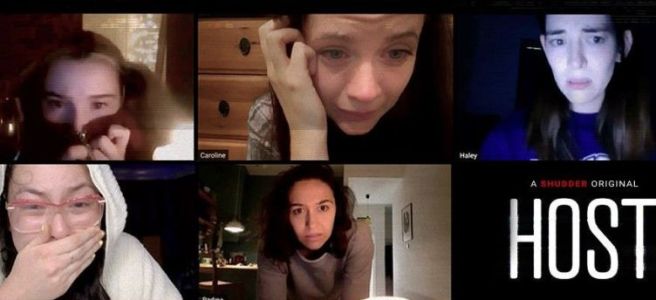
Be Careful What You Take In: Rob Savage’s Host

Some films are a product of their times or, if you’d like to pardon the pun, the Zeitgeist: the Spirit of the times. This is definitely the case of this Shudder Original film Host. Host is a film directed by Rob Savage, co-written by both Gemma Hurley, and Jed Shepherd, and its one of those cinematic narratives created in the fear-soaked environment of the pandemic: of COVID-19.

It takes the form of a Zoom call, in which six young people decide to have a seance with a medium online to pass the time. Obviously, this turns out to be an excellent life — and afterlife — decision as these things go.

The conference call seems be on a Macintosh Apple computer based on all the colourful buttons, and the Zoom platform itself transitions between the different windows of the users involved as a six-panel screen format, and sometimes a single screen when the story needs to focus on one character. It feels like a call, like you are in the chatroom seeing people get invited in, and having little glimpses into their quarantine lives. It feels like an epistolary fictional narrative, only live. There are no letters, journal entries, transcripts, or even texts but if you take it as a recording of the situation you see these different narratives united under one theme. Perhaps it’s more accurate to say that Host is a found footage film, arguably a cinematic descendant of the epistolary, that feels as though it is live: that it is happening as you watch it.

Unlike The Tribe Murders, another short Zoom-modeled film that, in the words of H.P. Lovecraft “is devised with all the care and verisimilitude of an actual hoax,” there is no disclaimer at the beginning telling you that this happened because, very simply, it is happening as you watch it. There is no past-tense here. Only the eternal, oppressive, over-present.

The pacing of the film is excellent. You have six friends brought together in different places holing up against the pandemic, going about their lives as best they can and under different circumstances, while talking about their lives, and sometimes even gossiping about each other beyond their backs before coming onto the screen. You know it’s the beginning of the end when the six characters can’t take the seance seriously, and try make a drinking game from hearing the words “astral plane” from the medium who so graciously offers to guide them through the ritual.

Strangely Seylan the medium herself as she guides the characters — who are, for the most part, irreverent — brings a feeling of tranquility, even ASMR to the chat with her voice, her calm instructions, and her gentle manner. It makes the tense worse because you know that despite the previous joviality, the latter is a false serenity, a deceptive sense of security. Slow-burning stories or, Hitchcock’s “anticipation of the bang” happen this way. The manifestations of everything that goes wrong are planted in subtle images or distortions, little visual and audio feints and red-herrings, but ultimately the tragedy begins from a sense of utter irreverence against an invisible force that the Zoom participants have vastly underestimated. By the time things get serious, the effects are simply extensions of the infection that has already been growing, its signs already there, the connections not cut away in time.

There is a lot of that language in here. There are at least two themes in Host, not including the title as well. It had only been towards the end of the film that I realized it, and began to think about these elements. The first is the togetherness yet distance of the Internet. A Zoom call, like Skype before it, brings people together while being spatially distant. Seylan goes out of her way to tell each participant to visualize a connected string to their doors should they want to terminate communication with any spirit: kind of like how you would stop a Zoom call. At the same time, even the medium has to think about how to adapt her ritual to an online forum: which she has never done before. Usually, the rite involves physical touch and more direct guidance from the medium or spiritual expert in question: in far more tactile, tangible, and ritualistically secure settings.

To be honest, while some characters are practical jokers, I think in a lot of ways the character of Seylan is the most irresponsible: starting these young people on a potentially dangerous activity, and then leaving them to get a package, and not following up when her Zoom call gets dropped. She also doesn’t consider actually encouraging the characters to have physical elements beyond candles to help them have something material to ground themselves into the ritual. Sometimes, for all the information the Internet has, online existence loses something from the offline world in translation, and this disconnect can make all the difference.

At the same time, when you utilize the Internet as a medium to communicate and you don’t follow the right protocols or you disable privacy, or take it for granted, anyone or anything can be seeing or listening in on what you do. In this sense, this is both a twenty-first century cautionary tale, and an element from the entirely timeless folklore of human hubris.

The Internet and the spiritual intersect in another sense. You need to be careful about what information you broadcast, or put out there. In this case, it’s a falsehood — a story — told by one user that ends up becoming a mask, an anonymous persona, for an unwanted, malicious guest.

This feeds into the film’s other theme, the more implicit one. While the dangers of the Internet and that feeling of connection conflicting with detachment and disconnect are there and the characters operate in that background of life as usual while struggling against global despair, the pandemic itself is another major part of the story.

Remember what I’ve said about the Zeitgeist. If F.W. Murnau’s Nosferatu serves as an artistic attempt to exorcise the demons of World War I in Germany, if the jinn in Babak Anvari’s Under the Shadow represent the darkness of the Iran-Iraq War and Iran’s fundamentalist patriarchy, and if Pornsak Pichetshote, Aaron Campbell, and José Villarrubia’s comic Infidel deal with the forces of xenophobia in contemporary America as ghosts feeding off hatred, I think there is something to be said about Host and its status as a piece of horror symbolizing the fear of the pandemic.

It is no coincidence that it’s due to the actions of the characters in underestimating the powers of unseen forces to the naked eye, and downplaying manifestations — or symptoms — of the supernatural that everything begins to unravel. In fact, it’s only one of the characters, Jemma, who brings a false narrative — or a false positive — into the procedure out of boredom that their spiritual, and material spaces are compromised by a hostile, foreign agent. One of the characters, Radina, looks pale and sick before the seance begins. Jemma claims to feel a tremendous pressure on her neck, making it hard for her to breathe. Everyone involved doesn’t even consider the other people in their spaces, not participating in the spiritual activity but still present: and how they put them at risk.

Haley is the only one of the characters aside from the medium who she brought into the Zoom call that takes the entire situation seriously, but it’s too late as she’s been exposed to the break in their neutral safe space. Caroline’s Zoom background of herself eternally repeating the same mundane task, a hope to return back to normal, plays as she is brutally possessed and murdered: life going on after being taken by something for which she hadn’t prepared herself. This looped background becomes something of a mockery for the group, for the normalcy they will never have again, that will never cover up the horror they now understand. Even Emma, who is hiding to her last breath, under her blanket — perhaps symbolizing her former ignorance, a flimsy safety — knows the terror that lurks outside, and that will get her now that she’s let it in: and there is nothing she can do about it. There is no cure for this plague they let into their lives.

Jemma herself hastily grabs a medical mask before fleeing her space, barely even getting it on her nose which one needs to have in order to have some protection against the virus. However, even though she ends up putting it back on, it gets knocked off: as if to say it’s already too late for her, and for Haley whose place she breaks into in order to get some protection from this infection. Of course, it’s too late for all of them as, one by one in both in full knowledge and unknowing they watch each other fall — separated — into absolute helplessness: all because of the mistakes of a few.

The film itself, aside from its jump scares — feints and special effects-wise — especially at the end, are fairly predictable, though I was always wondering who would die first. And there is something about a childhood fear in the form of a music box with a limited time span, with something of a timer — much like the one at the corner of the Zoom platform that needs to be upgraded monetarily — that hits home the fear that permeates our world now. It’s just my read that the demon summoned on this Zoom call is a metaphor. The spectres of World War I, the spirits of the Iran-Iraq War of the 1980s, the hungry ghosts of xenophobia and hatred in contemporary Trump era New York, all them would be in good company with this unseen demon — borrowing the tools of our online culture, misinformation and terror — that will consume us if we underestimate it, or ignore it, or pretend that we’ve banished it when we know that we haven’t, when we don’t listen to the experts, when the experts themselves don’t even know the full implications of its adaptation, and we let it in.

When you take this read of Host into consideration, you realize that it doesn’t just mean the facilitation of a Zoom call with privacy that doesn’t exist as is examined in The Tribe Murders, or a chatroom, forum, or platform without moderators that can get hacked by entities revealing secrets and spreading lies. Rather, a host is a person who sometimes takes an unwanted guest into themselves, thinking they are safe or non-existent: and both they, and everyone around watches their space get taken over, and they pay the price. That is the fear I feel that Host plays on, and with, and this — combined with how it presents its aesthetic all the way to the credits being a list of participants in the Zoom call itself (almost all them having the same first names as their characters, by the way) — is nothing short of something terrifyingly beautiful, a prime example of imminent horror, and it should be considered a classic of our time.

Son of Shadows

Dedicated to Harry Kümel’s 1971 film Daughters of Darkness

Stefan feels nothing.

He sits in the King-sized bed, now empty aside from himself. And he doesn’t count. The honeymoon suite is a mess. After he and Valerie talked, after she left … he must have destroyed the entire place. All the blankets, his clothes, the ornaments, even the bathroom toiletries are strewn everywhere.

And the phone. The phone is in pieces on the floor, against the wall. The same phone that he called …

Stefan notes his hand. His belt is the only thing he’s kept on him, wrapped around his hand. Pins and needles prickle across it as he realizes he must have blacked out with the strap around it, gripping it into a tight fist.

His chest feels tight, as the events from hours ago fully materialize back into his conscious mind. He sits up, maneuvering his legs so his feet can touch the cool wood of the floor. He puts his head in his hands. The leather of his belt, and the metal of the buckle keeps him grounded. All that volatile emotion that he’s tried to avoid, and all he feels now is hollow. Of course Valerie is gone. His wife. As if …

He lifts his head out of his palms, and blinks. There is a figure, standing near the window. So silent …

“Valerie?” His heart leaps into his throat, with many other feelings that are harder to define.

She steps away. The woman isn’t Valerie. She has short black hair. Red lips. White skin. So pale … so …

“Ilona.” Her name comes to his mind, as does her smile at him from the stairway from what seems to have been a thousand years ago. Stefan’s fingers are inches away from where the lamp used to be, until he realizes that it’s one of the things he’d already smashed in his earlier rage. He lowers his hand. Ilona is at his side, sitting at the edge of the bed.

“Why are you here?” He asks her, suddenly feeling incredibly exhausted.

He can see her a little better now, in the dark. It’s foolish that he mistook her for Valerie, showing him just how foregone he really is. He can see her black dress, her clothing not like Valerie’s lighter colours. And the pearl necklace stands out around her neck and chest like a string of small full moons.

“I’m so unhappy.” She tells him, tracing a hand across his cheekbone. “Unhappy.” Her fingers trail down his chin, and rest in her lap. In the darkness, she is an eclipsed silhouette, a silvery outline of a ghost. Stefan doesn’t say anything. What does one say under these circumstances? It’s not the first time he’s heard a woman say these words, directed at him, or no, far from England, in a Continental hotel room. But perhaps it’s the first time they really hit home, in the moment.

Instead, seeing this vulnerability that he can somehow feel, he touches her cheek. He looks her in the eyes. “You’re as white as a sheet.” He murmurs, remembering his own terror.

Ilona turns away from him. “No, no.” She whispers. “I’m frightened.” She pauses for a second, as though letting that admission sink in. “I don’t know what’s going to happen … to any of us.”

It is such a bizarre thing to say. But Stefan has no witty rejoinder. Nothing clever. Nothing dismissive. He thinks back to the events of the evening, and the phone dashed against the wall of their honeymoon suite, feeling the old, oppressive tide of helplessness rise up inside his throat again, no longer enraging him, merely threatening to choke him and take him down with it into its depths of self-loathing. “Neither do I.”

They sit that way for a time. He feels something cool and soft on his hand, on his fist wrapped in his own belt. He realizes it’s Ilona’s hand. He feels her other hand stroking his hair, bringing him closer to her.

He shouldn’t. It’s a bad idea. It’s not good to look up at her right now. It’s bad enough that he’s naked. Because if he does look up at Ilona, if he meets her gaze …

Stefan does it anyway, another terrible decision in a series of awful life choices. There is some consistency in that much. Ilona’s eyes are dark, and they reflect no light. But they are deeper than the unlit room, and there is both a sadness that makes her seem a lot older than what she is, and a hunger beyond a simple midnight rendezvous. For some reason, they make her red lips seem more crimson, less of a pout and more of the orchid that … Stefan doesn’t want to think about.

“I know.” She says, softly. Her lips are inches away from his own. “You didn’t understand anything yet.”

“No.” Stephen also admits, more to himself than to her. “I’m afraid not.”

“How could you?” Her gaze is the equivalent of a sad shake of the head as she lowers her hand again. “Anyhow, it doesn’t matter anymore.”

“No.” Stefan says, thinking of his own circumstances and the bed that he unmade in which he must lie. “I suppose it doesn’t.”

Her hand keeps circling on his own, over the belt. Somehow, he can feel her fingertips trail across the veins underneath. Slowly, imperceptibly, his hand begins to unclench, to let go. All that’s left is that one emotion in Ilona’s eyes.

Loneliness.

And as she strokes his hair, with a combination of fondness and despair in her gaze, her generous lips brushing against his cheek, as she gently but firmly pushes him back onto the bed, her mouth on his collarbone, his chest, and trailing wetly lower, Stefan gives into that loneliness as well.

*

Ilona’s mouth tastes of both Stefan and Valerie. She knows they’d made love, before the telephone call. Before their argument. Before Valerie left. It’s the closest she’s come to having either of them. She remembers her orders, as much as she would nothing more than to discard them, and slake her thirst.

But she has done this. She can no more disobey Elizabeth than leave her. Yet it is the smaller things. The little moments under her. Away from her. They are victories. That is what Ilona tells herself. After sampling the other precious substance that Stefan had to offer, to distract him, to become diverted herself, her core contracts within herself, and around him as she moves slowly, sinuously, contorting her body in the way that he needs. That she needs.

Ilona Harczy knows what she’s doing. She’s done this for a long time. She doesn’t know if she does this for her own enjoyment, or Elizabeth’s, just as much as she’s forgotten the fine line between loving her Countess, and hating her. It is same with this young man. She isn’t blind. And neither is he. In the darkness, at least he won’t see the red stain on the side of her throat. Not that it matters. It’s too late for them, one way or another.

He’s so callow, and venial. So weak. And yet, there is anger inside of him — a profound unhappiness at his life’s circumstances — and a concurrent fear of leaving those elements that so confine him. The truth is, for all she sees the seeds of what Elizabeth finds amusing in the man while lusting far more for the girl — the traits that attract her like for like — she sees a scared youth: trapped in more ways than one.

And Ilona can relate to that sentiment. For deep down, as she folds herself back and moves, and he loses himself in her, and as he gives her the means to take the edge off her red hunger for a time, her red lips parting at their temporary solace, Ilona knows that the person she despises more than Elizabeth is herself.

This is something else that she and Stefan have in common: this, and this momentary, sweet sensation of blissful, unthinking oblivion.

She lies with him for a while, in the dark, watching the rise and fall of his chest. The sound of his heartbeat against her ear makes her feel alive, gives her a sense of anticipation, of having something other than more cold nights with Elizabeth with which to look forward, if only for a little time.

Ilona unwraps Stefan’s belt from around her neck, from where she forced his hands around it, which she inevitably took from his grasp. She touches the imprints left in her flesh, and smiles.

This. This much, right now, is hers.

*

“Do my questions upset you?”

Valerie looks out into the sea, at the dark grey sky, and the turbulent waters. They mirror her heart like some brooding form of romantic cliché. The Countess’ … Elizabeth’s dulcet tones are soft. Inquisitive. Once, that same whispering voice entranced her, just as much as it repulsed her in the lobby of the hotel with what it promised her, with what it shared with Stefan.

Stefan …

“The answers …” She replies quietly, bitterly, realizing yet again in the fog of confusion and pain that Elizabeth’s stories from the hotel lobby, and Stefan’s conversation with her that night aren’t, in their very nature, that dissimilar after all.

There is a chuckle. Faint and throaty. “Not always pleasant, eh?” The Countess sighs. Valerie is mindful that she’s still holding her carryall, having intercepted her at the train station so fast.

The dead travel fast, she thinks to herself, and wonders of the truth of it, especially of the girl in Bruges. Valerie tries not to shudder in the cold winds of the night. Elizabeth, however, continues speaking as though reading her mind of that afternoon. “But as I always say, one must never be afraid to look deep down into the darkest deeps of oneself where the light never reaches.”

Valerie turns to look at Elizabeth. “But you cannot imagine what —”

The Countess smiles. Her hair is wavy, and golden. There are laugh lines around her mouth and eyes. Between her and Stefan, they believed her to be in her mid-thirties, but as Valerie looks into her eyes she sees a wryness, an old amusement. Her smile makes her cheeks dimple, her cheekbones more prominent. There is something glamorous about the Countess, obviously regal, and incredibly worldly.

“Oh, yes.” Elizabeth says. “I can.” She puts an arm through hers and Valerie, again despite her best judgment, allows her to do so as they walk. “It’s not so difficult to see through your Stefan.”

The jolt of her words hits Valerie, as she remembers Bruges, and the Countess’ arms around him in the armchair, and the phone call. That damned phone call …

“Tell me, Valerie.” Elizabeth says, smoothly interjecting over the trembling storm inside her heart. “Didn’t you already know?”

Valerie suddenly feels tired. The fury, the hurt, the way his dull, flat tone hit her harder than any belt ever could, leaving a numbness inside of her that reminds her of just how young and idealistic, how stupid she really was: that she still is. “He said the same thing to me.” She murmurs. “On the bus, back to the hotel.”

“It began in Bruges.” Elizabeth prompts quietly, her question more of a gentle statement, a lingering on the skein of her mind.

Valerie finds herself shaking her head, feeling herself hurting again. “No.” She blinks back tears. “It was before. On the train. In the bed. Our words to each other.” The two of them walk back into the darkness as she allows herself to full her resignation. “Deep down, that was when I knew.”

*

“You’re both so young.” Elizabeth Bathory tells Valerie as they head to her rooms after walking a few hours through the deserted city. “You can’t give up after a few days.”

“I —” She watches the young woman, barely out of girlhood, her blonde hair a white-gold, her sky-hued eyes keenly poignant, not like the faded disenchanted blue of Ilona’s gaze. “I don’t know if I can face him. Right now.”

“It’s all right.” Elizabeth tilts her head, and attempts a smile. It’s hard, sometimes, to remember how to make a facial expression that is so reassuring. “You may stay with us for the night. I will join you shortly.” She turns and pats Valerie’s hand, holding it in her own for a few beats. “Trust me, Valerie. I meant what I said by the sea.” So many changes, the prospect of it fills her with a warmth she hasn’t felt in a while, not with Ilona, not even in Bruges, and Nice, and Monte Carlo. She realizes the name for this feeling. It’s genuine excitement. Elizabeth doesn’t know what’s going to happen next, and she adores it, almost as much as the woman she is putting into her room. “You do understand Stefan, if you truly think about it.”

“I …” Valerie finally looks down. “I’ve tried. I can’t help it. He … frightens me. He needs help. And I …” She turns her face. “I don’t know.”

“Does he?” The Countess asks. “Or is that what he said scared something within yourself? Are you truly frightened of your own feelings?” She shakes her head at the younger woman’s silence. “Don’t trouble yourself with this right now. Get some sleep. I will …” She pauses, considering her next decision. “I will send Ilona to check in on you.”

“I …” Valerie actually meets her gaze. This pleases Elizabeth a great deal. “Thank you, Elizabeth. I don’t know what I would have –”

“You would have left.” Elizabeth sighs, deciding on honesty. “And you would have regretted it.” She leans forward, and gently kisses Valerie on her pallid cheek, the colour and texture of warm marble. She smiles, a little more truly, at the red mark that she’s left there, the Dionysian upon the Apollonian. Such a symmetrical, Grecian beauty. “Have a good sleep. Tomorrow evening, we shall speak further.”

She hands Valerie her luggage, and gently but firmly pushes her through, past her threshold. Then, when the door closes behind her, she lets out a faint huff. Right. This is a … complication. But if time has taught Elizabeth Bathory anything, it’s that for all things change the right amount of patience will allow everything to fall into their places.

This is her thought as she walks towards the honeymoon suite, and lets herself in.

*

Ilona watches Stefan bathe under the shower. She doesn’t care, at this point, if he sees her looking at him. Her lips are parted, and her teeth are exposed. In the light of the bathroom, he can probably see her, if he just turns around.

She observes his shoulders straightening, his posture under the running water becoming still. His neck is rigid. When he turns to look at her, she closes her lips. There is a new light in his eyes. He’s grinning. They are just separated by their naked bodies, and water.

“Come on.” He says, his tone lighter than when she first came upon him. She can see him eyeing her, her flesh, and the marks that he’s left on her.

“No.” Ilona says, her skin crawling away, instinctively, from the running water. One of her first lessons that, in her eagerness, even now she sometimes forgets.

“Come on in.” Stefan invites her, his smile almost matching his dead set eyes.

“No.” Ilona says, a little more urgently, fear of another kind creeping into her heart.

Stefan smiles. It’s as though he’s sensed this spike of terror. He comes out of the shower. “You’re not afraid of a little water, are you?”

Stefan’s arms are around her. He grabs her, forcefully. Their liaison has woken something inside of him. She can see the fire in his eyes, but it is the water and not the figurative blood in it that scares her far more. Suddenly, she is reminded of just why Elizabeth has her eyes on this couple. She thought it was just the girl, but …

“Ilona. There you are.”

Thinking of, almost literally, the Devil. Ilona turns, in Stefan’s grasp, to look at her Countess. She’s alone. The girl is nowhere to be seen. Did she think she was going to take him? Even now, Ilona knows better. There is a faint amusement in Elizabeth’s eyes as she takes in the scene. Stefan, for his part, tenses. His assertiveness, his aggression, leeches out of him as he looks from herself, to the Countess. And back. For some reason, Ilona finds herself putting a hand on the small of his back.

“Now —” Ilona isn’t sure whether Stefan is about to issue a demand, or an excuse.

It ultimately doesn’t matter. It never did. Elizabeth shakes her head. “Come now, Ilona.” She says, her voice melodious, drifting. She tosses Ilona’s black dress and pants to the ground. The white pearls stare up at her like sightless eyes from a dark shroud. “We have a guest in our rooms. I need you take care of it.”

It is clear to Ilona to whom Elizabeth is referring.

She stares into Elizabeth’s eyes. It’s strange. She’s noticed, over time, that her Countess merely runs through the bare minimum of emotions beyond her strong appetites, a dance or pantomime of social behaviour barely recalled. Even in humiliating her right now, though this is not even close to the worst of it. She turns back, to look at Stefan. She can feel him breathing hard, his wet body rigid, his face full of fury and passion before slack and speechless.

“Now, please. Ilona.” The Countess brings up her willowy arms, and delicate fingers like she is wearing her boa and dress, and not her simple white sweater. This is Ilona’s summons.

Ilona turns back to Stefan. A smile curls on the side of her red lips, as crimson as Elizabeth’s. She reaches up, and grabs the sides of his face. Then, she crushes her lips against his own. She trails her lips down, to Stefan’s neck, letting them linger against a faded scar from the nick of a razor, allowing Elizabeth to see it. It had been good to feel like a desirable object again as opposed to a detached entertainment, an echo of both being the lover and the ardently beloved. There is a defiance in her heart, for a second. A thank you. A goodbye.

Ilona turns, and bends down to pick up her clothes. She doesn’t look at Elizabeth in the eye. She’s done enough. She’ll probably pay for this later. But it’s worth it. Just for that moment. As she walks past Elizabeth, putting on her slacks, pulling her blouse over her head and chest, she wonders wonders if her Countess would be jealous that she got that taste of her lovers together — of the complete set — first.

This what Ilona uses to fortify herself as she returns to their rooms.

*

Stefan can barely process what’s happening. He feels Ilona’s lips on his skin, on his neck. She’s so pale, even after what they … what they did together. And that emotion in her eyes when he came for her, to drag her into the shower. It was genuine fear.

He recalls the bed. The coolness of her body against his. The way she slowly moved, the position she fell towards, what he did to her, what she made him do to her. Even her hands in his own felt like … and the way she remained so utterly still.

The weight of what happened before, with Valerie, hasn’t left him. But something that had been building inside of him — coiled — ready to pounce, ready to explode has, for lack of a better term, unfurled. It thrums inside of him, even now, at this strange scene. He watches Ilona’s perfect, porcelain buttocks retreat into the shadows of the room, thinking about how she instinctively sucked on the part of his neck that he cut, the sight of blood making him feel … behind the Countess who, idly, strokes her dark hair as she passes. It’s a detached gesture. A possessive one. It’s like the way a girl would play with one of her dolls.

And suddenly, the reality of what has happened, what he has done, all of it, hits Stefan. Hard. He tries to recall what he was trying to say to the Countess before she’d interrupted, but the words don’t come out.

“Your wife is staying in our rooms.” The Countess tells him softly, her gaze never wavering.

It occurs to Stefan that he’s still naked. “Oh.” He replies, then takes a step back, sitting on the rim of the bidet.

“You are having troubles.” She says. Her face seems sympathetic, but Stefan can tell there is something hard about it, an effort, like the muscle memory doesn’t entirely recall the motions.

“She …” He stops himself, thinking about their time on the train, on the bus, on the boat. “She doesn’t want to see me, anymore.”

The Countess almost glides. She sits on the edge of the bathtub. It occurs to Stefan that both she and Ilona match the ivory material. “Do you wish to talk about it?”

Slowly, Stefan shakes his head. “If my wife is with you, surely you’ve already talked. And …” He waves his hand, at the room, at all of this. “I think I’ve done enough.”

“Have you?” Unlike Ilona’s sad eyes, or the heavens in his wife’s, the Countess’ are a darker, almost steely grey. “Tell me.”

“Countess —”

“Stefan.” She trails her hands over his, folded over his lap. “Remember our talk. We are friends now. You may call me by name, yes?”

Her touch is faint. Ghostly. But muscles in Stefan that he didn’t know were tense begin to loosen. “Of course, Elizabeth.”

She smiles. It is a radiant smile, almost tentative in the manner that he’s observed. “Come.” She puts her arms around his shoulders. “Let’s go back to your room, and talk some more, yes?”

Stefan nods, once. He lets her help him up. They walk across the tiles, and the mirror, and he is so lost in his thoughts he doesn’t particularly see anything other than the outline of himself, wandering through the fog on the reflection. A part of his mind registers, distantly, that his razor isn’t on the basin. It must have fallen in, he supposes. Instead, Stefan focuses on the Countess’ movements, and her form leading now him by the hand. Whereas Ilona reminds him of a flapper from the Roaring Twenties, Elizabeth is akin to a ghost of an actress from the era of Silent film, ethereal white and faded gold. A queen from a bygone time.

He finds himself seated on the bed, still rumpled from his time with Ilona, from his rage, from his time with Valerie. She sits beside him. Their feet almost touch. A part of him wonders if he should cover himself. He can see his clothes on the floor, his white shirt, his black pants, his red sweater …

“We wear similar colours, you and I.” Elizabeth laughs softly.

Stefan recalls her attire when they first met, and realizes she’s right. He decides to give up, that it is far too late for modesty. She’s seen enough of him tonight. It seems as though everyone has, at this point. “Great minds.”

“Yes. With great expectations heaped upon them.”

He looks up at her, his eyes scrutinizing. “How much do you know?”

She shakes her head, the look on her face distant, musing, mulling something over. “You are so sad. So tense. I can see it.”

He feels her move up behind him, folding her legs until she has them on either side of his, her feet hanging again from the bed frame. Stefan doesn’t know what to think of this. He’s just, he’s so tired. Her hands are soft, but firm on his shoulders as her fingers begin to knead the muscles underneath.

“She wouldn’t let up.” He explains, her hands finding the knots in him, unkinking them. His mouth opens and closes almost of its own volition. “She wanted it to be known that we were married. I tried everything. And I thought that maybe …”

He doesn’t finish the sentence. He knew what the result of that call would be before he even made it.

“Family.” Elizabeth drawls out, silvery, behind his ear, making goosebumps crawl up the bare flesh over his back. “It is the first love. Obligation and Duty are unto it like Sin and Death to Satan.”

Paradise Lost.” For a few moments Stefan allows himself a crooked smile, losing himself in the voice of the Countess. “I wonder if it is possible to lose something that you never had.”

“Lucifer had no choices. You never have a choice.” The Countess says, her fingers moving towards the sides of his neck. Perhaps it’s just Stefan’s imagination, but there is a lilt to her tone that hadn’t been there before. “That has nothing to do with love. That is what I told Valerie.”

He stiffens under her touch, hearing his wife’s name again, recalling that night. “What do you know of that, Bathory?”

The absolute venom in his voice startles even him. The Countess’ fingers stop in their massage. Stefan breathes in, and lets out a long sigh. “Of course you know. A stupid question.”

“You told her.”

“Yes.” Stefan says. “After the call. I felt it welling up inside of me. That helplessness. I thought — I thought she wanted to know. About me. I thought that maybe …”

Elizabeth starts to probe the back of his neck with her fingers, her clothed body against his spine.

He bows his head. “I told her everything. All of it. The Manor. The Continental trips. Being alone. I thought maybe if she understood that, realized that, she might know where I came from. She might … know me.”

“You went to the only place that could understand you.” Elizabeth’s words flow through his mind like smoky molasses. Rich, and elegant, and deep. “It’s all you’ve ever known.”

“But it wasn’t enough!” Stefan hisses. His fist tightens as he clenches his jaw, looking away. “I needed more! I need more. I …”

“You wanted to hold her down.”

“Yes.” Stefan murmurs.

“You want to have power over her.”

“Yes.” Stefan feels Elizabeth’s fingers splay out on his chest.

“You wanted her to feel what you have felt, all these years.” Her hands roam around his ribcage, her lips in his ear, her legs wrapped around him.

“… yes.” Stefan closes his eyes.

“You wanted to take that belt, the one you didn’t use, the one you thought about using on her, and thrash her with it within an inch of her beautiful life.” Elizabeth’s hands roam downwards.

“Mmph.” Stefan groans, his eyes clenching shut, his body betraying him under her hands.

“You wanted her to be like the girl from Bruges.” A pair of lips husk as they kiss his earlobe.

Stefan’s eyes flutter. “Oh god …”

“No.” Elizabeth murmurs. “We are talking about love, remember? God has nothing to do with it. Or everything to do with it, if Family is the first love as is to Satan. You told her all of that, didn’t you?” She continues stroking him, idly. “Just as we talked about those things back in the lounge.”

Stefan’s throat is dry. Something is tensing up inside him, a massive knot in his chest. In his lungs. In his heart. “I can’t …”

“It’s all right, Stefan.” Elizabeth tells him, one hand stroking the side of his face. “That is why you love her. Valerie. It’s what you dream of making out of her, what every man dreams of making out of every woman — a slave, a thing.” Her lips drone into his eardrum. “An object of pleasure.”

Her other hand lets go of him, and scrapes her nails up his inner thigh. “It is understandable.” She tells him, his senses everywhere, his body trapped between the state of animation and stasis.

“It sounds …” Stefan says, his mind almost back into his body from Elizabeth’s caresses. “It sounds like you want this as well.”

“Mmm.” Elizabeth’s hands spread across him again, going lower. Stefan finds himself thinking about Valerie again. Valerie. If Ilona is a doll, and Elizabeth a femme fatale, then Valerie is a nymph. Playful and coy. The answer to that age-old question as to how something so innocent can be so lustful at the same time. And she knows. She knows what he is.

“They are fantasies.” Elizabeth says, teasing him again. “Fun. Little things to spice up a dreary life. All to make a show, like that week in Bruges.”

“Is that what you are …” Stefan sighs, his mind coming back to him. “Like in the stories? Erzsébet Báthory tormenting young women, the only thing she’s known her entire life … in a life of Obligation, and Duty? Sin, and Death? And Satan as her Family …”

He looks to see Elizabeth staring at him, her eyes misty but gazing right into him. “And what if I were?”

“Hm.” He lets himself become distracted, by the thought, entertained by it as she is amusing him now. “It would explain a lot. After all, if she still lived, she wouldn’t want to be stuck in one place. She’s always been stuck, hasn’t she? When she was born, when she lived … and when she died. You’d feel trapped. Claustrophobic.”

“You make me sound like some kind of ghoul? A vampire?”

He laughs. “You can’t stop. You could have a mansion, an entire Castle, to feed to your heart’s content. Why travel against the edge of the sun to do so?”

“Why don’t you stay and enjoy the garden in England? After all, who understands a boy better than his own Mother?”

Stefan’s heart jolts as Elizabeth’s grip tightens. He finds that he has nothing to say.

“No.” Elizabeth murmurs into his neck, continuing her movements. “Just as Dracula is not Vlad Tepes, I am not my ancestor, the Blood Countess. I am even less than that, Stefan. I’m just an outmoded character, nothing more. You know, the beautiful stranger, slightly sad, slightly … mysterious … that haunts one place after another.”

“W-who are you?” Stefan grits his teeth against the growing sensations in his body. “Are you even real?”

“Are any of us real?” Elizabeth asks. Even her breath smells red. “We all make stories of ourselves over time. Little artifices. Fictions. Am I the Countess Elizabeth Bathory, for instance? And are you really Stefan of Chilton Manor?” Stefan opens his mouth, and he is past the time for words. “Come.” Elizabeth purrs, wrapping herself tightly around him, as he loses himself in her embrace, as he lets her let himself grant him permission. “Let us make a new story together.”

*

Stefan stands on the boat in the night. Everything after their time in the honeymoon suite moved so fast. Elizabeth explained to them that it was like this: time moving slowly, in increments, and then all at once.

He remembers Valerie’s screams as they came into the bathroom of Elizabeth and Ilona’s suite.

Poor Ilona. Stefan finally figured out where his razor had disappeared. In the end, she found the water after all, and turned it red. Their favourite colour. Valerie, her white sweater covered in blood, like the spot on Ilona’s pale neck grown and turned large. Stefan keeps the image of Ilona’s body in his mind’s eye.

Elizabeth assured Valerie that it hadn’t been her fault. That she didn’t suspect her, despite the implications. Of course it hadn’t been Valerie’s responsibility. A part of Stefan wanted to rib her further, as he had with the Belgian newspaper, to rankle her, to probe that place, to enjoy her squirming. But restraint. Elizabeth teaches restraint. And patience.

Stefan decided to dig the grave, in the mud, in the darkness, though it’d been Elizabeth’s plan. He hadn’t forgotten how quickly she’d come to that decision, to deal with Ilona. He’d laid a kiss on Ilona’s lips, so pale in death, that when Elizabeth threw the earth on him, and he’d become tangled in the corpse’s limbs, it’d taken him aback. He wondered then, if this had been her plan all along, to bury them together … until a hand reached down …

And Valerie pulled him up. Despite everything.

Then, the Countess’ red bed. And the two of them, as she explored them, and the violet boa around her shoulders. Seeing Ilona’s body, being entwined in it, terrified but … excited him. It helped make that night even more memorable. He wishes he can thank her for that. The last thought he had, of his old life, was seeing Elizabeth’s boa, its feathers reminding him of a bird in a gilded cage, and he couldn’t help recalling the orchid: the Laeliinae, Cattleya violacea. 

Stefan doesn’t think of flowers anymore. Instead, right now he stands on the deck of their ship, wishing it called the Demeter or at least the Persephone, crossing, in Elizabeth’s words, the River Oceanus. It is much calmer now than in those early nights. He turns to his side. Valerie stands there, a stoic, white statue from another time.

“Tell me.” He says, also from another place, another era. “Do you love me?”

Valerie inclines her head. “Don’t you know?”

Her mouth moves, her pouting naivety now become a calculating Galatea. “No.”

Stefan nods.

There is the pause, of a breath that neither of them need anymore.

“And you?” She asks, her eyes far away, the firmament in there as dark as the night that they have led her into, that they were destined for together.

He remains facing away from her, all of his lies now laid bare, now knowing every sordid part of each other. Now knowing, and reveling in, what truly he is. “No.”

Valerie also nods, curtly, hiding her face under her platinum bangs. “That’s good.”

And as their fingers reach each other’s, before Elizabeth can call for them again, Stefan thinks about Ilona’s necklace. She must have dashed it to the floor when she entered the bathroom. He imagines it, in her haste, in her stride as Stoker might have said, snapping, spilling every glorious, ivory bead, each one rolling away, released into the shadows and the crimson tide lapping around them. He considers what kind of newspaper article that would have made, back in Ostend. Stefan grows hard.

Their fingertips almost meet even as Elizabeth comes in from behind, languorously stretching out her arms under her black raincoat, sheltering them, her presence looming over them all.

It Isn’t About the Dick: Robert Hiltzik’s Sleepaway Camp

I first heard of Felissa Rose on The Last Drive-In.

Joe Bob Briggs had, during a “commercial” segment in his show, phoned her up and consulted her as a “mangled dick expert.”

Yeah. So, between her quips and her obvious charisma, I had to find out more about who she was.

I’ve mentioned on here before that I am not a horror expert. A lot of what I do here is me discovering the old classics for myself, or commenting on strange grindhouse, art, and mainstream movies and stories that speak to me in some way. Sometimes, I will just dissect, or reminiscence about my reactions toward them. Other times, I will create potentially bad revisions of the film stories for my experiments, or even outright homages (read: fanfiction).

But I was intrigued by Felissa Rose and her guest calls on The Last Drive-In. I figured out she was a legendary actress in the horror genre, and I had to check out the film in which she is most known: Robert Hiltzik’s Sleepaway Camp.

Now, before I continue writing, I just want to say the following. When I started this Blog, I was going to begin small. Originally, I would look at some older, perhaps more obscure works, and give my takes on them. And then, Cannibal Holocaust happened. It side-swiped me. It hid in the jungle and blew a dart in me with a complex substance that I couldn’t suck out of my brain, or ignore.

And, in that same spirit, so did Sleepaway Camp.

Yes. Even before this death-dealer loving film returned to Shudder, I watched it. And I felt like I got trapped in the sights of that point of view killer camera angle.

Of course, as with most old films the ending was spoiled for me. As Joe Bob mentions in his interview with Felissa Rose that I finally got the opportunity to see not too long ago, I too believed this is where the origin of the “mangled dick expert” came from. But I, too, was wrong: just differently. You know a word or a concept can mean something ages before, and as time passes it changes. Sometimes, it transforms so much there are legends attached to it, even mythologies or tall-tales? This seems to be one of those times.

See, I’m going to spoil the ending to this 1986 film. I’m not going to do it right now, but when I give you the warning, and you want to watch this, run. This article will deal primarily in looking at this issue, and how it relates to the film.

But before we do that, I just want to say I actually enjoyed watching Sleepaway Camp. Felissa Rose plays a quiet, shy, awkward, and terrified thirteen year old girl named Angela Baker who goes to a summer camp with her cousin Ricky, and proceeds to get humiliated and terrorized by both her fellow campers, and some of the counselors.

So, here is your first spoiler warning, with a side of violent trigger warnings.

Angela Baker proceeds to kill everyone that has wronged her in the most creative, and brutal ways possible. It is bloody inspiring. We only, for ages, see through the camera as a first-person perspective. I can just imagine it as a video game like Dennis the Menace or Home Alone, except instead of escaping Mr. Wilson, or planting death-traps for Harry and Marv, you get to pour grease on a pedophile cook, stab a malicious counselor in the shower, shoot a child beater in the neck with an arrow, create a death by beehive situation to a counselor on the toilet, Anakin Skywalker some little shits with a machete that threw sand at you after nearly drowning, and introduce a particularly mean girl — intimately — to a curling iron.

Somehow, I don’t think that by even today’s standards, that it would be a game for children, even if it happened to them in this film.

Yes, you can tell how much I enjoyed this movie. Almost every person that dies in it, deserves their fate. And those whose fates you have conflicting feelings about, you can understand why they are killed. You actually emphasize with the killer. You feel bad for Angela, and towards the end of the film and looking back, I know I can totally root for her.

And then … there is the other revelation. So, this is where I am going to put spoilers up, with another trigger warning.

So, in 1975, before the film begins Angela is seen with her brother Peter with their father who gets into an accident due to some careless teenagers. As a result, there are some injuries and Angela is the only survivor. This is not the spoiler, however. What you find out is that Angela’s aunt, one Dr. Martha Thomas — who is so much more terrifying than Angela will ever be — decides that she has a son already, and wants to raise a girl.

To get back to the end of the film, we discover that Angela — who is extremely aquaphobic, has issues with burgeoning relationships and her body image, and won’t even shower with the other girls in her cabin — is biologically male. Essentially, the movie ends with one of the counselors finding Angela — this young, sensitive, introverted child you’ve been rooting for — with the decapitated head of the boy she liked, naked, and grinning like a maniac, with a low animal growl in her throat following the man shouting: “Oh my god! She’s a boy!”

… yeah.

There is Angela, who had been, or is still Peter, naked with a demented grin of utter torment on her face, and her penis is fairly clear with a body possessing visible chest hair.

So yeah. I walked right into this. And I was so sure, like Joe Bob, that Angela — and it is unclear to me whether or not good old Aunt Martha made Peter take his sister’s name along with her appearance in some good old fashioned misgendering for her sensibilities — suffered injuries from that accident, and perhaps this is why her Aunt and family influenced her to transition. And, thus, the origin of Felissa Rose’s moniker.

It turns out, we were both wrong.

A lot of reviewers have mentioned that the twist ending of Sleepaway Camp has not … aged well. And I see their point. The transphobic elements from the 1980s are pretty clear. Certainly, the fact that Angela and Peter’s father had been gay, or involved in a gay relationship before their accident adds some homophobia and the implication of this arrangement affecting Angela’s sense of identity adversely to this mix.

I don’t think at this point I’m telling you anything that you don’t already know, or can’t read elsewhere.

Personally, between you and I, I like other takes on this film. Certainly, BJ Colangelo, and more extensively her partner Harmony M. Colangelo on their Dread Central and Medium articles respectively, look at Angela Baker as a young victim of misgendering in a social system of transphobia and bigotry. Harmony M. Colangelo goes as far as to say that Angela is something of a Frankenstein’s creature: a symbol of transgender rage against a social order that maligns her because of her sense of identity.

Colangelo isn’t the only writer that identifies Angela as such. Daniel Sheppard sees Angela as a supposed antagonist that he identifies with as an LGBTQ+ man who had been a fifteen year old boy struggling with gayness. In addition, he ascribes to Angela something not out of place in The Queer Manifesto and Queer Ultra Violence: Bash Back! but draws the idea from Sam J. Miller’s “Assimilation and the Queer Monster.” Sheppard argues that the “queer monster” functions as a symbol of anger, and pain, and radicalism to which LGBTQ+ audiences can relate their anxiety and fear: something that the “normalizing” queer identity can erase for the sake of assimilation and hetero-normative comfort. In other words, the “queer monster” or ” queer radical” isn’t all about “gayness” as “happiness” but as a symbol of every terrible negative feeling an LGBTQ+ person is forced to feel in a system that is supposed to be “natural” or “no longer an issue.”

It’s easy, the argument goes, to claim that representation has been achieved, and there is no need for the radical another, but often the image of the radical or the “monster” makes you look at just how flawed society truly is: even when it seems to be “fixed” — and often isn’t. So when you look at Angela in that light, and consider her utter torment, and the discomfort of watching a young human being in their formative years twisted into something that barely resembles a human anymore, having sympathized with her and — literally — seeing her actions from her perspective, perhaps finding themselves complicit in the impetus that forced her to this point, in a dual juxtaposition that all comes together traumatically at the end of the film, it hits home just how utterly fucked up this situation truly is.

Did Robert Hiltzik and his crew intend this reading — this subversion — of transgender and LGBTQ+ exploitation? I don’t know. However, I was curious to know what Joe Bob and particularly Felissa Rose — who played Angela in every scene except for the murder perspectives, and the nude display of the character at the end — had to say about the issue.

It is already complicated. You have a cisgender girl playing what seems to be a transgender character, but when take away the time period and prejudices of the time in which the film is made, and you really look at the film: just what is Angela’s identity? How does she identify? Is she still Peter in her mind? Is he still there? Are they, beyond arguably functioning as a symbol of both “the danger of the queer infiltrating straight spaces” as Harmony M. Colangelo put it, or the radical image of LGBTQ+ pain striking back against “the heteropatriachal norm” as Sheppard states even transgender? What pronouns would they have? Do they even know? Does this character even know what, or who they are at this age where their aunt has proceeded to “convert” them into her perspective of the female gender?

Does this character, does Angela, like Arthur Fleck in Joker except from a gender identity slant even exist beyond working as a cipher for what others project onto, or see reflected in her portrayal?

Felissa Rose seems to think, from her interview with Joe Bob, that in that scene when Angela and Peter are facing each other after seeing their father and his boyfriend together, they are exploring their own concept of sexuality: a situation that gets disrupted with their father and sibling dies. It isn’t about the genitalia of Angela, or however or whoever this character identifies. Felissa corrects Joe Bob, and says that the character’s body is intact, which leads Joe Bob into making her The Last Drive-In‘s resident mangled dick expert. Rather, I would argue that what’s mangled is Angela’s mind and soul from a lifetime of trauma, and gender projection and enforcement.

Joe Bob says it best, I think. He tells Felissa Rose that he believes that it had been totally unnecessary to state that “She’s a boy!” That image of Angela, if you can even call her transgender — beyond any idea she may represent to audiences — growling deep in her throat, her face twisted into a death-head’s grin, her adolescent body covered in hair and blood, cradling the head of a boy she had confused and conflicted feelings about, is an image that will certainly haunt me far more than any ghost or spectacle ever could.

Ephemera of Disconnection, and Moments of Painful Clarity: The Etheria Film Night Shorts of 2020

It’s hard writing about anthologies. And the only film anthologies I’ve ever written about — Tales of Halloween and XX — have been in the auspices of the horror genre. And then, you have an event like the Etheria Film Festival.

This is an unusual situation, I’m given to understand. Usually, the Etheria Film Night Shorts are shown in the Egyptian Theatre, and Aero Theatre in Santa Monica to a live audience. However, due to COVID-19 the film entries for the 2020 Etheria Film Festival are all available on Shudder until July the 20th. These are unfortunate, and unprecedented times, and it’s only fitting that these nine short films possess both unique elements, and misfortune for quite a few of their characters.

Tales of Halloween and XX had framing narratives, a film that basically attempts to bring all of its other cinematic stories together. I know that, in the case of XX — another woman-directed, written, and acted anthology — a unifying theme had developed: that of family. The Etheria Film Night Shorts of 2020 do not have a framing story woven through them, even though Heidi Honeycutt — the director of programming — introduces the anthology, and then just leaves us to experience the films for ourselves.

The Etheria Film Festival features short science-fiction, fantasy, horror, and weird films created by female directors, and the 2020 selection is no exception. However, even without an overall narrative, I began to pick out something of a theme due to how each film is curated and ordered one after the other. If I were to really sit down, and think about the themes presented in the 2020 Etheria Film Night Shorts, I would settle on the danger of a superficial world of disconnect in a time of intense connection.

Many of the films feel like the feminist elements of XX meeting the dystopian banal technological reality of Black Mirror. The shallow, transactional “swipe-left” relationships displayed in “Waffle,” directed by Carlyn Hudson, and written by Katie Marovich and Kerry Barker are in some ways far more terrifying than even a self-entitled psychopath. After all, what is more deadly: a predator that takes advantage of a system, or a system that normalizes such hollow relationships to be exploited? This definitely bleeds — figuratively and literally — into Mia’kate Russell’s film “Maggie May” which focuses on the dangers of self-centredness and that evil doesn’t so much happen when “good men” do nothing, but when banal people only care about themselves, and will do anything to avoid personal responsibility or consequences.

And if “Maggie May” is about a character who ignores what is right in front of her out of convenience despite having so many ways to correct the situation, and claiming to have no impetus to do so, then “Basic Witch” — written by Lauren Cannon and directed by Yoko Okumura — has one character use her power to make another face what he has done to her. It’s so deceptively gentle at first, complete with a sunny background and a latte and what looks like an episode of Charmed that teaches one person — perhaps even both characters — the lessons of consent. In a short period of time, we see a myriad of different thoughts and emotions between the characters and a form of communication that is usually so difficult to express is made manifest through radical empathy. It manages to make fun of parts of itself while also allowing its message to be painfully clear. The nuance and depth and that gradual horror but level ground of understanding in it makes it one of my favourite films in the whole anthology.

My other favourite movie in the Etheria Film Night Shorts is one I’d heard about when this event was being advertised online: “Conversion Therapist.” There are so many ways this short film could have gone, or been introduced, and Bears Rebecca Fonté subverts all of these expectations. Imagine a group of pansexual, polyamorous people utilizing a gruesome yet poetically justified set of techniques against a captive Evangelist conversion therapist. It is dark, what they do, and you can be terrified at their cruelty until you realize they are just using the tools of the oppressor against one of their tormentors. The moment I saw the man with the rainbow coloured T-shirt, I just knew what their prisoner had done, and that he was so utterly fucked. It’s not certain, to me, whether or not he did everything his torturers claim he thinks about or enjoys, but what we know he has done is enough to warrant the vengeance happening to him, and others of his kind. Talk about queer ultra violence.

So, at first you might be forgiven into thinking “Conversion Therapist” breaks the pattern I’m trying to work with, but aside from the fact that it takes what happens in “Basic Witch” to a much darker and more punitive level, it goes back to the hypocritical double-standards of a society or a social system that fails to understand its humanity. “Offbeat,” written by Chiara Aerts and directed by Myrte Ouwerkerk, is the non-English subtitled film in the anthology — made in the Netherlands — which displays just what happens when a dystopian society called the Dome creates the only clean highly technological environment built on conflicting ideals and statistics without humanity, while claiming to embrace diversity. It is here that the protagonist has to face the stigma of labeling while watching other characters like a disabled man, and a transgender woman struggle through tests of admission try to stay true to his own self and basic decency.

And this societal critique of a system that inherently discriminates in a cycle, while pretending at fairness, again literally bleeds over from science-fiction to horror tropes in the form of “The Final Girl Returns.” Alexandria Perez explores the idea of a survivor of a horror serial slasher being condemned to rescue the horror trope’s “final girl” only to have each one die to the murderer from she supposedly escaped each time. I am not entirely sure, but all of the characters seem to be people of colour — just as the protagonist from “Offbeat” is — and the subtext about the authorities never dealing with, or capturing each serial killer in this self-aware horror genre universe speaks very intersectional volumes, and is very timely.

Taryn O’Neill’s “LIVE” is a nice transition considering that each character from the last two films is attempting to survive, but “LIVE” goes back to a similar conceit as “Waffle” in that the world is ruled by social media but in this case the protagonist is forced to engage in something of a fight club for views along with other nearly 24/7 streaming activities just to survive a world where the growth of AI has made most human activity irrelevant. This is a reality where everything is, again, transactional and the only way to stand out is to give up your sense of privacy for spectacle and drama and so many more views.

This lack of privacy seems to be a theme in itself within “Man in the Corner” written by Daniel Ross Noble and Kelli Breslin, the latter of whom is the director. After viewing this short film, I tend to think that it can be a metaphor for “catfishing” — of meeting someone online who is under a false identity, except this is interpreted as physical — or ignoring the red flags of the situation around a hook-up for the physical immediacy of the experience. It is a surreal atmosphere, whose reality is unclear and both the protagonist and the reader wonder if they are involved in a dream, or a nightmare.

But I think the film that took me off guard the most is the last film of the anthology. “Ava in the End,” written by Addison Heimann and directed by Ursula Ellis, starts off as a story about another seemingly shallow, hollow science-fiction dystopia — this time with people being able to upload their consciousness into a digital cloud — where a young woman has an interaction with an AI called “Bae,” but as events unfold in such a short period of time you feel for both of them. In fact, I think what makes this film the strongest is that these two characters — who start off in one place — find a commonality, a humanity, an empathy with each other, a sense of connection that can happen in a world that is supposed to be so connected.

That is how the 2020 Etheria Film Night Shorts end. From superficial rent-a-friend and dysfunctional familial interactions, to revelations of harm caused through a lack of connection, to systems of impossible perfection and literal cycles of horror confronted, and the threat of privacy as an illusion to be preyed upon, it all concludes with two lost souls reaching for each other across the digital darkness to make some meaning — to share some solace — in their terrifying existence. And if the results of what should have been a live showing of the 2020 Etheria Film Festival doesn’t capture this contemporary feeling right now online, where so many of us now live even more so than before, I don’t know what does.