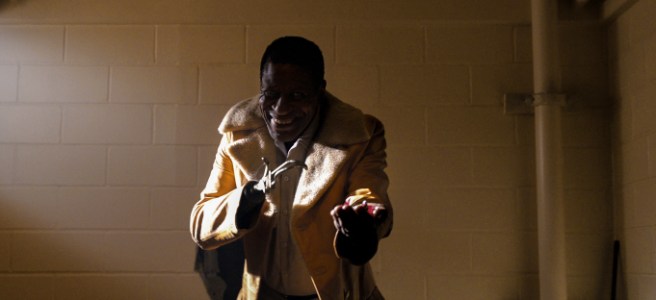
Made Family: Clive Barker’s Nightbreed

I bought the Director’s Cut of Clive Barker’s Nightbreed in the latter days of Suspect Video’s existence: a unique Toronto movie store, and cultural landmark. 

You know, to this very day, I don’t know why I bought it. It wasn’t the discount, at least not completely. It wasn’t even because it had been directed by Clive Barker. As it was, I’d only read Barker’s Books of Blood, and I am almost ashamed to say that I’d not watched any of his mainline films: not Hellraiser, nor even something based on his work like Candyman. Seriously, I’d only watched The Midnight Meat Train, and Dread

But I bought Nightbreed, long after I read about a contest in which fans of that world were to write stories set in Midian. And I had no idea what any of it was about. All I can remember, like a half-unmade dream, is that the title, and the premise of a community of monsters against humanity stood out at me. Or maybe this is only what I remember in retrospect. I know that there were a few cuts of this film, and that its initial release had been compromised by many studio decisions, and that “Occupy Midian” was all about restoring Barker’s original vision of the film to its audience. 

I’m not going to talk about that, except for the fact that I am glad I got this DIrector’s Cut, and watched only this version. What I will tell you is that it was only far after I watched the first Hellraiser, and before Candyman, during the height of the 2020 Quarantine that I opened up my copy of Nightbreed, put it in my portable DVD player, and saw it in its infinitely dark and glittering world-building glory. 

I saw a protagonist suffering mental trauma, never really quite finding his place in the world, and getting gaslit by someone he trusted, and then slowly realizing after running from the woman he loves that his delusions about a city of monsters free in the night, hiding underground, were all true. Madmen became his allies, and his brothers. Humans reveal themselves to be the ignorant monstrosities they really are. And the monsters that the main character always feared kinship with, yet secretly yearned to be a part, were complex, beautiful, terrifying, and so very vital and alive. And there were so many different creature designs, and mysteries, and a story that felt like both an ending, and the beginning to another. I think what really got me was that throughout all of it, as the protagonist progressed, it wasn’t all about him, even as he navigated his way between two worlds the woman he thought he had to leave never abandoned him. Not once. 

And I watched this film all the way from the late insomniac night to the wee hours of the sunlit summer morning during a time of earthly purgatory. Yet, somewhere, I knew the monsters — the Nightbreed — were still dancing their labyrinthine, Dionysian dances of which no mortal could ever truly be a part. 

Monsters. Creatures. Outcasts. Dreamers. Beings of the night. All of them live in the city of Midian. Just think about it for a few moments. This film was released, such as it was, in 1990 and had antecedent in the late 80s. This was a movie about monsters where humans invade them, where the greatest murderer is a man, and the man who becomes one of the Breed is the hero: or at least, an exemplar of sympathetic beings that just want to maintain, and then be reunited with their home. During a time when markets were inundated with generations of films about evil monstrosities, things not human, things being different as threats to the humans that eventually destroy them — or are destroyed by them — I can see why executives couldn’t deal with that concept: even if they had read Barker’s 1988 novella Cabal from which it was based. 

I’ve read Cabal recently. And it read like an expanded story from The Books of Blood, all tight third person limited thoughts, otherworldly descriptions of monstrosity, sex, fear, and desire, and the petty parts of people warring with the melodrama, and the messy, hopeful life inside of them to show what they really are. I recognized Boone in this story, and his girlfriend Lori, and the tormented Narcisse, and the sadism of Decker. Certainly, the perspective on Decker himself — the psychologist who is both Boone’s gaslighter, and a secret serial killer with his “murder-hard” — was disturbing, and fascinating in turns. And it was particularly intriguing to see the psychic link that the young Nightbreed Babette made with Lori, and what they shared together. 

But honestly? I prefer the film version of this story: Nightbreed itself. Much of the plot is the same between both novella, and film. But there are differences. Lori has many more doubts about reality in the novella and has a distinct and instinctual revulsion of the Breed that she encounters when looking for Boone. We never see the strangely alluring spined beauty that is Shuna Sassi which we are introduced to in the beginning of the film. Rachel is more reticent and distant from Boone and Lori, even when the latter had saved her daughter Babette from being killed by sunlight. The priest Ashbury, who is a crossdresser blackmailed by the small-town Albertan police captain Eigerman, isn’t rendered into a mutilated, maddened torso by the scattering of Midian’s god Baphomet, but becomes a twisted version of Cecil B. DeMille’s Moses: killing the bigoted police officer to pursue his obsession on the Breed. Eigerman doesn’t survive to get petty revenge. In the novella, we see that Midian is a ghost town, but that the real Midian is established under the town’s cemetery, and Boone is first shot down in an abandoned house by Decker, getting the police to follow suit instead of claiming Boone is going to shoot him in the woods.

We see the brutality of human systems in the film, and their joy in it. Boone is brutalized by the police after they capture him when Decker frames him for another serial killing. And for a small Canadian town, we see that the police have a large armoury of weapons that would make some soldiers in the military envious when Decker mobilizes them to exterminate the people of Midian. This fervour reminds me so much of Barker’s  “Skins of the Fathers,” it hurts. And we see that this isn’t the first time. Indeed, in the film Rachel telepathically shows Lori the systematic genocide of the Nightbreed over the millennia by various human holy crusades that couldn’t bear their physical differences, and practices. It is graphic and upsetting, especially when you see how humanized they are, when you look at the Breed living their lives in the catacombs of Midian. It is the moment where you see the mural on the wall showing their history, and their underground markets, and rendez-vous that you realize what is at stake with this coming purge. 

And, like in the novella, Boone decides to save Lori’s life over the vows he made to keep Midian a secret: and it not only costs him the home he long sought, but even that place and people’s safety. However, when he returns and accepts what he is, and what he has done — like a more active Robert Olmstead trying to save the people of Innsmouth — he helps create a defense for his people. He even encourages Lylesburg to release the Berserkers: terrifying Breed not in the novella that are contained by their fellows because of their violence, just to allow women and children a chance to escape. 

But what gets me is that Boone isn’t alone. Lori never leaves him, and indeed goes back to save him from the jail, but unlike the novella it isn’t just Narcisse who aids her but both Rachel and Babette. There is this sense of comradery, this bond going deeper than a predatory bite turned into a supernatural rebirth, or baptism by the blood of a sundered, burning god. You see a disparate people, rejected by the world, or at least misunderstood by it, coming together to free one of their own: an outsider from even other outsiders, and they all return to where they belong: for as long as they have it. Narcisse’s death, after he sought Midian for so long and gained such power, to be killed by a psychopath like Decker is still heartbreaking, and there is something fearsome in Decker — in the film — having searched for Midian through the delusions of his other patients, just so the human monster can kill all other monsters that aren’t human. He is a counterpoint to Boone, especially in how he massacres families of both species, and I am for one glad that in the Director’s Cut Boone kills him for good. The tormented Boone dies with Decker, and after he encounters Baphomet one more time — with Lylesburg unfortunately dying in the film — he is re-baptized Cabal: to work towards gaining his people a new home that he lost them … no matter how long it takes. And meanwhile, Ashberry is a throwback to that terrifying Moses — chosen or marked by a deity beyond his understanding — to destroy these beings as so many so-called holy men had tried before: and all for a purpose beyond his understanding, and those of our own.

At the end of the film, we see the Breed did escape — though many also died — and they dwell in a farm. And the mural that we saw at the beginning shows both Cabal and Lori as Breed who will lead their people to a new home. 

When I think back to Nightbreed now, it reminds me of an older story I read years back. In Ray Bradbury’s “Homecoming,” we see a young boy named Timothy who is raised by the Elliotts — a family of ghosts and monsters — attending an All Hallow’s Eve family reunion. He keeps hoping that his powers will manifest, or he will start drinking blood but he never does. He ends up realizing that one day, he will grow old and die like an ordinary human by his monster family, and it breaks his heart. Yet the poetry of it is that this story is part of a larger one where the Elliotts themselves begin to decline as humans stop believing in them, as their homes are obliterated and appropriated, and Timothy — the human among them — helps them survive by carrying their stories onward: even recording them for the new world. I wonder, now, if Cliver Barker read Bradbury’s story at one point as it has a few beats with itL but while Timothy never becomes a monster, he is part of that family that took him in, just as Boone for all of his mistakes, becomes Nightbreed as more than merely being an outcast, or vampiric: but in continuing to wander, and help his family search for home.

There are a few subtexts here. It is no coincidence that Barker created this film in the 1990s given many LGBTQ+ events such as the AIDS activism, and anti-homophobia marches occurring for a vibrant people and subculture trying to survive a world that wanted them dead or buried. Also, the intersectional addition of Hugh Quarshie as Detective Joyce as a Black officer who sees the atrocities of the police on the people of Midian is no accident either: as you can see the evil of what happens when one diverse or historically discriminated group is silent the poor treatment of another. At the same time, I can see how many queer-adjacent spaces of kink, and polyamory, and geekery and — yes — horror fandom can relate to this film. We that glorify in watching blood, and sex but also justice, and the search for a new home, and even as we sometimes hurt and reject each other too, those that remain and remember what’s important will bust each other out of the jail cells of our personal despair, will band together, and celebrate what we love in macabre and beautiful dances in the night. It means a lot, to think of those late night revelries — dancing spirits — finding where you belong all the way past the twilight.

And some of these things are why Nightbreed is important. Many of them are why Nightbreed is important to me. 

A Tell-Tale Heart

I said it a year ago, on the first Halloween of The Horror Doctor, that this is the time when the veil between worlds is thinnest. It’s a time of costumes, candy, and contemplation. 

A year ago, it was the first Halloween everyone spent in Quarantine from the grim harvest that was COVID-19, before we had a vaccine. It was also the first Halloween without my partner Kaarina Wilson: an avid horror lover. 

So I wanted to enjoy my Halloween twofold, for the two of us, since she wasn’t here anymore to celebrate with me, or her family, or on her own. So I decided that from September to October would be a Grand Halloween, and I would do my damnedest to enjoy it all before I’d have to deal with a reality that I’d rather not.

And I did well. I went to my friends’ virtual horror viewings. I attended some Lost Drive-In Watchalongs, and even interacted with Joe Bob and Darcy, and the fine folks that also love them. And I watched as many of the Toronto After Dark Film Festival, having returned and being all online this year, that I possibly could. 

So I’m not sure what this was going to be, this latest October 31st post, before the events of a week or so again, when my grandmother passed away.

My grandmother and I used to talk a lot. We were close. I was a demanding child, somehow to counterbalance the extreme introversion and shyness. I had her make me things all the time, when she could, and I was exacting. I wish I could tell you what I had her make for me, but it’s all lost to time now. 

During that time between my childhood and adolescence, I was a nervous being. In retrospect, a lot of my maladies were probably the result of anxiety. And my grandmother played cards with me, we watched television — usually Early Edition, or Keeping Up Appearances, or Are You Being Served? — to calm down.

But then, she also read to me. A lot of the time it was from books she already had like Little House on the Prairie, but sometimes I wanted her to make stories. To create them. I was fascinated, and scared, by horror. My parents wouldn’t let me watch 1980s or 90s horror, so I wanted as much of the classical stories as I could get away with. Now, my grandmother was many things, but she didn’t make stories. But she did retell them. I remember being in the basement of a house that saw at least four generations of my family on my Mom’s side, a dim place with crackled red and white checkered tiles with a bar that never saw much use anymore, and a fireplace that did. I recall, like my horror, being fascinated and terrified by that fire place. We would put in wood, but mostly white paper birch that we used to write on from a tree in the front yard, to burn. I’d stay away from that old grate as it would barely contain the crackling embers that spit out, as my grandmother would nudge it with a poker, as she would tell me about the heart buried under the floorboards, and the man that put it there: haunted by his crime of murder: committing it, and hiding it from everyone except himself.

It didn’t take long to realize that she was retelling Edgar Allan Poe’s “The Tell-Tale Heart,” and possibly conflating it with “The Cask of Amontillado,” but it did the trick, and it made me want more. And to do more.

I made all kinds of weird clay creatures from Magic Model plasticine and Play-Do in that house that she displayed for a while. I would create men out of Silly Putty, give them Lego armour, make vehicles, and crash them down the long stairs into the basement into a million pieces just to reassemble it all, and do it again, and again. And again. I am pretty sure she knew I did it too, but let that slide as I had some aggression to work out, those dual forces of creation and destruction that are so intrinsically part of my character. 

There were always woods where she and my grandfather lived, in her own parents’ house. I was always exploring, and contemplating the many ghosts that could be in the area from my late relatives alone. It was a bubble of time that also managed to make me very aware of it having passed. 

Sometimes, my grandmother let us get away with some things. For instance, while my parents didn’t want my brother and I to watch horror films, she would rent us movies, and some of them fell under that umbrella. I am pretty sure we watched Anaconda and Mimic under her watch while my parents were busy dealing with adult matters. And this isn’t even going into when we could get away with staying up a little later. I recall one time, at night, when there was a TVO horror movie with a woman affected by a love potion by a man, who dies, and her ghost haunts him still from the obsession he gave her. It was probably the first time I’d seen a simulated sex scene in a horror movie. There were many other times as well, and this didn’t even include when I could sneak snippets of Tales From the Crypt on Fox 29 when we were over for Passover Seders. 

Things were not always easy between us, especially as I got older. I was questioning a lot of my parents’ beliefs, and therefore those of the family. My grandmother was noted as being a peacemaker, but sometimes what that meant was that she would strongly advise something “for the good of the family,” even if you didn’t like it. Even if, sometimes, it was kind of tone-deaf. She couldn’t help it. It was probably socialized into her, her whole life, being a matriarchal force in a patriarchal family and culture. She would always side with my parents when I just wanted more freedom, and less structure, and her spoiling only went so far. 

Poetically enough, it all came to a head one summer when she blamed my first girlfriend for my rebellious behaviour. It should be mentioned that my first girlfriend wasn’t Jewish, but that I was rebelling far before I met her. She literally took me aside, and chewed me out over it, and essentially told me to tow the line. Never mind the fact that I’d missed spending more time with my friends at this time in my adolescence, at one point being dragged out before I could finish watching Fright Night with them, or not going on cottage trips despite my good grades, and academic behaviour. It was an unfairness that struck me, and those phone calls I used to make to her talking about new ideas, and my days, stopped. I didn’t feel like she was on my side, which I needed her to be — just once — but in a choice between me and my parents, it was kind of inevitable where that decision would land. As it was, it drove me further into my own rebellion, and alienated me a great deal. Years later, I would talk about this incident in Pornsak Pichetshote, José Villarrubia, Aaron Campbell, and Jeff Powell’s horror comic Infidel: which was funny, as my own father once called me a heathen, so there in a symmetry in the miniseries published two of my letters. Infidel is a comic about differences, and how in attempting to overcome them, sometimes they tear us apart. Sometimes, as Stephen King notes, the monster wins. 

I know I didn’t win, then. And this was a powerful experience from my grandmother that I carried with me for the rest of my life, for good or ill. Sometimes the people you love, that might even have good intentions, make mistakes. Sometimes, they simply come from a different place, and they will not see your perspective.

Sometimes, they will fail.

Our relationship was changed. I buried my part of it in the floorboards when I could. I moved as far away from it as I could, which I began to do with other relationships that failed as well. 

Of course, she was always there. She would be invited over to my parents’ and I made token appearances: and made them as brief as possible. I drew her birthday cards. And when COVID-19 hit, I wrote her letters: especially when she sent me birthday money, which she always did without fail. Eventually, over time, what was anger became just awkwardness, and distance, a gap of age and time. I knew she was never going to change who she was, and I wasn’t going to do so either. I didn’t go to many family functions. I still don’t as they aren’t really places for me anymore, unless I have the will and the lack of anxiety to do so. 

When she was sick, it’d not been the first time. I guess a part of me, just like with Kaarina, thought or hoped that she would pull through. Despite our differences, I still loved her. She was stubborn, you have to understand. So am I.

So, one day, I was told she didn’t have enough time. And, despite missing Kaarina’s passing and others, I made my way with my Dad to the house. It’s hard to see someone you saw so independent and strong, and stubborn, even when you disagreed with them, even when you remember all the times you spent with them, tired and worn away. She wasn’t speaking anymore. It was like she was in between dreaming states on that easy chair in the Den. The following morning, she passed. 

It was as though the darkness in the halls of that house I always walked through consumed the dimming light, and it grew throughout the entirety of the week of the services and the funeral. And I realized, with her being gone, that all of it was gone: the childhood, the house that was a part of my reality — even on the fringes — the anger, the disappointment, her distinctive chuckle, and all of it. She loved mystery novels, she always read them and got them from my Mom, and I can see how Poe came to her mind all those years ago when she retold those stories to me. 

And I suppose the mystery is how it all came to this point, which is life, and the horror of realizing one day I would be lying down like that in my own home surrounded by people that knew me: if I was lucky. If I am lucky. 

Reality sucks. I wanted to stave it off for just one more month, but these Twenties evidently want to suck as much as their twentieth century counterparts. And I have been angry, hurt, sad, and terribly tired. 

But this is something I have to write, something real, as autumn becomes fall, and Hallow’s Eve passes to the Morning. It was my grandmother’s house and the land that helped nurture the horror inside of me. It was those stories that made me want to know more, in addition to the remnants of old pulp comics she kept, and books that were collected. It was the little moments of grace where I got to see, and gained things I probably shouldn’t have but she let it pass. 

So maybe I did bury that old part of me. But perhaps, through seeing what was important at the end, I don’t have to have it drive me mad. I don’t have to have it beat through my conscience for the rest of my life. I got to see her again, for at least one last time. 

Rest in peace, Bubby Rose. You were almost a century old, and you saw wonders and horrors I can’t even begin to imagine. I am going to a Halloween Party with friends today as of this writing: where we will participate in a roleplay game as monsters attacking some heroic antagonists coming into our Dungeon. Maybe it’s not what the family might be interested in, and I know you would have hated even the idea of me hurting simulated lives, but it interests me, and I intend to have as much fun for as long as I can.

A funny thing though, before I end this post. When we used to eat at her house more often on weekends, when I stayed up late I would sometimes see some other television shows. And on a channel called TNT, far after Dinner and a Movie earlier that evening there was a strange man in a cowboy hat sitting on a lawn chair that was always hitting on a red-head that viciously never gave him the time of day. I never understood the point to all that, or the weird movies that played … But I do now. It was great meeting you that first time, Joe Bob. And thank you again, Bubby, for that little indulgence. 

Next time, on The Horror Doctor, I think we will talk about something else. Something else to do with family.

Creepshow Commentaries Season Three: Episode 5 – Time Out/The Things in Oakwood’s Past

Warning: Potential Spoilers for Episode 5: Time Out/The Things in Oakwood’s Past

To be honest with you, I wasn’t sure if I was going to write this Commentary this early morning during my nocturnal hours. I finished most of the films of the Toronto After Dark Film Festival, even as my grandmother was fading from almost a century on this Earth. Frankly, I just didn’t know if I had time.

Time.

If there is one thing this episode of Creepshow has in common it is literally the theme of time. Remember when I left off my last entry wondering what surprises this show would have for us next week? Well, they weren’t exactly surprises. When you study a literary or cinematic trope for a while you identify beats and patterns. You can generally see where the story is going when you are practiced enough, or you’ve seen a fair bit. 

It’s like knowing people are born, they live, and they die: just as you have, you are, and you will — or that there are cycles to events that will always come around again. Sometimes you might forget the particulars, or lose yourself in the moments — and those are the places and situations that stand out from what is otherwise a predictable existential framework. 

“Time Out” is a story written by Barrington Smith, and Paul Seetachitt, and directed by Jeffrey F. January. A young man named Tim gains an inheritance from his grandmother Catherine, who recently passed away. I can’t begin to tell you how that hits close to home due to the fact that as of this writing two or three days ago my grandmother also passed. But unlike The Complete Works of Shakespeare that I was given, Tim gets a wardrobe that his grandfather — a World War II veteran who also apparently had a monkey’s paw (and thank fuck it wasn’t going to be a repeat of that episode, or the story from which it was derived) — got in Germany. Tim had also been at his funeral when the segment starts, and his grandmother warns him away from the wardrobe before he can go in there with the key he discovers in the drawer.

That wardrobe is no gateway to Narnia, however, and the key is no Silver Key back to some halcyon childhood, or dreams, or other planes of existence. Instead it contains a pocket of time outside of the main flow of linear time. And Tim takes advantage of it. He does much of his academic and legal work, spending hours in that wardrobe getting it all done just come out without even a second of external time passing. I’m not going to lie: as a writer, and creator I would have abused the hell out of this artifact. Imagine how many works I could create in there: though whether or not I’d be able to get a wifi signal based on the different flows of time is a whole other matter.

No, the wardrobe has two drawbacks: the first is that time does pass for you, and you will age more quickly. The second is that you must keep that key on you. Otherwise, the doors automatically close, and they will not open.

Tim is a man that wants to make up for the lost time of his father who died prematurely in a car accident before he could finish law school, or spend time with him. The poetic cruelty is that while he accomplishes tremendous amounts of work in shorter periods of time — relatively speaking — he accelerates his own physical decline, and doesn’t spend time with the family he’s making. The man even has a mini-stroke at a younger age: with the doctor going as far as to say he has the health of a man ten years older than he should be. 

It’s the same challenges someone would have in a high-pressure job, and having a family: in the workload always being on you, and the people you love wanting to spend time with you whether you are in your own mind a success, or not. But as Tim’s grandmother Catherine puts it, “you can’t cheat time.”

Tim almost backs off. He almost listens to his wife in saying that she doesn’t care about his position, but that she just wants him to be with her and his son. He should have listened, right? But Creepshow is about more than retribution, but also morality tales. In the end, he goes into the wardrobe one last time, and his key falls out of his pocket: outside. We already saw what happened to the cat at the beginning of the segment, and poor Kitty didn’t make it to Ulthar. And what makes it worse is after Tim turns into dust, his son goes into the closet — too — and the door shuts. That is how the story ends.

Tim’s grandfather had done the same thing. His father died in a car crash. And both Tim and, presumably, his son will follow them. There is always just that one more thing, you know? That one more task. Then you can rest, right? Then you can replenish yourself, or heal. But it’s always that one more thing, that becomes many more, and even when you see it coming the pressure, and the expectations on yourself keep accumulating … until it is inevitable. Until it’s too late.

This story hit me hard, and it would have done so even before the events of this week as I write this Commentary. Even now, I’m writing this extremely late when I should be sleeping, when I’m mindful of the habits that I kept when I was younger not necessarily serving me now that I am getting older. Imagine if Tim had pre-existing medical conditions, and he used that wardrobe. It’s grim, either way you look at it. But damn, did that story deliver. Damn, did I want Tim to make other choices. 

And sometimes, as I said earlier, you don’t see it coming: though there is this nagging feeling that you should. History repeats itself, or at least human arrogance dooms us to a cycle of events. In “The Things in Oakwood’s Past” we find ourselves in a glorious animated feature as directed by Enol and Luis Junquera, written by Daniel Kraus and Greg Nicotero, and directed by Nictero and Dave Newberg. Unholy hell a lot of work went into this production. And Mark Hamill is a voice actor in it too: playing Oakwood’s self-serving Mayor Wrightson.

The story begins in a news segment obliquely referencing a Carpenter Arctic Expedition Collection: a reference to John Carpenter’s classic 1982 horror film The Thing, and perhaps even Lovecraft’s novella  At the Mountains of Madness.

But then we have the actual story. Two hundred years ago, the people of Oakwood disappeared and left that mystery behind them. Now Marnie, the town librarian, found the journal entries of the previous librarian even as the town has discovered a time capsule in the form of a chest that doesn’t look ominous at all.

Apparently, the cycle of disappearances is older than merely 1821. They occurred in 1621, and even 1421 with the Mi’kmaq First Nation. Marnie discovers all of this in the journals, and the realization that the people weren’t killed by plague or war, but by a demonic monstrosity that slaughtered them. And, fairly soon, this iteration of Oakwood will be having its two hundredth anniversary. Marnie wants to stop this from happening, and according to the journal, the original townsfolk believed that the key to preventing their destruction is in the capsule: which, conveniently, has the date “1821” on it. It is also found under a particularly friendly tree that has the same markings in the journal and chest of not a Jack-o-lantern from hell. She and Mac, the news reporter interviewing her, have a great and wholesome attraction as they seek to solve this mystery: especially after the terrifying slides of villagers being massacred and flayed alive.

But Marnie’s father, the Mayor, has them stopped and they can’t open the box prematurely. You can already see where this is going, of course. It turns out, the chest contains the evil that they desperately seek to stop. It’s Pandora all over again. An added twist to it is that the historian Marnie is reading lies about the chest containing the salvation of the town: that an elder killed his daughter, and was then exonerated, and he told the people about the chest to make them open it, and slaughter everyone.

The monsters are grotesque and Lovecraftian. I thought there would only be one, but Hell is generous. We watch as the Oakwood people of 2021 are flayed open, cut in half, amputated, and murdered. Marnie barely escapes, with her father charging the sheriff in getting her — barely — out of town. A demon has a camera strapped to it as they all return into the chest, probably to wait another two hundred years. Why they do this, I don’t know: and it almost doesn’t matter. Demons always have rules, which I’m sure they hate but they will do whatever they can in the meantime within them to get their full of flesh and blood. No one else survives.

It’s sad as you see that these people had lives, and even the historian from two hundred years ago had his very human reasons to make that lie. We see what hell looks like as the demons not only don’t care, but they revel in showing it to viewers. The newspeople attempt to shrug it off and mention something about Rider’s Lake, and I don’t know if that is a reference to anything else. No one really learned a thing about history. The story will live on. It will continue on.

Creepshow outdid itself with this episode. Time comes for everyone involved. And seriously? If this were the last episode of the season, I would be all right with that given its strengths in making us relate to the characters, have empathy for them, dealing with the consequences of hubris and greed, and also telling some good stories, and creating even better art all around. But there is another episode, and I have to say: this one will be harder to live up to … or die for.

Creepshow Commentaries Season Three: Episode 4 – Stranger Sings/Meter Reader

Warning: Potential Spoilers for Episode 4: Stranger Sings / Meter Reader

I’ve been busy, watching the return of the Toronto After Dark Film Festival and a whole slew of Canadian and International Shorts. After watching these short films, this time on a laptop screen as opposed to the larger theatrical view, and also being away for a day or so having attempted actual sleep during the night, returning to Creepshow is something of a breath of fresh air, or at least a sea breeze.

“Stranger Sings,” directed by Axelle Carolyn and written by Jordana Arkin, has a cute title which is a play off a popular Netflix nostalgia horror series that has nothing to do with this story whatsoever. Right, so the conceit of the story is that a recently divorced gynecologist named Barry meets with a seemingly equally awkward woman named Sara at a bookshop, and she invites him back to her place … where he finds out that her roommate Miranda is a man-eating Siren. Literally. Now, they don’t want to get him in order to devour him, in the ways he does not want. No, Miranda is tired of being an immortal being luring men to their deaths to fulfill her dietary habits, and Sara wants the Siren’s voice to attract, control, and kill any man she wants.

Basically, Miranda and Sara want Barry to switch their voice boxes: rendering the former mortal and human, and the latter immortal and supernaturally powerful. There is a little riff on the Siren mythos in this segment. Sirens technically are bird-legged, perhaps even bodied women that lure sailors to their deaths with their songs. Mermaids are a different form of mythological being preying on male sailors, but in this episode both are called Sirens: they just have different animal parts. So think about the Sirens of Homer’s Odyssey: they aren’t mermaids, but these bird women instead.

You got it? Good. A lot of that isn’t really important to the story. But it’s clear Miranda’s voice has absolute power over a man, and can make him stab his own eyes out, or worse. The eye-rolling practical effects we see when Barry gets affected are impressive. As for the plan though? Well, it is fairly risky for both women to attempt this. For example, they want Barry — who has no medical background or experience to do this procedure — to put one of them under while the other watches: so that there will be no funny business. And Miranda goes first.

I mean, if Miranda is knocked out, Barry could overpower Sara, kill her, and then slit Miranda’s throat. Or, he wouldn’t even need to do that. Think about it: Barry doesn’t have the background to transplant voice boxes or vocal cords. All Barry has to do is fuck up the vocal cords, Miranda is helpless. But Barry is a relatively bumbling, and well-meaning man: who in the beginning of the story says he should be lucky that Sara likes “weird things.” Like him. He just doesn’t have the nerve to do anything of that kind, even the surgery without being threatened. I suppose I can also see why Miranda just doesn’t take over his mind, and make him do the surgery: as she would have to be quiet in order to have that power taken from her, and a man only remains ensorcelled by the Siren’s song if she is singing. It won’t last if she stops. 

It’s an interesting dichotomy looking at Sara and Miranda’s dynamics. Miranda is ancient, at least five hundred years old, young looking and beautiful with the power of her song. But from my understanding, she has difficulty pretending to look innocent, or not-threatening, and this is why Sara is used as a lure to bring ease to men, pretend to need help — such as books and coffee carrying, and door-opening — so that Miranda can do whatever she wants to them, and even feed off them. What’s also fascinating is that Miranda started off as a Siren, and was getting tired of eternity and feeding on human flesh. She couldn’t, as she mentions later, help what she was: which is why she needed someone to “help her die,” and free her from an existence that’s become a burden to her. But Sara is different. Despite her seemingly innocent and awkward mien, she is vain, petty, and cruel. She thinks that a lifetime of being passed over as “the fat or dumpy woman” by men gives her the right to take away people’s freewill, and therefore entitle her to their lives. She makes no bones about wanting to kill Barry once he’s done, and even makes fun of the fact that his ex-wife found him worthless in complete contrast to their sympathy from earlier.

The thing is, Miranda might be a monster but Sara is a genuinely terrible person. In the end, however, as Sara gains Miranda’s voice box and is about to kill Barry, Miranda murders her with a blade bathed in the blood of her last human victim: which can actually kill immortal Sirens as it so turns out. I’m not sure why she killed Sara. Perhaps Sara had always been just a means to end: to allow her mortality. Maybe she didn’t want Sara to potentially kill her one day, or she knew too much about what she used to be. Or perhaps Sara was just that unpleasant a person that even an inhuman being like a Siren couldn’t stand her. Or perhaps, to make another Odyssey reference, Miranda is to Scylla as Sara is to Charybdis.

Or it may be even more banal, as Miranda seems to have a thing for Barry herself. And, after all, she said she “might” let him live if he did as she asked. Certainly, she gave him way more chances to obey her without hurting him too much. Meg Shields, in her Film School Rejects review of the story, examines a lot of its narrative flaws, including the Karmic Houdini aspect of Miranda getting what, and who, she wants despite centuries if not millennia of consuming men. I don’t know. Personally, I was more confounded that Sara wasn’t already a Siren, and I believed there might be a third one as per the mythological trope of mystical, monstrous women. Really, though, I’m glad nothing bad happened to Barry — who seems like a genuinely good person with terrible luck in relationships — and that Sara pretty much got what she deserved. As for Miranda, well can you judge a monster by human standards, and when a monster becomes human and wants to be better — even killing another monster, albeit by their own design — can they be judged by what they once were? Or am I just overthinking this, and would I have made another story with some more depth that Creepshow episodes don’t always allow time for? I like the ending, for what it is, so I will take it. Besides, I absolutely loved the Siren’s lair — their home I mean — and their costume was so ancient Achaian.

But speaking of a lack of consensual control, and a title’s poetic rhythm we have “Meter Reader” to consider. “Meter Reader” is a segment written by John Esposito and directed by Joe Lynch. So imagine The Exorcist: except instead of it just being Pazazu possessing a prepubescent girl to destroy humanity’s belief in a benevolent Creator and Creation, think of a whole slew of demons taking control of millions, if not billions of humans all over the world. There is debate as to whether it is an infernalist attack, or a plague. The episode is narrated by a periodic voice-over from Therese, played by Abigail Dolan, as she explains that less than 10% of the human population is unaffected by the contagion, and of that number a few have created green crystalline wands called meters that can detect possession: and that the people who go out to deal with demonic infestations are called “meter readers.” I absolutely adore the rhyme.

The story, at first, seems to be about a meter reader named Dalton: who visits a mother whose daughter is affected by the plague. Apparently, in this world there is a point where a victim can still be saved if you intervene fast enough, but barring that the only known way to stop a possession is to kill the victim: usually by decapitation. This fact is why there are garbage trucks that come along to pick up heads, and burn them. Also, if someone comes back from the worst demonically-affected territories after three days, they are to be considered infected and quarantined until a doctor can test them. To get it out of the way, the COVID-19 parallels are incredibly on the nose in this story except, I would argue, for one thing.

There are people with natural immunity to this infection. Not so much in our world, and this doesn’t count vaccines: of which this world does not seem to have the equivalent.

When you are first introduced to Dalton, he seems like a lone demon hunter: intervening in the worst places he can. He even carries a mirror, and knows he can spot a demon on its victim through it. He also seems to know that they have names, or true names, and that after conferring with the girl he is supposed to help, he doesn’t seem surprised that her tormentor doesn’t share its name willingly.

I did see that twist coming about her mother, or the adult woman claiming to be so. It was well-played, and even more narratively clever when you realize this isn’t Dalton’s story: but that of his oldest daughter Theresa. She and the rest of his family are waiting for him to return, and realize he is past the time of being safely uninfected. He ends up coming back past that time, and they get him to stay in the cellar: with Theresa wanting to kill him, by his own previously standing orders, because she believes it is too late for him, and he is already possessed. It’s a bit confusing: some people have immunity, but through perhaps intentional exposure to the demons, they can get affected. Or perhaps it isn’t immunity that they have, but greater resistance: which would track more with the COVID-19 parallel.

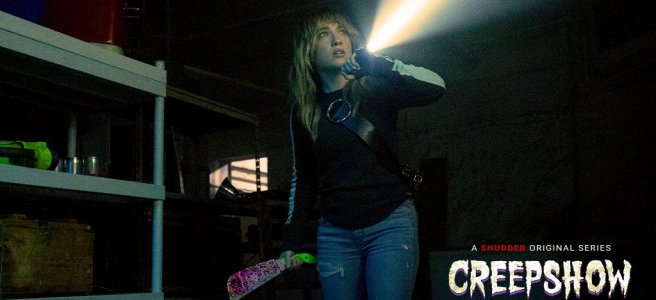
These parallels keep going. You have people wondering if it is a religious reckoning, or a scientific phenomenon: though in the end, it doesn’t seem to matter how it began, just how it is dealt with. Theresa’s mother wants to let her husband back in the house, downplaying his potential possession and the danger he could pose to the rest of the family, as does her younger brother who her mother keeps encouraging. Theresa also has a bad ass colourful and artistic machete, as Meg Shields also points out. And to think I almost believed it was just blood on the blade.

Now, of course, you know the family are going to break for that cellar. And Theresa has nightmares of her father slaughtered their entire family. She had a younger sister named Maddy who had been taken over, and Dalton had been forced to cut her head off. I knew there would be another twist somewhere. See, I wondered if perhaps that 10% of initially unaffected, or resistant people, were the ones that created the plague or summoned the demons. Maybe they were demons, and they tricked humans into hunting down others of their kind. I mean, those readers look like mystical staves or wands: not something scientists, or even conventional monotheist mystics and theologians would forge. I was just imagining Theresa realizing, or remembering, that she is a demon herself as is the rest of her family.

I was kind of right? It turns out her mother and brother were both affected by the plague, and Dalton didn’t get home in time to deal with it based on what happened to him on his last mission. Dalton is dying in that cellar as Theresa is forced to kill her mother and brother. Maybe they had gone out and been exposed to someone else, or it had already affected them and Dalton had a method of keeping their possession at bay — I keep on wanting to say their “assent”: that point where a human and demon soul bond forever, a concept mentioned in Pearry Reginald Teo’s The Assent. Theresa has inherited her father’s immunity or greater resistance, and isn’t affected by demonic possession as others might be. She ends up taking his reader, and going out on her own to continue his work. Basically, as Dalton said on his last mission, he isn’t a priest: most of the reader’s aren’t. Instead, they are just an everyday working Joe or, as Therese says, Josephine. That hoky last comment aside, I how Therese starts off the segment saying how this incident is something “putting humanity on trial,” and it just hits home.

I love the world-building here and, of the two stories, “Meter Reader” with its “Stranger Danger” subversion — the idea that anyone can carry this disease, or be a monster — carries through. Both segments are about monsters in human form, regardless of whether or not they stay resembling the latter, and the little cruelties we can do to each other. And, as such, hopefully we will see what other surprises might be waiting for us in Creepshow

Creepshow Commentaries Season Three: Episode 3 – The Last Tsuburaya/Ok I’ll Bite

Warning: Potential Spoilers for Episode 3: The Last Tsuburaya/Ok I’ll Bite

I was hoping for a stronger episode of Creepshow this week, and after an autumn evening excursion to Stormcrow Manor in which I watched the show the following day, I wasn’t disappointed.

It is beautiful to make something. It’s also satisfying to help something grow. And when it’s arbitrarily destroyed, or ruined, it is equally edifying to see that revisited on the parties that have done it: or seeing from that destruction something newly created. 

“The Last Tsuburaya” is a segment directed by Jeffrey F. January and written by Stephen Langford and Paul Dini. The title itself keeps you guessing for a little bit. At first, you might be thinking that it’s the story about the last descendant of Ishido Tsuburaya receiving the final painting of his ancestor found in a monastery under Mount Fuji.

They make a great deal about Tsuburaya himself: claiming that he was one of the greatest artists of the Meiji Era: namely, the time of the Emperor’s Restoration after the fall of the Shogunate. None of that particularly matters, though, as Tsuburaya — the contemporary of seemingly also fictional luminaries such as Beguwa and Yoshi-Doshi — has a painting style very reminiscent of pre-Meiji Era Japanese art renderings of yokai: of spiritual beings and monsters in folklore. When you see samples of his work in the beginning of the episode, they remind me of something Utagawa Kuniyoshi — a master of ukiyo-e style of woodblock prints and painting — would have made if you’ve ever seen his “Takiyasha the Witch and the Skeleton Spectre” depicting the summoning of a Gashadokuro: a giant skeleton. Combine that with the disturbing and bloody manga work of Ito Junji and the darkness of Francisco Goya, and you seem to get the composite character of Ishido Tsuburaya.

Basically, before we can even look at the man’s descendant, or look at more the yokai that the man painted, or even hear about the “notorious art collector in Moscow” that the lawyer says is fascinated with this lost piece (who may actually be real-life collector and artist Alexander Ivanov), along comes in the aspiring Elon Musk known as Wade Cruise. This particular billionaire gets his jollies not from buying everything, or collecting art and women, but feeling the power of the destruction: specifically holding it over another person, or thing. He is a terrible human being. At least Tsuburaya, for all of this misanthropy, had been an artist and did something creative with his hatred for humanity. That is inspiring. Cruise is a consumer that finds life cheap, and destroys something unique, or threatens to do so to give his small, petty heart something to feel.

And this is what he does when he hosts a party at his penthouse, just to open the crate and look at the last painting of Ishido Tsuburaya: making sure he is the only one that sees it, so that he can burn it into ashes right in front of everyone. He thinks this illustrates power: his power.

What we end up getting is an inevitable lesson in karma.

Oh, I suppose I am a cheap date when it comes to horror and retribution, because maybe a petty part of me is like Cruise: except I like to see small, arrogant, snobby creatures passing themselves off as human beings get obliterated by their own actions. At first, I thought his artistic girlfriend would reconstruct the painting: that it would memetically take her over. But this isn’t her crime. It’s his.

Only Cruise can see — by his own design and sheer arrogance, his hubris if you’d like — the beautiful creature that very much resembles an oni. At first, you’re led to believe it is just in his mind, and perhaps it only manifests there as he is the only one that can see, and interact with it. It hunts him, stalking him, terrorizing him no matter where he goes. Finally, however, he realizes that not only can it affect him, he can damage it.

Cruise had the site of the painting’s destruction in his private gallery of culturally appropriated Japanese art, adding another layer of sliminess to this detestable man. He uses the weapons he has there, one of which being a sword, and a pistol, and even a bo I believe to eventually kill the demon … which turns out to be our friend Ishido Tsuburaya: whose hatred had transformed him into a monster, and trapped him in his own painting. For all that vision of Cruise’s girlfriend said that he and Tsuburaya would have been best friends, it seems to be the opposite. Tsuburaya may have had a long time to think about his hatred, and the place where it traps him, but as he dies he tells Cruise that while he freed him, his own curse is just beginning.

And, in a sequence that is beautiful, Cruise sees himself changing into the demon and runs himself through on the weapon he used — at least from his perspective — on Tsuburaya. It is so much more satisfying than if he had hallucinated his girlfriend as the demon. Later, we see his dead body — all that wealth and perceived power taken away by fear — and it may be that he had just gone mad: except one of the paintings has changed outside of his death. It looks just like the demon.

If any of the above names of Tsuburaya’s contemporaries are real artists, please feel free to let me know. I absolutely love learning about these elements, and I wonder what would have happened if Tsuburaya’s descendant had actually gotten, and seen the painting himself. I was tempted to think of Tsuburaya as a kind of Japanese Richard Upton Pickman: and though after all of this I suspect that the only ghouls he viewed as references were human beings, he did become a monster just him: though far less accepting of that fate.

I do like creative and innovative figures, but speaking of predators that are hard to see, and those that take advantage of the callousness of the bluster and carelessness of others, let’s talk about the spiders and their keeper Elmer Strick in “Ok I’ll Bite.”

I have to admit that this story, written and directed by John Harrison made me pause by the title alone. It seemed silly. Even the premise reminds of something of a combination between the Bird Man of Alcatraz and Willard. But the karma is dark and heavy, and Fall is an especially excellent time to reap it all.

Elmer is in prison because he committed euthanasia on his cancer-ridden mother. He’s been in the system for a year, and he almost gets parole: until a guard vouches for the fact that he attempted to poison another inmate. You see Elmer — not to be confused for Aylmer from Brain Damage — is something of a lover and expert of arachnids: spiders. He is a fairly gifted chemist, whether professional or amateur initially, that works with the prison’s doctor as an assistant. Before he was put into prison, he was working on a way to synthesize from specialized venom an agent that would kill someone quickly, and without any pain whatsoever.

See, this conceit for a character would be a good story in and of itself. But it doesn’t go there. Instead what we see is a man who is being exploited by a prison guard, who lies about his poisoning, to get him to work on creating opium for his shady side business. Now, you might already think that what this will lead to is Elmer realizing he has nothing left to lose with the loss of his parole and, combined with the guard’s prisoner lackeys making his life a living hell, unleashing a swarm of pet spiders all over the prison system itself: or just for his tormentors.

Yet Elmer doesn’t seem to have the right ingredients yet. I read, not too long ago, a short story by Neil Gaiman called “The Case of Death and Honey”: where we find out just why Sherlock Holmes undertakes beekeeping after supposedly retiring from solving life’s great mysteries. Elmer seems to also be engaging in a form of alchemy with his pet spiders: each one different from the other. He has five official spiders: Min (named after the Egyptian god of fertility), and his “harem” members Grace (for her delicate webs), Azrael (for the angel of death), Izanami (the Japanese goddess of the underworld), and Hecate (the Greek goddess of witchcraft). He also has a larger spider hidden behind the lower part of the wall who I believe he comes to call Sakhmet (after the Egyptian goddess of war and the destroyer of Ra’s enemies as well as a goddess of healing).

Sakhmet is only mentioned after he receives a letter from an Egyptian peer, who respects his work as a fellow scholar and scientific innovator, giving him a hieroglyphic spell that will apparently allow its user to be transformed: to be resurrected into perfection. This research and performance is accelerated after the guard’s criminal lackeys break one of Elmer’s fingers, and kill his beloved Min — a cute, furry spider — right in front of him: crushing him under his foot. Combined with one of the spiders attacking the prisoner trying to kill it too, and forcing the warden to order their destruction that Elmers: sketching glyphs on the ground, letting Grace, Azrael, Izanami, and Hecate pin his limbs as Sakhmet consumes his face.

Yet this isn’t end for Elmer. At least, I don’t believe so. If the spell is what it seems to be, it transforms hm — or transfers him — to Sakhmet: resembling a large spider with the face of the person whose victim fears to drain their life force away. This is what the spider does to the guard who comes into Elmer’s cell with the intention of beating him: only to be trapped by its webs, and consumed by the being wearing perhaps his mother’s face. It is also further implied that this being is still alive, and waiting behind the wall where Elmer had been feeding it initially. It might come across as a little corny, but revenge is juicy enough, in conjunction with the idea of Egyptians believing spiders can provide the means for immortality, to pay it off. Also, one of Elmer’s books, Bugs: The Miserable Philosophy of Billionaire Upson Pratt, is an excellent reference to “They’re Creeping Up On You” segment in the classic 1982 Creepshow. There is just something vintage and EC Comics about this story, complete with an obsessive but sympathetic protagonist, and his lovable spiders that just gets me right here.

I think I had a harder time writing about these stories because I like them a lot. When I do look at works I like, I generally focus on my favourite parts, and want to know or explore more about them. And I just can’t say this enough: you can never get enough karmic retribution, especially from the destruction of art, or a beautiful creature … least of all in the horror genre. 

Creepshow Commentaries Season Three: Episode 2 – Skeletons In the Closet / The Familiar

Warning: Potential Spoilers for Episode 2: Skeletons in the Closet/ Familiar

Spoiler alert. I … you know how you see a teaser for something, and there is a flashy moment, a scene that you think is really excellent and promising, and you want to see how it plays out? And then it doesn’t?

Yeah.

“Skeletons in the Closet” is a story written by John Esposito, and directed by Greg Nicotero. That title already had a great deal of promise to it, and the whole premise of a film buff opening up a museum display, only to have a rival collector threaten all of his plans, really intrigued me. Were we going to see them try to outbid each other on an auction? Were we going to see some weird, colourful horror collector characters, and a murder mystery amid gory practical effects memorabilia? Hell, were there even going to be some special guest stars?

No. Not really.

The murder weapons were all there. The effects were, well, in effect. We had so many Easter-eggs too, but you can’t make an entire story that is completely made from the bones of other works. My skeleton pun aside, I’m not talking about inspiration, or playing off a trope and finding your voice in it.

There is a homage, and then there is something completely derivative. And being derivative multiple times. It doesn’t even bother to hide it. It is a fairly predictable plot once it gets rolling. The film buff, Lampini, is actually the son of a former magician and movie memorabilia owner, and he is in a feud with a man who almost dated his mother before his father got him.

The collector, Bateman, wants the prop of a zombie from George Romero’s Dawn of the Dead, and is blackmailing him into giving into him as one of his displays is actually a body that the film buff guy had dug up. So when things escalate, his girlfriend — Danielle — kills the man with a shoe that has a knife in it. And this is after she doesn’t believe her film buff boyfriend would dare be a ghoul, and dig up a corpse that was already used as a prop in a film before being returned to that grave.

Yeah. She is a pretty one-dimensional character, in both senses of the word: constantly snotty, a horror elitist, kind of arrogant, and hanging on her boyfriend’s every word until, you know, she finds out he dug up a skeleton. To be fair, the commentary on horror fandom here — art house and grindhouse snobs alike — is so on the nose it’s probably broken some facial bones on impact. And then he preserved his own father’s bones to do them like one of Ray Harryhausen’s Spartoi skeleton warriors. By the way, I love animated skeletons. They are light-weight, agile, they move insanely fast, and if you are a necromancer they are cheap to make. And it is a bonus if they cackle.

I will say this. Bateman’s body, once the dynamic duo stripped him down, and put his remnants into acid, did deliver on the laughing skeleton part. I think one of the things that makes me sad is that we saw, in the preview of Season Three of this show, one of The Tall Man’s spheres — a Silver Sentinel: you know, from Phantasm. And I was hoping, I just hoping Don Coscarelli would write or direct or even have influence over this episode, and make it a tiny one-off Phantasm story even if Angus Scrimm can’t be with us. Hell, they did it with “Public Television of the Dead,” though minus Sam Raimi. Unfortunately, that was not to be, but that prop did get to be Chekhov’s sphere.

And at least Danielle died, which almost made it better except for the fact that it was a clear parody of the Psycho shower scene, and it was perhaps supposed to be funny but it … just fell flat for me. I did like how the film buff’s father’s skeleton, and his rival’s bones got into a fight, and the father won. I think of Lampini as kind of like Lovecraft’s Pickman except his “magic” — as is bandied about in the story — isn’t painting, but collecting props, and when he can’t he makes them from the dead: including from the bodies of everyone he loves. It just comes across as more weird, and silly than anything else. But hey, at least we got a skeleton battle out of the deal, and a Silver Sentinel fulfilling its true purpose. And that callback to the original 1982’s Creep’s model was great. 

I’ll take it, I guess. I agree with Karina Adelgaard of Heaven of Horror when she says this should have been the first episode of Season Three, if it was going to happen in this way. It would have been a great transition from Season Two’s “Night of the Living Late Show.”

But then we have the other story. “Familiar” is a story written by Josh Malerman and directed by Joe Lynch. It is harder to talk about this one. Whereas “Skeletons in the Closet” is mostly made of references and doesn’t have its own character so to speak, “Familiar” has a clearer vibe. One thing both episodes have in common is that the female characters are profoundly dismissive, but whereas the one in the former episode was practically singing her boyfriend’s praises, Fawn in “Familiar” teases Jackson a lot.

They go to a fortune teller named Boone after a night of drinking, to celebrate Jackson’s growing career as a promising lawyer and while the man tells Fawn her fortune, he passes a piece of paper to Jackson telling him that brought “something bad in with him.”

It makes you wonder, especially from the title of the story, if Jackson already knew about whatever this is. I actually thought that he was becoming successful because he had contracted a familiar — binding a demon — to do his bidding, but its presence was becoming intolerable, and soon he would have to pay the piper. That didn’t seem to be the case though, and he tries to dismiss it as if it’s nothing.

But when this creature seems to appear at random times, and then it goes all Brownie-Poltergeist on his office, and the restroom, he confides to his … girlfriend? Wife? He tells his partner Fawn, and she makes fun of him and his fear. She doesn’t see it and worse, when she’s not acting like the stereotypical white character in a horror film thinking something supernatural is cool and should be investigated or purchased for a lark as opposed to avoided like the plague, she is pretending to know it, and ignoring her partner’s obvious discomfort. Nevertheless, she doesn’t seem to mind him looking into it, but … You see, this is an interesting story for a few reasons, and one of which I hadn’t really thought about.

When I finished watching this episode, I looked at other articles to see if I could understand the ending. Yeah. That is never really a good sign, I even watched the ending again: to see I’d missed something.

Of all things, there is a Decider review of the episode by Walter Chaw which is profoundly also self-referential, highly full of itself, and eventually it descends into a kind of contradictory word-salad. I don’t generally get this critical of another piece of writing, but I have to call it as it is. But there is something he says in that article about Jackson being Black, and how the Familiar — the really cool antlered humanoid creature following him around — is subtext for, if you will pardon the borrowing from Forbidden Planet, “a creature of the Id.”

It is telling that the couple brings this thing into a room in which fortunes are told, that this is an unspoken, unseen dark force, a burden that they are unconscious, or subconscious about. Fawn is fairly dismissive of Jackson seeing this creature afterwards, and just goes about making fun of him. And what seems like mutual ribbing becomes a little one-sided. Other articles have said that the geriatric dog, Randolph, is Fawn’s but that was not the impression I got: that Randolph is in fact Jackson’s dog of many years.

These are all details that will be important because, after a while, Jackson goes back to Boone to get help to deal with this Familiar. Now, the story itself says the Familiar is a creature that is bound to someone and will do anything: lying, cheating, stealing, and even killing to stay with the person to which they are bound. The thing is, though, I know that familiars in folklore are summoned by magicians and witches to fulfill bargains, and carry out services. Certainly the book Jackson picks up seems to hint on this, and you’d think a lawyer that constantly prides himself on his knowledge of legal loopholes and the language of the law would be more interested in the symbolism of the magic circle and mage in that book.

How Boone presents this as, however, is that Jackson must take an object of innocence, in a binding circle, and trap the Familiar under a “magical crate.” Because this is, you know, all Loony Toons now, right?

So we can already figure out where this is going to go. It’s the Lambton Worm all over again. He has to take the crate, the magical crate, and dump it into a pond and get away from it as far as possible. So first, taking Boone’s suspect innocence sky pendant made by his sister, he traps the thing: only for it to mimic Randolph. You see, Familiars can actually possess the bodies of the dead and the dying just to masquerade as one’s friends, and stay by you because they are — again — bound to you. But when he lifts the crate, Randolph isn’t there, and the pendant is gone.

So no dog-killing today, just as it didn’t happen in the Lambton Worm story. Those poor, loyal hounds. 

Right. So Jackson realizes he needs a replacement for the not-suspicious amulet … err, pendant. And so he visits his partner, and yes, Fawn is a sculptor. He realizes after talking with her that her gift for him, which is a lamb figurine I believe, represents innocence and love. He uses this to trap the Familiar. It … seems to mimic Fawn’s voice, begging to be let out, but he doesn’t check, and she is not answering her phone.

Then he dumps the crate in the lake, and seems to feel better … even though we hear Boone laughing like a madman in the background.

So, at the end, we find the Familiar with Fawn’s drowned corpse. It fades, and Fawn’s body is reanimated. It croaks to Jackson, as it embraces him, that “I believe you now.”

He does fulfill the Lambton sacrifice. But instead of freeing him, it costs him everything.

See, Chaw in his article takes pains to show that one Black man — Boone — is showing another Black man — Jackson — that his white partner isn’t good for him, or the dynamic isn’t healthy. There is a grain of salt in this that wasn’t actually used in a protection circle, but the idea of a successful Black man or person dealing with an issue that a white woman or partner or friend can’t see, possible gaslighting, the Familiar — in more ways than one — being that resentment, and anger, and the idea too that it might be Boone’s Familiar that he is using to attack Jackson and pass onto him so that he can free himself, and that it takes his dead partner’s form in a creepily Shakespearean Desdemona fashion is something that is intriguing, and disturbing.

But I was really unclear as to what happened. Did Boone trick Jackson all along? Did he have that Familiar follow him because he wanted to be rid of it? Did he resent Jackson’s success? Did he make Jackson aware of the social and cultural inequalities around him? Was Boone just a dick? Is the Familiar in Fawn essentially the dream Jackson always thought he wanted, in a career in law that he didn’t really take seriously, or care for, made manifest?

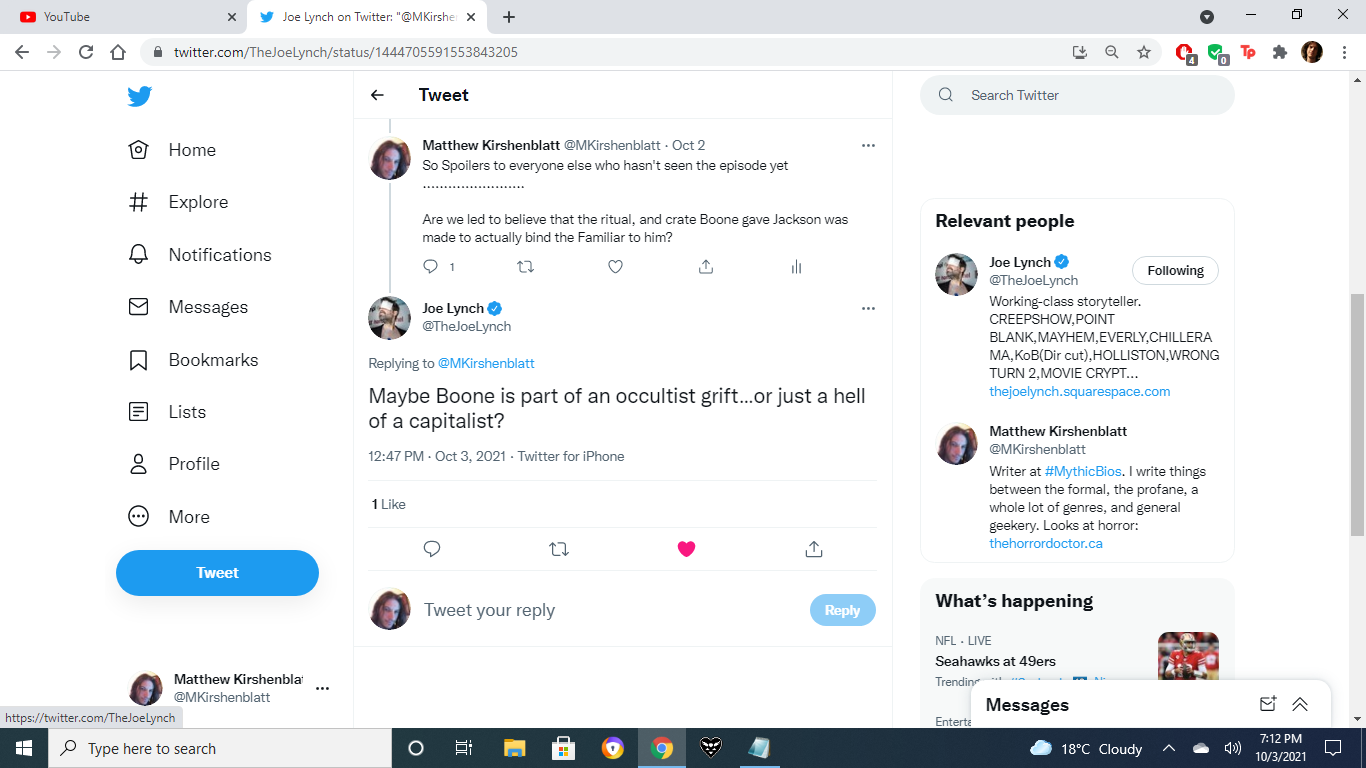
I went online — specifically on Twitter — to try to find an answer. Luckily Joe Lynch, the director himself, was in a generous and charitable enough mood, and he weighed in on the subject in the following exchange.

So, there you have it. But that matter aside, I feel sometimes I’m not as well versed in the horror genre as I should be, and there are references to other works and pieces that would help me get a better context. I will say that “The Familiar” was far more interesting, if sometimes vague, than “Skeletons in the Closet,” but while the former does have some charming, ridiculous moments, the latter definitely makes you think.

CORRECTION as of January 30, 2022: It was pointed out to me by Mike Smith, under the Twitter handle @bladeoffire1 that what actually was Bateman wanted the original Creep, in exchange for not telling the police that the original Dawn of the Dead skeleton had been dug up illegally by Lampini. It was a mistake on my part as both skeletons had white shrouds, and it was a bit convoluted. Man, if only Bateman knew the extent of Lampini’s ghoulish practices. He was no Pickman, artist or Dreamlander himself, but this observation actually improves “Skeletons in the Closet” a bit more for me.

Creepshow Commentaries Season Three: Episode 1 – Mums/ Queen Bee

Warning: Potential Spoilers for Episode 1: Mums/ Queen Bee

It’s been a long time since Season Two, and even the Specials, but after the Christmas Special we are now going into autumn, and the grim harvest, and everything that falls from there.

Chrysanthemums. In Japanese culture, they apparently symbolize death, but also immortality. Violet or purple ones also represent the wish to “get well,” while pink are all about “longevity.” I’m not entirely sure, but even if these aren’t the plants, or flowers, that feature in Rusty Cundieff’s “Mums,” the first Creepshow story of Season Three, adapted from a story by Joe Hill, these aspects can definitely be seen.

The story is a variation of what we’ve seen in karma-based stories that were ever-present in EC Comics and its spiritual successors such as Creepshow. A woman is abused by her husband, and a child — Jake — is forced to watch it all happen. His mother is murdered, and she is buried in the flower garden that she loves.

But the details are fascinating. Jake’s mother wants to take him to see his great-grandmother, his Meemaw, which is an interesting term as I didn’t know it was a common one for grandmother, and the rest of her family. She’s taking him away from what turns out to be a man, and his friends, attempting to create a “two-bit terrorist” cell that is both secessionist and Confederate-based. Later, we see them referring to a book called The Pale Horse’s Cookbook: which presumably is a compilation of American terrorist ideologies, and home-made explosive designs — the latter of which they are planning to apply to a building. Whatever the situation, in Creepshow death is always in season.

It is a well crafted cinematic narrative. At first, it almost makes you wonder if Jake’s mother — who plans to run away with him — is actually a good person, and if his father is necessarily a terrible one. There are  a lot of references to how bad his mother’s family was to her, and some “strange ideas.” The fact that Jake’s “Meemaw” is over a hundred years old, perhaps older, made me wonder if they were a family of witches, and his father was actually keeping him — or thinking he was keeping him — safe from them.

Even when his father murders his mother elsewhere, and he discovers the seeds in the packets — in the suitcase she packed for the both of them — and the emphasis on blood, I was thinking that both Jake’s mother and father were terrible people, just one in a supernatural sense and linked to her family, and the other in a more banal, abusive, “red-neck” terrorist one.

I really appreciate, however, the variation of abuser to which Jake’s father is actually depicted. He doesn’t smack his son around, or have incoherent rages. He gaslights his wife. He makes it clear that she is an alcoholic, though according to Jake she quit a while ago. But even if she didn’t, her illness and genuine pain is being used by his father to excuse his actions. He wants to keep Jake as his heir, his property, to indoctrinate into his whole idea of personal sovereign land, and make him read that terrorist cookbook. It’s your basic toxic masculinity with more than a side of guns, and explosives.

But Jake’s father fucks up. He kills Jake’s mother. And then he smoothly lies about it, pretending that she is in a “half-way house” and that she will choose “drugs and booze” over Jake any day. He also buries her in her garden, on his land, thinking the law won’t dare trespass. He is an overall terrible human being, who — as it so happens, and as also transpires — doesn’t know as much about the land as he thought he did.

Jake learns about blood. And when I say that, it’s not that he embraces the legacy of murder that his father sets for him — at least not in the way his father intends. He plants those seeds in his mother’s garden, which he doesn’t know is her grave. It’s your basic Cain and Abel situation of murder all over again, where the ground tells. But it gets told through pretty flowers. I began to wonder if Jake’s maternal family were, again, witches, that used blood magic to create plants that obeyed their will: feeding off life essence to do so.

I had it in my mind that the seeds Jake plants are like “dragon-teeth” as per the ancient Greek custom of Thebes, or in this case, his Meemaw’s teeth. Certainly, the humanoid face that appears from the ground could have been  his mother’s altered corpse, but also his ancient Meemaw who lives in the ground. But the story doesn’t go there, even though Jake and the floral entity he nurtures from his mother’s death, gain retribution on the woman who pretended to be her friend and betrayed her, the man who helped his father kill her, and his father who was ultimately going to kill him. And as Jake drives the van, with four of those plants with tiny skulls in them, to see his Meemaw, I wonder if she will ultimately be proud of the boy, and the kind of man that he can become: perhaps even under her tutelage.

Of course, we can’t talk about flowers without considering the bees that pollinate them. I mean, in the hellscape that we’ve made our world bees are an endangered species, and their extinction will mean our own. The honey they create is a byproduct of what they truly do, as is the growth of the plants that will become fruit and such to keep our ecosystem going. They do, however, prefer human aid in continuing to build more secure colonies, and reproduction is their main goal.

Greg Nicotero is the one that creates the story “Queen Bee.” It feels like that would happen if Are You Afraid of the Dark, or Goosebumps, attempted a … B movie. Three adolescent children want to see their favourite singer, Regina, give birth. She actually goes as far as taking control of an entire hospital floor to have privacy. There are so many references to “not having a father,” the name “Haddonfield,” and pregnancy in a secret place, and even a reference to the end of the world that made me thing: “Oh yes, this is going to be another Anti-Christ.”

It’s not. Instead, what happens is the stupid antics of these three kids reveal as they infiltrate the hospital to invade their idol’s privacy, that Regina is actually a … not even vaguely humanoid giant Queen Bee, who is mind-controlling staff with green eyes to facilitate her transformation into her real form, so that she can give birth. She controls them through the sounds she creates, which makes sense given how she’s also a musician.

Eventually, at the end, one girl betrays her friend — even after they are nearly killed by Regina’s drones, and one of their friends is murdered by her — because she is her “biggest fan” at all costs. The fanatical girl, Debra — as played by Hannah Keple — has an absolutely smackable look on her pouting lips. You seriously wish, at the end of this story, that she and her snooty attitude of fan-worship would be repaid by her becoming a meal for her Queen. Seriously, I didn’t love to hate her. I just hated her, though it is in keeping with some stereotypical teenage — and even some narcissistic adult — selfishness. But this is one story where treachery, and even hypocrisy as it was Debra who had them go into the hospital and knew about the whole situation because her mom was a nurse there, is rewarded. Or, perhaps, it’s safe to say that her loyalty above friends and family to her idol is what is recognized.

It’s funny. Jake’s mother, the gardener, in “Mums” is named Bloom and she tries to save her son’s life: and in an indirect way she succeeds: the archetypically feminine power of flowers consuming blood, making it, and freeing him from patriarchal control. It even helps him realize that Beth, the woman who betrayed his mother for his father, isn’t the matriarchal figure that he wants. Whereas in “Queen Bee,” even though I feel like it is the weaker of the two stories, Regina also cares for her children and kills and controls anyone and everyone to nurture them: while taking those loyal to her under the hive-structure in which she creates: her musical production linked to her own reproduction. These are some fascinating feminine themes either way you look at it: the story about a flower and her seed, and about a queen bee recruiting another drone for her hive.

And as with “Mums” — which as of this writing is misspelled as “Mumms” on Shudder — and “Queen Bee,” the journey will continue deep into the ground, where the dead go and their spirits rise, and covetous, green-eyed fans will continue to do anything to make sure that their stories continue on: and they get their pound of sweet, sticky, bloody things. 

Pat Mills’ The Retreat Bashes Back

I wrote this response to Fangoria back in June, and I thought I would share my thoughts on Pat Mills’ The Retreat with the rest of the class, with spoilers.

As a disclaimer, I’m not an expert in the exploitation genre, or any of its subgenres. As of this writing, I haven’t even seen I Spit On Your Grave. However, after reading Phil Nobile Jr.’s “I Spit On Your Gatekeeping” on the Terror Teletype I watched Pat Mills’ The Retreat at the beginning of Pride Month, where a lot of other discussions about respectability politics, and some resurgent controversies about marginalized identities in horror itself were — and perhaps still are — taking place.   

In particular, I’ve been thinking about queer exploitation, and if a slasher revenge subgenre has a place within it. I personally think it does, and I think that The Retreat is both — to paraphrase Phil Nobile  — something that portrays “queer folks fighting back against hate and violently fucking up some bigots,” and also has “nobler goals.” One thing I’ve learned in my crash-course in the exploitation genre is that it has the potential to subvert the very subject that usually gets maligned by mainstream society, even if sometimes the piece of art that results is made problematic by doing so. 

The Retreat addresses itself. It doesn’t sexualize its characters. Scott and Connor at the beginning of the film, and Valerie and Renee are in loving relationships and attempting to live their lives: the former wanting to celebrate their coming nuptials, and the latter trying to figure out just what they are as a couple after some time together. The tension is there from the start of the film, and not just because of what happens to Scott and Connor. It’s stated by partners of both couples that they feel uncomfortable out of the city, which tracks with many LGBTQ+ experiences of ignorance and fears of violence and discrimination. Moreover, in the midst of the rural convenience store with its knickknacks joking of putting putting a bullet in your ex’s head, and a man very micro-aggressively coming onto a clearly uncomfortable Valerie while waiting for Renee in the restroom, we see Renee herself going out of her way — awkwardly — trying to downplay their romantic relationship to this imposing heterosexual man, and the toxically masculine environment around them. . 

Those tensions are symbolized the most in Renee and Valerie’s relationship: where the latter wants to be open, and know where they stand as an official couple while the former — having her own experiences growing up as a rural hunter, feeling bad for the deer her family killed and not answering Valerie’s question about whether or not she had a choice in that, or indeed any questions about where their relationship is headed. Fear is already a factor there, and The Retreat goes out of its way to illuminate this trait in an otherwise loving LGBTQ+ relationship. What if they are seen? Who is watching them? 

The surveillance screens shown in the convenience store, and in the house of the extremist snuff-film homophobe hunters, are no coincidence. Nor is the deer stand Val and Renee come across on the “Gay BnB” retreat property, or even the painting of a stag being beset on all sides by a pack of wolves in the dark of the wood. This place screams of the masculine gaze, of LGBTQ+ people being objects of violation, violence, and entertainment, and as such prey to be hunted by anonymous killers of an “Alpha-male” quality. Even the one other woman in this whole film is homophobic, perhaps consumed by internal misogyny, and all of this contributes to the hunting ground outside of the safety of a more accepting city that the protagonists must escape. There is nothing titillating about it. What should have been a safe space, a place of joy between friends, brothers and sisters — of family of the made-kind — is, literally, a trap.

But perhaps some of this is the wrong perspective to take. Maybe the titillation is not sexualizing or objectifying the LGBTQ+ characters in this film, but rather the cathartic element of watching the protagonists escape their predicament, and turn the rules of the twisted game against their homophobic kidnappers and assailants. There is certainly a historical precedent for it. Documents like the Queer Nation Manifesto, Michael Swift’s “Gay Revolutionary,” and even the Queer Nation banners of “BASH BACK” — along with other bodies of thought — advocate retaliating against systemic violence with its own methodology: going as far as to take back the slur of “queer” to make it mean an outside agency or power that puts the tool of the oppressor in the hands of the oppressed to destroy the entire structure. 

Of course, the label of queer — taken back or not —  is still contentious among the LGBTQ+ crowd in and of horror. Certainly, Kirk Cruz — from The Mutant Fam fan-run community — discusses these details, and his own experiences growing up LGBTQ+  and dealing with the horror genre and scene on Twitter, but I feel like The Retreat not only covers a need for burgeoning — and veteran — LGBTQ+ people to vent their frustration and fear against social structures that still persecute them, but it comes from the very spirit of Pride and the Stonewall riots that led to the former’s creation. Sometimes, talking and reasonability — respectability — can only go so far. Even Renee attempts this in the beginnings of the film, and actually hesitates in killing the homophobic wife while she’s down. She and Val consistently beg, even plead, for the hunters to let them go, as did Scott and Connor before them. It’s only when Renee tells the leader of the hunters that she doesn’t even know what he looks like, that he can just let them go, and he takes off that dude-bro macho camouflage skull mask — perhaps a shot at homophobic anonymous elements online, especially given that he and his buddies make snuff executions of LGBTQ+ people for online consumption — and when his wife proves to be just as sadistic as he is, that’s when Renee realizes she has to survive at all costs. That’s when she, and Valerie — who deliciously mixes chemicals together into something acidic against the toxically masculine man who cornered her at the store, and killed her friend in front of her (I just love poetic justice) — realize that the only way they will live if they kill the people trying to murder them. 

The pay-offs are beautiful. Not only is there the aforementioned getting his face burned — albeit not as much as I would have liked — the wife, who likes to watch the violence voyeuristically through cameras gets a screen smashed onto her head, turning it into pulp, while the man who orchestrated the whole thing is shot by a bullet from the deer stand he used to hunt, and his throat slit on camera by the lesbian women he hunted. The tools of the oppressor are turned against him, and the spectacle of ending lives — Scott and Connor being portrayed as more than victims or casualties of cruelty in this film, but as human beings that love, and are loved — is thrown back in the face of the silent, cowardly, unseen spectators and enablers of the Dark Web as love lives. 

I also love the fact that there is nuance in the film. We see the leader of the hunters kill another kidnapper, who doesn’t want to go along with the murders — who just wanted to “scare the queers.” Toxic masculinity and homophobia turns on itself too. And even at the end of the film, Valerie and Renee make it out. They get to that pick-up truck with those two male passengers. You are expecting something horrible, for these men — whatever their sexuality — to turn on them. It gets even more tense when Renee finally, after that entire ordeal, kisses Valerie in the back of that car in full view of the driver’s front view mirror. She feels no need to hide, or be afraid anymore. She’s faced the demons, worse ones, she and Valerie. They’ve fucked fear, and now they want to embrace love. And then, the film ends and as far as we know the protagonists are safe. 

It was a nice, straightforward revenge slasher film with a solid LGBTQ+ theme. No twists. No honey-pot subversions like you had with Get Out, and the women live at the end. I’ve watched short films such as Blake Mawson’s Pyotr495, and Bears Rebecca Fonté’s Etheria Film Festival 2020 entry Conversion Therapy with similar themes, but while the former has supernatural elements and the latter has twists and focuses primarily on the torture and punishment of a high-profile homophobe, Pat Mills’ The Retreat fleshes out its characters in the trap of what should be a safe place turned violent — a microcosm of social factors against LGBTQ+ people — and shows that despite terror loss, they survive, and persevere. So, I definitely think that while The Retreat  has that “cathartic homophobe bashing” element, it uses its own self-awareness of exploitation to comment on exploitation and use it against itself while telling a story about love and survival, and that is a story that is — and will always be — relevant. 

Fuck Cancer: James Wan’s Malignant

I didn’t know much about James Wan’s Malignant going into the film. In fact, I wasn’t even sure I was going to view the film at all. It was really one of those situations where everyone on social media, in various horror circles, was talking about the movie — or pointedly not focusing on the details of the piece so as not to reveal spoilers, or the twist — that, eventually, with nothing further to do that Friday evening I had to check it out.

Before all of this, all I knew of Malignant was a spike to the head. Literally. The image of a blade inches away from a woman’s eyeball. Really, as you watch the film, it sums it up fairly well. So yes: this is going to be full of spoilers, a twist straightened out, and a malignancy dissected. 

I like how Wan just gives us Gabriel. He doesn’t fuck around. There is an entity in a Research Hospital back in 1993 that seems to have telekinetic abilities, or influence over electricity, and the strength to maim and slaughter full-size adults. There are also children’s toys everywhere in his room, and the hint of some malformed creature seems to be connected to a child. The doctors manage to incapacitate him, followed by the words “Time to cut out the cancer.” And then, we are in present time — perhaps 2021 — where the events of Malignant unfold: where Gabriel somehow returns, and the plot is slowly unveiled.

Wan isn’t trying to be subtle. He is practically spoon-feeding the details that you need to either figure out the twist of the entire film, or at the very least have it all make sense when the reveal occurs. I had a few ideas about what Gabriel was. Gabriel, the name, is that of an angel: the archangel who appears to the prophet Daniel to explain the nature and meaning of his visions, and also apparently the guardian angel of Israel who guards it against the angels of other nations. Angels are not attractive, or humanoid beings in ancient Judaic culture, an idea of which the Gabriel of Malignant definitely follows, but he is no celestial or infernal being, even if his sister-host Madison calls him the Devil. Yet he knows all about visions, and all about explaining or elucidating reality and events to someone else.

It’s no coincidence that Madison continues to have visions of people — and as it turns out specific people — being murdered, except instead of her seeing them before they happen, she sees them afterwards. It’s like a delayed reaction, or perception of events. Basically, when you watch the scenes melt away and Madison can only observe them helplessly, you are cinematically seeing the very definition of the term “unreliable witness.” 

For a little while, I was taken a bit off track, though mostly in the beginning. Originally, I thought Gabriel was some kind of sentient tumour like that of the creature in Clive Barker’s “Son of Celluloid” that fed off of negative emotions, and transferred between hosts. Certainly, the fact that the film begins in Simion Research Hospital made me wonder if he was some kind of research discovery or experiment that the staff there simply transferred to another child, or if he was just one example, and the rest of the film would be finding others of his kind. I guess, like a few people in other horror social scenes have already mentioned — including myself — I was applying Frank Henenlotter’s 1982 Basket Case to a lot of this, even at this point in my viewing experience.

Then I was confused for a time in that Gabriel was very clearly linked to Madison, and I thought that perhaps Gabriel was one person, and that the researchers were able to excise the Gabriel-tumour, and make his host body transgender: with Gabriel haunting, and possessing Madison as a spirit. But this didn’t add up as Madison could clearly become pregnant though, granted, it was also possible that Gabriel could have been the masculine gender he chose before the scientists and doctors lobotomized him, or something to that effect.

But it was far more streamlined than all of that, as it became more apparent what was going on. Like I said, Wan isn’t subtle. We find out Madison is adopted when she’s talking with her sister Sydney. Simion, from the Simion Research Hospital, is a Romanian spelling for Simon which is Hebrew for “listen” and “hearing,” while it is a Classical Greek adjective for “flat-nosed.” Now, look at freaking Gabriel with his vestigial lack of a nose when he and Madison are eight, and after the surgeries dealt to her when his face emerges from the back of her skull. And then consider, as well, how he communicates with her: telepathically through their shared brain in which Madison “listens” and “hears” what he has to say, and what reality he is dictating to her. 

I didn’t know about Simion at the time, but given the name of Gabriel — which is about as elusive as the name Belial with its own meaning of “without worth” and being associated with the Devil — I knew it had some significance. So speaking of Belial and going back to the comparisons between Basket Case, and Malignant, there are obvious similarities. Gabriel and Belial are teratomas — or what are theorized to be Fetus in fetu, basically parasitic twins. At least, that’s what it seems. Belial himself is flat-out considered another being, Duane Bradley’s twin, even if others think he is a monster, or a growth. Gabriel is seen by the doctors and specialists as a mutation linked to Madison Lake’s body and nervous system. Of course, there is one more obvious difference between these characters and their plot points: Duane and Belial never wanted to be separated, and even when they were and they conflicted with one another, they still loved each other in a warped and twisted manner, even if Duane tried to kill Belial in the first film. Duane often carried Belial around, after he was cut away by inexperienced surgeons and con artists, to get revenge on the people that did that to them.

Madison and Gabriel are still connected. The doctors weren’t able to fully remove ‘the tumour” that is Gabriel, not without damaging Madison’s brain, or making her comatose for the rest of her life. There is no love between Madison and Gabriel whatsoever. Gabriel terrorizes her, taking over her body and functions, and making their body do whatever he wants. Any attempt at love or affection from Gabriel’s part is always a deception to attempt to kill or destroy someone else. Gabriel takes away, or deeply compromises, Madison’s agency whereas Belial resents not having Duane’s life, and Duane is angry at having to take care of Belial while also furious at the world for thinking the latter is a monster. Both sets of siblings in their films do have a telepathic link with their counterpart, though Duane’s is when he sleeps, and Madison’s state of consciousness is always pliable to Gabriel’s manipulations. And although they don’t go into it with Duane and Belial, in order to keep himself alive, Gabriel needs to absorb nutrients from Madison’s body as a child and, when she is an adult, from the fetuses in her womb: using them as batteries that he drains to keep himself alive in the background when she’d unconsciously repressed him after her time in the hospital.

But with these pleasant comparisons aside, there is one other thing Gabriel can do differently from Belial aside from hijacking his, and his sister’s body, which is electronic manipulation. It is basically psychokinetic in origin. He uses radio waves, or electricity to speak to anyone that isn’t Madison. It’s fairly clear that the reason he can do this is due to all the electro-shock therapy — or torture, if you’d prefer — that he received from the Simion Hospital when the doctors were forced to pacify him when he became violent with Madison’s body: on her, and others. Eventually, even electricity doesn’t hurt him anymore in 1993, to the point where he has influence over it, and can cause disruptions in devices powered by that energy.

It is a little clunky, but this power doesn’t come from nowhere, and as a creator myself I was more than a little disappointed that Gabriel doesn’t use this power more often when he commits to his assaults. No. Gabriel is an up-close and personal slasher-killer. I don’t know how he does it, or did it, but perhaps due to his access to Madison’s limbic system, he can control that body’s pain and damage threshold. And, more than that, he alters their reflexes in inhuman ways. Perhaps he has control of their adrenal glands, and can increase their physical strength, endurance, stamina, and their reflexes. At first, I thought — and I already knew he was taking her body, or their body — that Gabriel wasn’t used to controlling an adult Madison’s body with how awkward he was moving. But then it occurred to me as I watched the film, that he bent her joints backwards to match where his face emerges from behind her skull. He isn’t able to do much about her feet, but he seems to adapt to that with crawling, and a lot of jumping. Human beings can adapt to various environments, and disabilities, and as such Gabriel in this fictional world is no different. 

Now, as for how Gabriel has his knowledge of the secret levels of Seattle, that is fascinating. You see, I think that both he and Madison had this knowledge. They were given to the Simion Research Hospital by their fifteen year old mother Serena May. Madison’s original name was Emily, before it was changed by her adoptive family. She and Gabriel were both eight when they were given away because Serena’s religious mother refused to take care of them, regardless of the fact that they were the result of rape. Serena’s mother blamed her, and the Devil for what happened, and the abomination that her children are: to the point where even Serena calls Gabriel that. Fascinatingly enough, Serena actually named Gabriel as we find out towards the end of the film where she calls him by that name and apologizes to him for how she abandoned them. Serena May is a tour guide through the lower levels of Seattle: the Underground that the original city of Seattle became in the mid-nineteenth century when it was burned, and the people decided to rebuild around, and over it: much like how Gabriel’s limbs had been cut off, and buried inside of the former Emily turned Madison.

All of these Jungian parallels, including Gabriel capturing Serena in Madison’s attic aside, Serena May seems to have a tremendous enthusiasm for the Seattle Underground. Perhaps she even had it when she was fifteen, and spent that time telling her children about it. This could be where Gabriel’s knowledge, along with his sense of vengeance for his mother abandoning him, came from.

At this point, we are past talking about the clues that lead to the twist which anyone who has seen many horror films or read such stories, can predict. I’m mostly talking about how it all comes together. From the videotapes Sydney retrieves from the abandoned hospital that shows the former Emily being able to see everything that Gabriel does in one of his uncharacteristic moments of cooperation with the doctors, to the family tapes where Madison is talking to Gabriel who wants to kill Sydney in her mother’s womb, and the revelation that Madison’s attic may well connect to the Seattle Underground in a large bit of metaphor. Hell, even Gabriel’s blade is made from the Award he stole from Dr. Florence Weaver: the emblematic blade of the whole film.

I want to write about Gabriel’s downfall. He is malicious as all get out. You can understand it to an extent. Imagine being born attached to someone else’s body. You can’t leave them, even if you want to, no matter how badly you want to be somewhere else. Your mother abandons you, and considers you a monster because of the way you look, even though she named you after an angel. She hands you over to doctors who routinely drug you, and torment you with electricity. You know that everyone thinks that, at best, you are a tumour or a deformity of your sister’s, and at worse you are a monstrosity they want to either curb, sublimate, or destroy. And then, when your rage gets too much, they’ve had it with you. These intrusive people your mother handed you over to essentially murder you. They cut off your arms, your legs, they take off your head such as it is, and they push the destroyed, ruined remnants of you deep into your sister’s skull, and bury you alive. Never mind the fact that you tried to kill them: that was just revenge, perhaps even self-defense, or you just didn’t like them.

Then they take your sister to another family, where she slowly forgets about you, to the point of pushing the phantom of you down into your body: not just her body, but yours. You know that once she sees her adopted sister, once she is exposed to Sydney, she will completely drown you out, and you will exist in a living death in a body turned into a prison that you can’t control. So you bide your time. You consume those “parasites” in your body to regain strength. It’s just as well, as you know if she didn’t get pregnant you would feed off of her too much, and potentially kill yourself as you share the same body. But then your sister’s abusive husband slams the back of her head — namely you — into the wall. And you. Will. Not. Have. It.

It’s been thirty years later, practically, as scientists and doctors attempted to mutilate, and bury you alive. All that’s left of you are vague memories of a traumatic imaginary friend, some family tapes of your sister “talking to herself,” the tapes and folders left in a rotting, abandoned hospital, and the bad memories of doctors. You remember everything. And you take your body, because you are the only one who really knows how to use it, to the nth degree. And it is all because Emily — or Madison — is too weak-willed to do what must be done.

And this is where Gabriel fucks up.

You see, Gabriel forgets that he shares a body. It isn’t his body, but also Madison’s, and it has been hers for years. Madison has had years of love. Her pain still affects her, the trauma is still there, and perhaps it affects her life’s decisions. Or maybe assholes came in, and took advantage of her kind nature. She is a nurse, and tries to help people.

There is a lack inside of her psyche, however. She wants someone she’s blood-related to in order to fill that void. Unfortunately, she doesn’t remember until much later that she already had that, and it was hell. She is all too ready to leave her abusive husband, she wants to have one of her children survive, and she loves her adopted family and her sister. But Gabriel threatens all of that, but it’s not until she’s in a holding cell that she finally begins to understand that Gabriel’s gotten even more adept at altering her memories: that he is holding her in the prison of their body now.

What happens is something beautiful. One thing I absolutely adore about Malignant is the unapologetic mass-murder. It’s true. Gabriel could probably destroy people with electricity, or short out more technology as he does in the hospital at the end. But he goes in, up close and personal, and slaughters every prisoner and police officer in his way. Hell, he doesn’t even have to kill everyone in that precinct. He just … enjoys it. It’s this ugly catharsis after seeing Madison get imprisoned, and tormented by the other inmates, and disbelieved by police who even saw a phone activate and the power go out thanks to Gabriel: and he likes to do that, cutting the power out of a place, and going to town on it as he tried to do back in 1993 when he was much younger.

Yet this fucks him. Because Madison is older, and she has something to fight for. The film could have been so easy. Gabriel’s defeat could have been Madison committing suicide, or letting someone else kill her. But Madison has had enough. This is especially true when, as Gabriel tries to murder Sydney, when she tells Madison to wake up and realize what Gabriel did to her unborn children: how he devoured them to keep himself alive. And just as he is going to kill Sydney and their birth mother, Madison traps Gabriel in the same prison he always put her in: altering his memories, and stopping him.

He claims that he will return, of course. This doesn’t surprise Madison. But she claims that when he does return, she will be ready for him. And this is one of the strengths of this film. Not only do we get the chance for a sequel, but we realize that the power in this film isn’t knowing the twist. It’s seeing the characters come to that realization, to all the discoveries, and overcoming the challenges that come to this point. Madison’s mother finds out the truth, along with Sydney, and and instead of leaving her to Gabriel’s devices, they still love her. Sydney goes out of her way to know more about her sister, and save her. It gets to the point where she won’t shoot Gabriel because she knows it will kill Madison.

And Madison ends up achieving self-agency. Her abusive husband is dead. She remembers Gabriel, and what the doctors did to her as well as him. And she stops him from hurting the family she loves, and even the woman that abandoned them. She thinks to herself “Never again.” She takes control of her body, which is still altered because it isn’t just Gabriel’s body and physiology but hers. She still has that incredible strength. She can control it, and the speed, and possibly more. Hell, and I am saying that a lot since we are talking about defeating a Devil, Madison could simply deprive Gabriel of sustenance: slowly shrinking him over time, perhaps if she still wants a child and keeps him locked away, into nothing.

Gabriel is rage and hatred and fear of abandonment. Even internal misogyny. He is a parasite that threatens to make her wither away while he grows malignant, and strong. Madison uses the tools of her oppressor to defeat him, and whittle him away. As was said at the beginning of the film, he is the cancer — the word and breath of him threatening to grow, and spread — and while he will never necessarily be gone, Madison has put him, and everything he stands for, into remission.

Spoiling of the Sweet: The Hives Between Nia DaCosta’s Candyman

In response to a Tweet talking about Candyman, I said:

“What I love is that build up and the false Candyman right before the real one just comes in, and you hear his voice echoing in Helen’s mind, booming, but also quiet. And he is so calm. So collected. And Helen is entranced by him in terror, and awe. He only loses his cool at the end.

“But as Tony Todd recites those delicious lines from “The Forbidden,” you feel that power resonate in a way not unlike, but not like buzzing. And you know, without a doubt, that he is in control here. He is the nightmare. And is bringing her home.”

And these Tweets, and Facebook comments got me some pushback, as some people believed I was spoiling Nia DaCosta’s Candyman film — directed and co-written by her, Jordan Peele, and Win Rosenfeld where, in actuality, I was referring to Tony Todd’s performance as the created urban legend in Bernard Rose’s classic 1992 film. At first, I was annoyed at people not bothering to read, or examine what I was saying more closely, but now in retrospect I can’t particularly blame them.

I mean, they are both called Candyman even though DaCosta’s film is the remade sequel to the events from Rose’s movie: possibly creating a new continuity diverging from its previous sequels. And both films share beats with the original 1986 short story from whence it came: Clive Barker’s “The Forbidden.”

I’m very interested in the creation of myths, and stories. Folklore, and more contemporary urban legends, and even electronic creepypastas have different iterations of themselves, though like a twisted Campbell mono-myth they come from an original narrative, or at least common human themes. Many people have already mentioned how Clive Barker’s Candyman differs from the one transmitted into the films. He is more of an elemental, wilder being, like some kind of Celtic god of sweets and blood: the painted, end continuing result of a class of people so trapped by gentrification and class that they glorify the horror and violence they can’t escape, worshipping it to stay it off, but also feel a sense of importance and perhaps even catharsis with the sacrifice of innocence, and death of an outsider. He also has a hook for a hand, just like “The Hook” or the “Hookman” urban legend, but being situated in the Spector Street Estate in England, and having British almost pagan roots when you consider his almost agrarian characteristics  with the bees inside his body. And, unlike the Candyman played by Tony Todd in Rose’s film, he doesn’t have the Bloody Mary element: in that you don’t need to say his name five times in front of a mirror to summon him.

He will come to you if you search for him, or attempt to dissect his myth. More often than not, he is content to simply be an idea and let others tell stories about his atrocities, his cautionary tales, and occasionally have someone enact murders in his name: unless, of course, an outsider like Helen Buchanan — a cold, detached and rather shallow student of “sociology and aesthetics” in this short story caring only about proving herself right, and even her sense of conscience in exploiting the suffering of a lower-working class neighbourhood — begins investigating too closely. From Butts’ Court, to Ruskin in Spector Street, murders and mutilations are attributed to this figure, but they only become more immediate and real to Helen when Anne-Marie — the single mother she’s been talking with in her flat about the graffiti and the homicides — is caught in her own tragedy as her infant son Kerry has his throat slit by the Candyman himself. In fact, the reader doesn’t even see the Candyman’s name mentioned until later in the story, and he only appears himself far towards its end. We never get an origin story for this boogeyman, as he simply exists in the hearts and minds of the people of Spector Street and — eventually — Helen’s as well.

Helen becomes interested in this figure, past her love to document graffiti as some kind of urban cultural or historical art, mostly to spite her husband Trevor: who she has a jaded, and often adversarial relationship with, as well as her equally shallow and insincere academic peers and friends. Trevor already cheats on her, with several women, and she is just over it. Barker is not flattering to anyone in these depictions: not even Anne-Marie who, for all her grief and then her nervousness over Kerry’s death, becomes almost effulgent during his funeral: as though she is, from Helen’s perspective, the centre of attention for the first time in her whole life, or made illuminated by this ritual sacrifice of a child. The whole neighbourhood is in on placating, and worshipping this Candyman — this immediate specimen of primal and bloody divinity, forged from visceral and personal tragedy — and even Helen, deep down, feeling distant and empty in her own life of background homicide news and papers, wants to be a part of the story. She wants immortality. 

What you fear is what you desire in Clive Barker’s Books of Blood collection at least, where “The Forbidden” is included. Helen ends up trying to find Kerry’s corpse, which is secretly held in the pyre the people are building — to bring his body as evidence to the police to prove there is a conspiracy going on at Spectator Street — only for the Candyman to hold her there, and they burn together under the flames of his worshippers. Murderer, victim, and child sacrifice are made archetypes, and Helen — deep down in a horrible place — secretly wants this. The story ends with Helen wanting to haunt Trevor, in a line not unlike that from Emily Brontë’s Wuthering Heights and it all has this particular Wicker Man feel to it when you look at how Helen is lured into the story of the neighbourhood: albeit more enticed by a lack in her life, than a stringent sense of duty. 

Then we get to Bernard Rose’s Candyman. Most of you all know this one. Rose moves the Candyman’s location from Liverpool, England and Spectator Street to Chicago, in America and the Cabrini-Green housing project: a Black neighourhood abandoned by white society, and terrorized by violence and crime. It is a film whose themes focus on both gentrification, and race. Helen Lyle is, straight-out, a semiotics student of Chicago and is fascinated with urban legends: wanting to do a publication on it with her friend Bernadette “Bernie” Walsh. Bernadette is in the Clive Barker short story, but she is mostly just someone in a conversation about the murders in Spector Street, and nothing more is really said about her. In Rose’s film, she is a Black graduate student and best friend of Helen’s and — for the most — seems to have more common sense, or at least street-smarts than she does. There is a bit of the stereotypical “sassy Black woman” combined with “the Black best friend” trope.

Helen is more sympathetic, however, and seems genuinely interested in the urban cultural legend of the Candyman, and its implications. Anne-Marie McCoy, a single Black mother, with her son named Anthony, are also more humanized than in the short story. Cabrini-Green doesn’t worship the Candyman. Its residents are terrified of him, and Anne-Marie is absolutely and ferociously protective of her son. We find out that the Candyman was once the son of a slave, who was educated at the finest schools, and became a master painter: an artist that, unfortunately in the 1890, fell in love with a rich man’s white daughter, got her pregnant, and was tortured and murdered by a lynch mob organized by her father. He gets his hook after having his hand cut off with a rusty saw, he’s stung to death by bees, and his ashes are scattered all over the site of what will become Cabrini-Green: a ritual of hatred laying the groundwork of Black generational suffering to come due to gentrification, and his restless spectre.

In a Fangoria column and interview Problematic Films: In Defense of Candyman (1992) Sean Abley and William O. Tyler discuss Tony Todd’s Candyman, in which Tyler notes his “black and white checkered pants that you see line cooks wear” combined with his fur coat symbolizing a working class man or street denizen “elevated to this theatrical, supernatural being”:  a fairly different depiction of him from Barker’s version.

Helen and Bernadette are fairly methodical, in that Helen realizes her apartment is sister to the one in Cabrini-Green where a woman reportedly killed by the Candyman: realizing her mirror is attached to another room. This same mindset works against them as they both utter his name, with Bernadette doing it four times, and Helen completing the fifth. This is where the horror icon develops. We also get a sense of the gentrification and the ghettoization of Cabrini-Green from Helen and Trevor’s more affluent neighbourhood: even though they were both made by the same developers. This similar, but mirror-opposite — if you will pardon the pun — arrangement gave me some major Jordan Peele’s Us vibes, which given what we are talking about makes sense after the fact.  

In Fangoria Volume 2, Issue 12, in his article “Reconsidering Bernard Rose’s Candyman,”  Richard Newey focuses on “the mirror component of the urban legend”: on Candyman being a projection of white guilt and I would add gaslighting: as if all the violence, hatred, and fear white society creates doesn’t exist, and it is all in the minds of its victims. Newey goes on to say that Helen Lyle is “a tourist of the Black American experience who seeks to devour an aspect of Black culture and reduce it into pedagogy [… ] she uses academia as a means to catalog and quantify Black suffering.” It reminds me of the schoolteacher in Toni Morrison’s Beloved who goes out of his way to methodically write down and quantify the characteristics of the slaves in the plantation of Sweet Home: though with less conscious and cruel intentions, but still paternalistic in a lot of ways.

Helen’s society — where she comes from — informs her behaviour, and she doesn’t realize its consequences to her, and those around her, until she interacts with Cabrini-Green. Helen summons the Candyman by trying to find him and calling out his name. She investigates the apartment room, the mirror to the one across from her, and finds his shrine there: except it is not in a maisonette or flat, but another room not far from where Anne-Marie and Anthony are staying. But after “disproving” his existence by being attacked by a gang member with a hook, and betraying the child who trusted her with the secret of the public restroom where the mutilation of a developmentally challenged young man took place — in both the short story and this film some time back — the spectre himself is called upon to intervene directly.

And he makes her face her actions, and the influences that brought her there. He tells her to “be his victim.” And then it occured to me — after reading Newey’s article what that might mean in another context: that in framing Helen, perhaps even possessing her, to kill Anne-Marie’s dog, to steal and hide Anthony away, and to murder Bernadette and the psychriatrist Dr. Burke, holding her in a mental institution — that perhaps she begins to know what it is like to have crimes attributed to her by the system that once benefitted her, and be punished for it: showing her her privilege and what it is like to be scapegoated. If the Candyman functions as a mirror, as a horror created by white racism, he is the oppression made by society now oppressing Helen, a white woman, who dared to summon him for her interests: to let him in.

This especially works if Helen is truly the reincarnation of the woman he loved and died for. It is no coincidence that Rose changed Helen’s last name from Buchanan to Lyle, which according to a quote from Barker’s in Phil and Sarah Stokes’ “Say His Name” was the name of one of the people that made “a golden syrup” in which “The makers of this syrup put on their can a picture of the partially rotted corpse of a lion with bees flying around it, and the Biblical quote…[from Judges 14: 14.] “And he said unto them, Out of the eater came forth meat, and out of the strong came forth sweetness.” Not only is this origin for “Sweets to the sweet,” even though Barker quotes it from Hamlet, but one of the makers of this English honey is called Lyle, to which Rose probably made a homage. This links Helen far more directly to the Candyman, and his entire legacy. She is the sweet he died for, and also the sweet made by the society that killed him.

The overall film mythology here is that of Father, Mother, and Child: something of a twisted holy trinity or a thwarted life, though the way this story ends is Helen attempting to save Anthony’s life — and succeeding — at the cost of her own, only to become a cautionary tale and murderous entity in her own right after supposedly destroying the Candyman with fire in the pyre. The people of Cabrini-Green seem to exorcise him, even if some had once worshipped him or tried to keep him at bay with offerings of candies and razor blades, and replace Helen as their saviour-figure: with the problematic elements of that fairly clear in her being white. 

It is interesting to consider that, like William Marshall with the character of Mamuwalde in Blacula before him, that figure also being the result of racist violence turning a Black man against his own people, representing the perpetuation of hate in a cycle, Tony Todd apparently created — or had great influence expanding on — the Candyman’s backstory. And while we are looking at concepts,  according to Phil Nobile Jr. in the Fangoria Terror Teletype of August 27, 2021 in the script that existed before Nia DaCosta was tapped to direct and co-write the 2021 Candyman, it was Helen — who had killed her unfaithful husband that summoned her — that attempts to continue the cycle of resurrecting Candyman: through his chosen host.

Nia DaCosta, however, does something a little different. It is all about a piece of art. It is all about a ritual. It is all about a structure, and a cycle. She tries to show us, to truly illustrate, how the candy, and its rot are made.

DaCosta goes back to the hive, and much farther back than you might think. She follows history, shifting most of the residents of Cabrini-Green out, and leaving it a shadow of what it is in 2019: attempting to “white-wash” it further, but instead of focusing on an apartment building, we focus more on “row-houses” not unlike the flats or maisonettes in “The Forbidden.” She refers to Helen Lyle, but distorts her story from the perspective of the storyteller’s: making the other characters believe she was a white student that went insane, attempted to kill a child, and ended up burning herself alive in a pyre in Cabrini-Green when she failed. Instead of being remembered as a victim, or a saviour, Helen becomes the monster that she changes into at the end of the first film: at least, to those who weren’t there in 1992. DaCosta retains the name of Daniel Robitaille for the Candyman, taking it perhaps from Farewell to the Flesh, but in a way that mirrors — again, that unintentional pun — the foreshadowing of the haunted apartment room with Helen’s from the 1992 film.

But if Helen’s parallel apartment was the setup, the beginning of DaCosta’s film is a dress rehearsal. She takes us back to 1977, before Rose’s film, but long after the events of the 1890: to show us a whole other kind of Candyman. It is startling, at first, but later as the character of Burke — perhaps named after the doctor killed in the previous film — explains to Brianna Cartwright, and her boyfriend Anthony McCoy before her, Sherman Fields — a developmentally challenged, homeless, but kind man with a hook for a hand — was beaten and killed by white police on suspicion of planting razor blades in candy that injured a white girl.

However, it is only after he’s dead that the razors continued to appear, and it was realized that Fields was innocent. But he became the Candyman, and was summoned by Burke’s sister in the bathroom: killing her. Even throughout the film, when he appears to someone, candies are laid on the ground: filled with razors, a bit of a different slant on both Barker’s and Rose’s Candyman characters. This is not contradictory with Daniel Robitaille’s legend, or apparently others after as according to Burke Candyman is “the whole damn hive:” a collective of Black men and boys tormented, destroyed, and distorted by white racism to haunt the area of Cabrini-Green.

It makes sense. Gods themselves, going back to the first elemental Candyman of Barker’s creation, have different appearances, aspects, or facets depending on what roles they are supposed to fulfill, and based on from what areas they originate. A more contemporary example of this is how the television adaptation of American Gods turned William “Froggy” James into a furious ghost haunting Black people in Cairo, Illinois for not preventing his lynching and mutilation in 1909. That pluralistic approach to the urban legend — this myth — and the racist violence and trauma creates a cycle. It is certainly no coincidence that it is told that Fields’ face is beaten so bloody it doesn’t exist anymore: as if he could be any Black man at this point.

And Anthony McCoy fits into this archetype. The 2021 Candyman of DaCosta does match the beats of Rose’s 1992 film. Helen Lyle sought urban legends as a semiotics graduate student, but Anthony McCoy — the child that she saved from the fire and the Candyman — is a visual artist attempting to jog himself out of a creative slump: a painter needing inspiration. It all comes full circle, when you consider that Daniel Robitaille was a portrait painter himself before his murder and destruction, and subsequent transformation into the Candyman. Nia DaCosta, in her interview with Natalie Erika Jones in Fangoria Issue 12, explains that some of her central themes in this film are sibling relationships, absent parents, and the emotional burden and labour of Black women. 

And while she says this specifically towards Brianna Cartwright and her own past with her suicidal father, her emotionally distant mother, her relation with her brother Troy, and dealing with Anthony’s deteriorating mental state, you can easily apply this to Anthony as well. The Candymen — or the Candyman hive — are all brothers. They are all men murdered and remembered as victims turned into monsters by the system and belief that made them. Anne-Marie, Anthony’s mother, lied to him — or omitted — his kidnapping and kept from him his lost history with Cabrini-Green. You can even argue that Helen and the Candyman are  Anthony’s absent surrogate mother and father, the former having attempted to save his life, and the other endeavouring to take it and make it his own, their spectres always there even if he didn’t remember them personally. Even Burke, the laundromat owner who he goes to for information on the Candyman — who turns out to be his worshiper, a follower who wants to resurrect him — seems to fill a paternal role he never had: as we don’t know what happened to his biological father. 

The loss of Anthony’s history, the gentrification he grew up in, the inherently racist society he struggles against, his stereotypical absentee or dead Black father, and an estranged mother combined with the sensitivity of his artististic sensibilities, all become like the background buzzing — the “white noise” of violence and fear — we hear throughout the entire film.

The Candyman’s bees seem to always be there. And even they, these harbingers of the spectre, are not immune to the cycle of destruction. DaCosta tells Jones that she wanted more emphasis on body horror in this film, and this is fulfilled when a bee stings Anthony’s hand: a sting that injects a venom that slowly infects him over time, and incubates more of the creatures inside of him. But before that, the bee loses its stinger. It does, and Anthony watches a swarm of ants consume the helpless being: a microcosmic version of the puppet dioramas where white police murder helpless Black men and boys who become part of the Candyman. Interestingly enough, that ant swarm is a callback to Barker’s “The Forbidden”: where Anne-Marie is dealing with an ant infestation — the insects supposedly coming and surviving from Egypt — in the pipe system of her flat, and the entire Estate. She tells Helen, in that story, that the whole Estate is “infected” by them, and that no one will fix the problem. It is an interesting metaphor for an intentionally broken system, and a great coincidence or bit of creative synchronicity if nothing else.

Anthony himself tells the less than covertly racist art critic of his show about gentrification and touches on the idea of “white tourism” into Black spaces, talking from personal experiences, while Burke — when ranting to Brianna about the need for a Candyman — mentions the rot that occurs from white society: like an infestation you can’t stop.

Beats and mirrors. As DaCosta states to Jones: “I think it’s the cyclical nature of that story in particular, but also stories and urban legends in general and the place they have in our communities as a way of scaring us, but also searing us to protect us from it happening again. Like a warning, you know? The more horrifying the story is, the more important it is that we keep telling it.” There is definitely a transformation, or a broader understanding of the figure of the Candyman in DaCosta’s film from the rest of the mythos: for while he represents the power of fear and stories in Clive Barker’s work, and a cycle of hatred, and even internalized racism through the agency of Black male violence on Black people in Rose’s work, Burke — and through him DaCosta — wants to reclaim that power: to use it to defend Black people, or redirect it against the white system that created it.

But there is something else that DaCosta said in her Fangoria interview that sticks with me. She says, with regards to the lines she wants to cross with her film — as “a psychological brutal thriller” and a body horror work — that she doesn’t “want to traffic in Black pain to have a career.” It is something that comes up in the film narrative as well. Anthony, arguably, utilizes this to create his exhibit and attempt to get back into the art world from behind Brianna’s shadow, but it turns out that what he’s really looking for is a truth to fill the emptiness and anger in itself that he finds in the worst way possible. The story of Cabrini-Green is Anthony’s story, and Black pain is Anthony’s pain which he uses to create his art until it corrodes him from the inside, and despair takes him at the end. And you realize, that what we are seeing is not only the dissolution of a protagonist in this process, but the creation of the monster: especially as we see Burke cut off Anthony’s rotten arm with a saw, and replace it with a hook right in front of Brianna’s eyes: intending her, a Black woman, to be his first victim. His first sacrifice.

Yet Brianna isn’t going to have that. I wondered, a few days after I watched the film, just what Brianna’s function was in the Candyman mythos DaCosta creates. She has her own backstory, with her tormented artistic father who kills himself in front of her, a mother that leaves her to her own devices, a gay younger brother she feels protective towards, and seeking her own career while feeling like she has to take care of her boyfriend Anthony. She isn’t like Bernadette Walsh. She’s not a sidekick or a victim to be fridged for Anthony’s development into a monster. Brianna is a survivor. She’s had to remain strong, but she doesn’t let herself become the victim of male violence. And she doesn’t want to profit from it either. Brianna is reluctant to engage with a system of white racism that instilled mental-illness and imbalance in Anthony, in the art that she links in her mind to her father’s suicide — a style perhaps reminiscent of Anthony’s more blatant violent imagery in his paintings — and she won’t let Anthony, or Burke kill her.

In the end, she empathizes with Anthony’s agony, and grieves when the white police — summoned by Burke before she kills him — murder Anthony in cold-blood, in her arms. And it’s only when the police capture her, threatening her to testify on their behalf or she will face jail … or worse, that’s when she does it. That is the moment where Brianna embraces the art of violence — of murder — and utilizes Anthony’s torment and death, both of which she vehemently hates, to summon him as the Candyman: to protect herself from the white racist system.

Before this point, whenever we saw the Candyman kill people in DaCosta’s film he was always invisible, or seen as Sherman Fields’ grisly form in a mirror. And all his victims in 2019 are white: who saw his story as a lark. But now, we see Anthony infested fully by the bees, flying with impunity, an avenging golem as he massacres all the police officers in his way. It is a bloody, extra-judicial vengeance, a mirror turned on its perpetrators, and all Brianna had to do was look at herself hard in the front view mirror of a police car, turned to face her by a coercive officer at her own request, and sacrifice her boyfriend’s soul — already taken by Burke and the Candyman’s machinations from the first film, as he knew Anthony was part of his plan, that he needed to change — and her own morality to survive. To compromise. To become complicit. To use the system against itself. To live.

And she gets to live, afterwards, to continue to tell the story of the Candyman, no longer forgotten by the Cabrini-Green residents that left, nor left blissfully ignored by white society, and sent on her way by the man who no longer resembles Anthony McCoy, but rather Daniel Robitaille himself: the Candyman that so many horror fans had been waiting to see again.

And that is how the story ends. Yet we see it is only one story. We see more dioramas. More puppets as Black men and boys are beaten and gunned down. We see them fall, and then rise. They rise with hooks. They rise up, and take vengeance on those that wronged them. Anthony McCoy returned to the row-house from which he first took pictures for his art, coming back to that part of another cell in the hive. It ends where it began, and as it begins again the way it first started, with bees pollinating twisted life in flowers of hatred and leaving their stingers in candied spoils of urban war, I don’t think this is over.