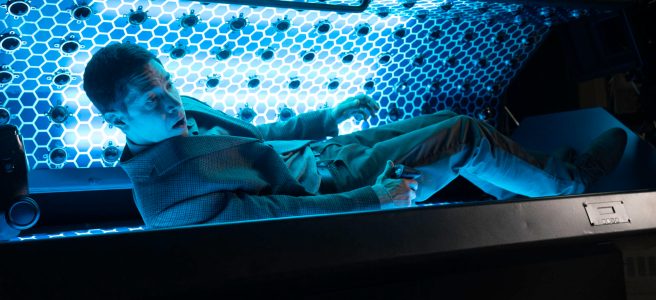
Dreams and Rats in the Attic: Charles Band’s The Evil Clergyman

I just came off of writing about Re-Animator and a cinematic Cthulhu Mythos, and here we are again. In fact, I meant to look at The Evil Clergyman first but when has anything been temporarily linear in my writerly laboratory, or in a writer’s world in general?

This is The Evil Clergyman, directed and produced by Charles Band, and written by Dennis Paoli. It was created in 1987 for an anthology called Pulse Pounders but it was shelved when Empire International Pictures closed, only for a workprint to be rediscovered in 2011, and then shown at the Chicago Flashback Weekend and put onto DVD in 2012. This is all information that you can find online, and I only found out about it thanks to the Joe Bob Briggs Drive-In Mutant Collective when I made a thread about some people’s favourite Lovecraft stories adapted into films. 

I am interested in looking at what Band did to make this film, and the differences between the movie and H.P. Lovecraft’s story of the same name. I find that the film adaptations of Lovecraft’s stories tend to do a lot of what I call “reptilian matter-grafting.” If you’ve read some of my work on the Horror Doctor already, you pretty much know the procedure and where it comes from: the directors and writers take a story from Lovecraft and his Mythos, adapt the overall narrative and spirit of the story, and then implant parts of his other stories into the film to give it that more overt Cthulhu Mythos feel. This isn’t always the case, of course, with the first Re-Animator film and the original Castle Freak — both made by Stuart Gordon — being examples to the contrary, with the latter having grown from “The Outsider” and into a whole other direction, but The Evil Clergyman has been mutated to make a very compelling visual tale from what Lovecraft has left behind, with some ethereal, sexual, and Gothic romantic sensibilities added in by Band and Paoli for good measure.

Neither the film, nor the story have protagonists — or characters — that are named. Lovecraft’s “The Evil Clergyman” has an unnamed narrator who is, presumably, male that comes to the attic of an ancient house in order to satisfy his curiosity about its former occupant: an Anglican priest that owned the entire house, and vast library of magical books. The house has an elderly male caretaker, who possibly belongs to an order watching over the structure, that warns the narrator not to touch or manipulate anything in the attic room. Some “abominable order” finally “took charge” and he says that he and some others don’t know what happened to the priest’s body. There is mention of a strange object on a table that resembles a match box, and he tells the narrator to especially leave it alone: as it might have had something to do with what the priest did in that room.

Well, you can figure out what happens. The narrator does, in fact, have to meddle with the contents of the room. His curiosity is his potential undoing, as the caretaker of the house tells him. He shines a pocket flashlight on the match box object, which induces a violet radiance from it. Now, this is fascinating because its effects are reminiscent of elements from two other Lovecraft stories: Crawford Tillinghast’s electronic resonance wave device that lets one see and interact with another dimension in “From Beyond,” and the plane of existence that one poor mathematics student Walter Gilman accesses in his sleep in another warped attic in “The Dreams in the Witch House.”

Sure enough, the unnamed narrator’s act of shining that light triggers the object, and he doesn’t find himself in another realm, but he seems to be caught within the past of that room. He sees the priest, with olive skin and a dark beard, throwing his books into the fire. Interestingly enough, the section of the room with the fireplace is on the window side of the room with a wall that slants sharply, reminiscent of the strange non-Euclidean angles of “The Witch House” and while the priest had been burning all of his books, they are all on the shelves in that room in the present day. The priest is confronted by his fellow priests led by a bishop. And it’s only when he gestures at the object on the table that they back away from him with genuine fear.

It’s interesting how Lovecraft describes the priest, and his relation to his former brotherhood. He is “evil-looking” but also nervous, grim, and both filled with hatred and fear. The other priests despise, and are terrified of him: and they actually leave him there through a trap-door, cursing him. The whole tableaux is fascinating because there is no sound. The narrator is only seeing this happen, the past seemingly reenacting itself through images and gestures, though — in the typical Lovecraft literary style — he can still smell the scent of the books as they burn. When the priest takes a chair and rope, and attempts to hang himself, the priest is actually aware of him and seems to smile in “triumph.” However, the narrator, sensing something is profoundly wrong with this situation, manages to turn the light on the priest — either through his flashlight, or the match box device — and it turns the man’s skin sallow. His flesh turns violet and pink — reminiscent of the mechanism in “From Beyond” again, and he flees in terror to the trap door, and falls. The narrator rushes there, and sees nothing except villagers who look at him, with absolute fear.

The narrator passes out, only for the old man to find him and help him realize that he’s become an exact physical duplicate of the priest. Apparently another man had done similar, and when he realized what happened, committed suicide. The old man is terrified of using the device further, as it “would only make matters worse to do—or summon—anything,” and he says to the narrator “You’d better thank heaven it didn’t go further. . . .” I don’t think there has ever been the case of a Lovecraft character physically transforming into another beyond the mind transfer technique we see in “The Thing on the Doorstep” and the merging of alternate selves in the Lovecraft collaboration with E. Hoffmann Price’s “Beyond the Gates of the Silver Key.”

“The Evil Clergyman” itself is an excerpt from a letter Lovecraft wrote in 1933, and it is apparently a dream he recounted to his friend Bernard Austin Dwyer. It reads like a fragment, and certainly has a dreamlike quality to it, and it had been published as a short story in Weird Tales in 1939, two years after his death.

Band’s film also resembles a dream, but it has more of an erotic and darkly romantic slant. The Evil Clergyman isn’t the story of an unnamed narrator, but of a priest and his lover. The lover is played by Barbara Crampton, and she is young and while tentative, passionate, and not afraid of her sensuality. Jeffrey Combs is the priest, of course, and he resembles the character quite a bit save for his facial structure, skin, and a lack of a beard: but he is every bit the intelligent spirit of that character extended into eroticism, and possessive malevolence. The music track, created by Richard Band, has a lilting, sad, reminiscent quality that spirals into madness, and whispering evil.

Charles Band and Dennis Paoli begin the story with the lover coming to a castle, as opposed to a house, where she confronts its landlady — played by the formidable-looking Una Brandon-Jones — into letting her visit the room in which the priest, the man she loves, hanged himself.

The atmosphere is set right from the Gothic castle with its ornate door knocker to its stone emblems, and the room which resembles nothing more than a small and modest cell, with a window, a bed, and of course the chair. There are no books here. No library. No strange devices left on a table. The window doesn’t open out into “the ancient roofs and chimney pots” of Salem that Lovecraft loves to describe in many of his stories with great and beauteous detail. It is just this small room where sex and love used to happen: pleasant memories soured by suicide, and grief: moments of the past once present turned bitter by the arbitrary passage of time.

The exchange between the young woman and the landlady is pretty intense as well, with a jealousy that is there in the older woman’s words, and her reference to “the worm eating beauty” being more than a little reminiscent of Edgar Allan Poe’s poem “The Conqueror Worm.” This landlady seems to know, or thinks she knows, the priest, and makes the young lover aware that the chair in which he stood to hang himself keeps moving back in a certain spot in the room. The old woman even has the temerity to mock the noises of the love-making she heard back in the days in which the lovers met in this room. The power exchange, for all of the young woman’s defiance, does seem to be to the old woman’s favour: through her obvious triumph over her discomfort. I mean, that portrait we see of a hanged man above or near the bed is a little too much on the nose. We also get a nod to Lovecraft’s “The Rats in the Walls,” when the old woman complains about hearing them scurrying in the walls of the castle — just like in the one owned by Delapore in England. The old landlady mentioning the rats, and leaving the trap with the flower in it begins the setup.

The grief, and mourning that Barbara Crampton conveys once the old woman is gone, as she sits on the softly sunlit windowsill is palpable. She’s lost someone important to her. Someone that made her feel alive. And then, she starts to hear his voice. We see his arms wrap around her, and drive her mad with feeling. Then it is gone. And then, we see him materialize in the corner of the room.

Lovecraft doesn’t write about sex, and physical acts are always “squamous” or “unnamed,” but what happens is neither as the two lovers — reunited despite death — begin fucking like mad on the bed. But underneath the bed, like a rejected parody of a Narnian beast is David Gale — you know, our creepy friend Dr. Hill from Re-Animator and Bride of Re-Animator — small, and dressed as a rat. He is chuckling, gross, and utterly pleased with himself.

The dream, like Richard Band’s musical score, spirals into a nightmare, as Barbara Crampton’s character wakes up and it’s night somehow — time not working the same in this chamber. There she meets the apparition of a Canterbury Bishop, played by David Warner, who tells her that her priestly lover had killed two other women before her, and that when he came to confront him about his crimes, he smashes his head in with a holy chalice. This is obviously a riff on the head priest of a group in the short story, but the gruesomeness, with the effects, are expanded on here. The Bishop looks on the young woman with disdain, and disgust, but he is also afraid. And Barbara Crampton has no idea what’s going on, or what is real anymore.

Eventually, we find out that the rat is the familiar of the priest. In fact, I will bet my sanity that David Gale’s twisted rat creature is essentially the same species, or kin, to  Brown Jenkin from “The Dreams in the Witch House” — an extra-dimensional entity bonded to the witch Keziah Mason who escaped to another plane from jail during the Salem Witch Trials. What we see unfolding after a while, is Crampton’s character realizing that Combs’ priest did kill himself. She sees him hanging himself again, and then talking to her from being suspended by that noose asking her to “kiss her like she used to” when she tells him she can’t reach his lips. Autoerotic-asphyxiation, and post-mortem having created a massive rigor mortis erection for a mortal blowjob aside, this macabre erotic act — designed to apparently give the young woman a chance to be released from the room — is interrupted by the bishop. She ends up beating him to death, again.

All of this, this ghostly afternoon delight turned into a nightmare with attacking rats, and a bleeding priest, and the harrassing figure of her hung lover — and not in the good way — seems to break the woman’s mind. After almost reenacting the act of murder on the bishop, she goes to the chair, takes the noose that’s been there from where her lover hung himself again, and hopes it will all end as she commits suicide. It’s an interesting parallel to the unnamed male narrator who tries to save the priest and then attacks him with the light, only to try to warn him from falling to his doom through the door. Crampton’s character is horrified at killing a man, lost in the dream logic of killing a dead man, and it prevents her from interacting with Combs’ character.

Now, it could have been left here. This could easily have been the lover losing her mind from grief. But then we have Combs talking with his familiar. They come to an agreement. He has a certain fondness for the woman, even loves her in his own way. But he wants her body. All of her body. In exchange, he promises the familiar her soul, but not before having to kiss him.  I keep thinking about “The Witch House” and how Keziah Mason can still manifest in the physical world: probably because the dimension she went to Lovecraft’s story, along with her link to her familiar from that realm, arrests her aging process, but the priest died. His physical body is gone. If he wants to come back, through his magic, through his own familiar, he needs a new vessel. He needs a new body. 

But I can’t help but wonder. At the end of the film, the priest seems to have taken over his lover’s body, freeing him from the contained dream-reality of the room. And yet, he has all of her memories, especially when the landlady’s words are turned against, her own chin is grabbed and she is told “You were never that pretty.” Because, sure enough, as the young woman leaves — confident, cold, and calculating — we see the rat familiar screaming, dying in the mousetrap the old woman left behind. Now, it seems simple. Whereas in Lovecraft’s short story, the priest fails to possess and rewrite the existences of two individuals — only succeeding in making them look like him — whereas in Band’s film the priest is triumphant in transferring his consciousness into his former lover’s body akin to how Ephraim or Asenath Waite took over her husband Edward Pickman Derby’s body in “The Thing on the Doorstep.” The unnamed narrator in the short story pays for his curiosity with the loss of his physical identification. The young woman in the film pays for her yearning, and grief with her very identity.

Yet the familiar is betrayed. He’s left to die. I get the feeling that the priest had influence over everything in that castle. He may have been with the landlady when she was younger, or at another time, and had her leave the trap there. Obviously he lured his lover there, maybe even others. He killed the bishop in that place, it seems, and yet no one reported it or investigated. And he had this deal with his familiar. Does the familiar’s death mean that the woman’s soul is freed? That she has bonded with her lover in her body in a strange form of symbiosis? A twisted form of liberation? Was the bishop representative of staid and close-minded Christian morality, and the familiar a debased lust that threatened to consume any meaning of passion? Is the attic a Jungian representation of the woman’s very mind?

Either way, I feel like this is one of those occasions where the film adaptation of a story is superior to the original source material, while changing the letter of its non-Euclidean law to match its eldritch spirit, and not shying away from pleasure turned into revulsion, and alien madness. It’s funny: almost everyone from Stuart Gordon’s Mythos films were in this movie, even the writer and musician involved in Re-Animator. It’s also fascinating to note that Gordon made his own adaptation of “The Dreams in the Witch House,” part of the Masters of Horror series that I still need to check out.

But this was a beautiful piece of a nightmare turned into a darkly lyrical almost thirty-minute film, and I am glad it was rediscovered, and it deserves its place in the Cthulhu cinematic Mythos. 

Reattaching An Amputation? Stuart Gordon’s Re-Animator

I didn’t think I was ever going to write anything on Stuart Gordon’s Re-Animator. I just didn’t really see the need. It is a film that has just the right amount of uncanny terror, visceral effects, titillation, and camp to make it a lively viewing experience. And between the twistedly morbid curiosity of Herbert West as played by Jeffrey Combs, Bruce Abbott’s overwhelmed scientific straight man Dan Cain, and the gorgeous and rightfully terrified Barbara Crampton as Megan Halsey you had the entire acting dynamic made.

It’s true. Re-Animator — co-written by Gordon, Dennis Paoli, and William J. Norris — has a few changes from its source material, namely, the serial short horror story H.P. Lovecraft’s “Herbert West – Reanimator.” Dr. Halsey, the erstwhile mentor of West and Cain doesn’t have a daughter in the story, as Lovecraft seemed reluctant to have many female characters, never mind romantic interests, or anything romantic for that matter. The character of Dr. Allen Halsey doesn’t die as a result of West and Cain’s meddling, but rather of typhoid fever while attempting to save countless patients from an epidemic. That, in of itself, makes him different from Dr. Alan Halsey  the Dean of Miskatonic University in Stuart Gordon’s film: for while he is also an old-fashioned doctor that doesn’t like West’s experiments, he cares more about appearances, grant money, and class than the Halsey of the serials. In the serials, in “The Plague-Daemon,” Dr. Halsey is reanimated by West and his assistant, beats the hell out of them, and runs off into the night as opposed to being captured and lobotomized by Hill. Cain isn’t named in the story at all, and is just an unnamed narrator — a function which happens a lot in Lovecraft — who is the assistant of West who is a blond-haired, blue-eyed young man in contrast to Combs’ iteration of the mad scientist. Lovecraft himself didn’t like this story, being derivative of Mary Shelley’s Frankenstein in a pulpish manner.

So of course it’s one of those stories that’s easy to adapt to cinema, and honestly the fleshing out of West’s assistant as a man with good intentions instead of a pedestal narrator, and the presence of Barbara Crampton to show the emotional impact and consequences of all their experiments, works for me. But you have, undoubtedly, already heard and read about all of this if you are horror fans.

Let’s focus on Dr. Carl Hill.

If you’ve seen the film, you know what kind of man Hill is. Hill is arrogant, he plagiarizes the work of better doctors and scientists, he has a creepy infatuation with the much younger and completely uninterested Megan, and he becomes the monster he was always meant to be after Herbert West kills, and reanimates his severed head and body, building for himself a little army of army to obey his every whim in a quip-filled rivalry between him, and West. David Gale plays Hill as a completely over-the-top antagonist, ridiculously so, but it is a counter to West’s combination of cold detachment, and demented obessession with his work. Hill is ego-driven, lecherous, and just a terrible human being that has no qualms about performing lobotomies on even former colleagues to get what he wants — and this is before he’s killed, and gets transformed into one of West’s creations.

So where do I start with this? In some ways, Hill is more of a banal character than West. West is about The Work, about experimenting with life and death, whereas Hill wants fame and power and flesh. Hill doesn’t exist in the serials at all. However, that isn’t entirely true. In the “Herbert West – Reanimator” serial chapter “The Horror From the Shadows,” there is a man working with West and his assistant — now both full-fledged doctors as opposed to medical students in the fields of World War I — named Major Sir Eric Moreland Clapham-Lee: a British-Canadian military doctor and pilot:. This is a funny link, given how David Gale is a British actor, though he depicts an American doctor who prides himself on class. He shares a lot of fascination with West’s experiments, and even participated in some in situ. Aside from his interest in reviving the dead, however, and perhaps some of West’s more esoteric explorations, Clapham-Lee doesn’t get much more character development after he’s decapitated in a plane crash … and West decides to attempt to reanimate his body parts separately.

This is where Dr. Hill is derived from, poor Sir Eric, and it is pretty much the last in a long like off poor life — and undeath — decisions that seals our friend Dr. West’s fate in the last of the serials “The Tomb Legions.” What happens here is nothing short of a cold, methodical hunting and takedown of West, who is hiding out with his assistant, as a mysterious man who seems to wear a waxen face — and is carrying something, always, in a bag — finds all of West’s creations, and purposefully take him apart in an ancient series of catacombs under an old house before vanishing behind a wall completely, leaving the narrator traumatized and afraid for his very existence.

You can see where a lot of the inspiration behind the ends of Re-Animator, and Bride of Re-Animator came from to this extent. But something perplexing always bothered me about Re-Animator itself, and I was never able to put it into words before this point. 

You see, there is one scene in the film where Hill stares intently at West, after attempting to blackmail the latter based on the knowledge of his crimes, into giving him his notes on the serum: or re-agent. He orders West to give him his work, and for more than a few moments West is speechless. He’s transfixed. Now, bear in mind that throughout this whole film Herbert West has been caustic and sarcastic as all get-out with everyone from Dan, to Megan, to Dr. Halsey, ranting at the police in Switzerland at the University of Zurich, and especially making barbs at Dr. Hill’s expense. But now, with the potential for revealing his illegal work on corpses, and what he did to Dr. Halsey, West is suddenly quiet? He just shuts up?

So, in an early draft of the script, it’s revealed that Dr. Hill is — of all things — a hypnotist. That’s right. This man of questionable science, whose work is apparently by West’s standards woefully outdated — specifically his knowledge of the brain and the surgery thereof — incorporates techniques that attempt to influence a suggestible mind. According to Joe Bob Briggs, it was the film’s music composer Richard Band, who suggested to Stuart Gordon that this element be excised as it would be implausible for two impossible things to happen at once with already a certain kind of belief suspension in place. Joe Bob was against this happening, referencing what seems to be Aristotle’s Poetics in that one should have two impossible things occurring in a work. I’ve attempted to look it up, but from what I can see Aristotle mentions something about how “With respect to the requirement of art, the probable impossible is always preferable to the improbable possible.”
In other words, perhaps Joe Bob was trying to intimate that in a world with reanimation already occurring, hypnosis in conjunction with that feat isn’t that farfetched, and that by attempting to just stick with revival of the dead, something is lost: the rest of it just becomes “the improbable possible.”

But according to what I’ve found, Aristotle essentially says that if you need a secondary impossible thing to make a primary impossible element work, you should use it.

And that is where Joe Bob and I differed, at least at first. I personally thought that this wasn’t needed: that adding hypnosis into a story about creating the undead in the way it is portrayed confuses the issue. What story is trying to be told here? And then, there is the Cthulhu Mythos fan in me that is also annoyed. By the time of “Re-Animator’s” segment “The Horror From the Shadows,” Herbert West seems to have come to the existentially terrifying conclusion that a previously living human organism’s parts have independent qualities: they are only interdependent — connected by nerves and viscera — because of evolution. There is no intrinsic force compelling them together. There is no life force. No soul. He is already experimenting with “lizard tissue” to make little animated creations from parts at this point in time — something we see him do in Bride of Re-Animator.

In other words, there is no intelligent design behind humanity.

Yet.

What I thought was brilliant about Lovecraft’s serials is how the other undead are mindless except for Sir Eric — our Canadian Major — who has not only retained his consciousness, but a sense of vengeance against West for turning him into an abomination. Moreover, Sir Eric is a decapitated head that understands the science of reanimation, and all of West’s dirty little secrets. He is a brain that controls his own animated body.

So why can’t Sir Eric control other reanimated bodies if they are potentially interdependent limbs, or extensions of a powerful will?

See, this is what worked for me with Dr. Hill. He lobotomizes Dr. Halsey’s undead form, not merely to keep him from potentially talking to the authorities if he ever got his faculties back, but to make him more suggestible. You see him, after his own death, doing this to other corpses in advance before reanimating them. It’s brilliant, and horrible. And I just thought that hypnosis is just a cheap way to explain something far more Lovecraftian and terrifying in that there is no intrinsic meaning even in human life and sentience: all just processes formed together by chemical forces and influences until someone learns how to manipulate them to do twisted and banal things, leading to a terrible and perpetual insomnia of eternal hatred.

Of course, the undead in the film are clumsy and directionless whereas the ones in the serials move fast, and with focus. This changes a bit when Dr. Hill controls them, but he barely has fine-motor control over his own body at times, never mind the bodies of others. And there is still the fact that West is awkwardly paralyzed just looking at him in that one scene.

So, in my early articles I’ve mentioned that I wouldn’t change a thing about Re-Animator, even if it is not up to Lovecraft’s standards: the serial, or the film derived from it. But now? Years later, after seeing some attempts at a Cthulhu Mythos shared cinematic universe in Color Out of Space, and the remake of Castle Freak, as well as seeing the cultists as displayed in The Deep Ones, there is a solution.

You see, I’ve changed my mind. What if Dr. Hill, as seen by Herbert West, is into defunct and “quack-science,” but it goes further than his “stealing” of Dr. Hans Gruber’s work. What if he is also into the theories of Madame Blavatsky, and Theosophy, some very racist and eugenics shite. It’s true that unlike the serials that take place at the turn of the twentieth century and WWI that Hill exists in the 1980s, but I can see him subscribing to these ideas. And what if he is a cultist of Cthulhu or Dagon himself, but instead of making it blatant with what he says, you can just see it in his study — that typical arrogant office with shelves of idols stolen from other cultures, but nothing really specific … Until you see the Elder Sign medallion that he flashes out to hypnotise or mesmerize people. It should have been short, and to the point, and a good nod at the literary heritage from which this film was grown.

In this sense, it works for me because we establish Dr. Hill: as not only a terrible human being and an arrogant narcissist, but also believing in some abhorrent practices, and his mysticism would make him doubly hated by West even as he rubs it in the younger man’s face. He still continues to lobotomize patients so his rituals make them “more suggestible” and it says a lot more about the Western colonialism in how he treats women, perhaps other minorities, and the vulnerable. It also doesn’t take away from the insanity of the whole film. It just adds another layer. One, or two lines, even West being disparaging of Mesmerism and hypnotism, and Hill hamming it up with “there are forces that work in mysterious ways,” which also leads to West attempting to animate Hill’s parts after he kills him with the shovel … it just sits well with me.

Obviously, this injection into the body of Re-Animator wouldn’t be possible now as it isn’t fresh anymore, and David Gale and Stuart Gordon aren’t with us anymore. And the film is great as is, and discussion of these film adaptations always seems to come down to an issue about either the inherent meaningless of existence, horrifying mysticism, or just plain entertainment. But like West, I guess I still like to play with other people’s toys: a fact that will probably never change here, at this Horror Doctor’s laboratory.


The Terror of Mathematics: Angry Video Game Nerd’s Polybius

October 27, 2017. I was on YouTube, navigating through the site, when I noticed an uploaded video in Cinemassacre Plays.

I’d been following James Rolfe as the Angry Video Nerd for over a decade. His persona as a raging, scathing nerd stereotype that neatly eviscerates terrible video games, with nineties gross-out humour and profanity, really hit a nostalgic factor in my heart. When James Rolfe plays the Nerd, to me he’s both a figure to laugh at, but also to sympathize with as a child of the eighties and nineties. In fact, a lot of the time I laugh at the Nerd I am laughing at that part of myself. 

Seriously, for me the tone of the Nerd was set when I first watched his video episode on the Nintendo Entertainment System’s Dr. Jekyll and Mr. Hyde game. I saw a deadpan humour, a story being built up about how he encountered this “vile piece of goat shit,” as he put it so poetically, a slow building dread in the narrative that he created, followed by the denouement of a game that arbitrarily hurts and kills the protagonist almost instantly. It’s so absurd, and so ridiculous that you can’t even believe it is an actual interactive game with rules or any sensibilities. Towards the end, he breaks character as he just can’t help but laugh, but at that point I was so invested in the whole “What the Fuck” lead up and conclusion, that I just — again — laughed with him. 

It’d been a long time since that episode, however. Rolfe had been busy working on his AVGN film, and a lot of the day to day posting had been given to Mike Matei, with some appearances by Rolfe. After a time, I became more interested in Rolfe’s Monster Movie Madness episodes, and of course his interview with Joe Bob Briggs whose work I didn’t know I would become so invested in at the time. Mostly, I just listened to James Rolfe and Mike Matei talk about games and movies. I began to truly become interested in Rolfe outside of his AVGN role, perhaps more so than even the AVGN episodes themselves.

And then one day on October 27th Cinemassacre Plays, which was a channel dedicated to both Rolfe and Matei playing games and Matei in particular having rage-sessions, a short video was released. It was the Angry Video Game Nerd, who I hadn’t seen in a while, except he was talking about a whole other kind of game. Now, for those who don’t know, the Nerd’s whole theme is that he plays the worst-made video games ever created, and he critiques them and swears at them a lot while going as far as to even destroy hard copies of that game. 

But this time, the Nerd was talking about Polybius

This was when I knew we were going to be in for a wild ride. Polybius is a video game urban legend about an arcade game that apparently could affect the minds of those who played it: inducing seizures, insomnia, dementia, and pure insanity in those exposed to it. I have nothing to add to the urban legend itself, as many people have delved into it far deeper than I can at this time. I did think about doing something with the Roman historian Polybius and his possible relation, of that of his work, to the game as an attempt at a creepypasta: a copy and paste internet attempt at an online and electronic urban legend of my own creation.

As a bit of background, there was a time when I was fascinated with creepypastas — you can thank my late partner Kaarina, and Kris Straub’s Candle Cove for that — and I wanted to make one myself: to create a story so compelling, and seemingly real, it could become viral. It’d be the perfect test of my abilities. I never got there myself. I went as far as a few ideas, some notes dealing with eighties nostalgia, and getting some concepts rejected by the SCP Foundation.

James Rolfe went farther, utilizing this idea that has existed online since the early aughts. It’s funny how horror and humor relate to each other. I’ve probably mentioned it before, but just as fantasy and the macabre share the same road and branch off, comedy and terror tend to share similar pacing, unexpected beats, and familiar ends. 

Rolfe released his Polybius episode in a five-part serial. He controlled the pace right off the bat. Each part was divided into Days, and he filmed it in the found footage format that I love so much. Day One is great because it starts off with him sitting in front of the camera like any other AVGN episode, and giving a detailed run-down of Polybius and the rumours, and legends surrounding it. And that’s it. He says that he found a lead on a possible cabinet with the game, and he leaves it at that. 

Already, it piques interest. You want to know what he finds. It is a line between knowing it is fictional, to the meta-narrative point of practically winking the viewer, but also playing it straight as if the character of the Nerd is genuinely pursuing this venture into finding this potentially terrifying game. He finds bad games, but generally not deadly ones. By Day Two, we are in a warehouse with old game cabinets, and eventually we find the Polybius cabinet itself. We follow the Nerd from his camera as he shows us what is going on. Of course, the caveat is that he isn’t going to reveal the game and its graphic “because it might be dangerous,” though he claims it is all probably just a hoax. They do say that showing less of the monster in a horror film is more after all. 

Most of the time and throughout the rest of the Days, we watch the Nerd play Polybius and not the gameplay itself. He downplays a lot of it initially, stating that it’s mediocre at best, but he weaves little snippets of facts, an email of warning that he laughs off, and the realization that the Nerd is spending more and more time playing the game. His estimation of the game changes during these periods, his esteem for it rising from mediocre, to good, to one of the best games ever made … and the slow realization that he is becoming addicted, and that his senses have become, well … unreliable at best. 

Rolfe’s AVGN episode plays off of the Video Game Panic of the late twentieth century, of the medium affecting the minds and health of children, and those who play them. Video game addiction, like most addictions, is also real and has been discussed in that context. When you also add to the fact that Polybius was supposedly released by the American government as limited and localized experiments in mind-control, and you see the place in which Rolfe is playing. The way the Nerd described playing Polybius “like watching a waterfall” reminds me of the Star Trek The Next Generation episode “The Game” where there is a virtual reality simulation that creates mental geometric shapes that interact specifically with the brain, and induces pleasure in those interactions. 


In Rolfe’s Polybius episode, we see the Nerd’s addiction become his fear as he realizes he can’t rely on his own senses, or personal judgment anymore. But in one Day, one installment, we see a shape rise, look at us from the reflection of another cabinet screen, and run away: drawing us into the hallucination, or the supernatural element involved as well. It is reminiscent of those terrifying Easter-eggs in Ghostwatch

But it becomes clear that Polybius doesn’t just want to be played. It wants others to see it be played as well: like a Let’s Play version of Ringu. The torment and exhaustion in the Nerd builds up, and gets real. In the last installments of the serialized found footage made a web miniseries, he struggles against Polybius — even working in the historical Polybius’ mathematical grid in an attempt to escape — but to no avail. What I think is fascinating is how Rolfe manages to play on the Nerd’s general frustration, on his sense of unfairness in dealing with games that break their own rules, and douses these traits with fear, and despair. Even though you know this is fictional, and the Nerd is a persona, you get invested in his genuine distress because Rolfe builds it all up to that point: from one to eleven.

In the end, after shifting the camera away and back from the screen, he relents — apologizing to the viewer — as he knows the only way he will escape this fate, like Ringu again, is to show us the game. And we see it, and the geometrical graphics warp and change, and we get a demonic jumpscare. Personally, I think it was a good lead up, and I really like the emulation of  YouTube’s “This video is unavailable screen …” though I think we could have done without the second jumpscare.

AVGN’s Polybius episode is a very tongue and cheek construct that plays with the found footage webseries format, with that electronic serial epistolary place, with hints of images, glances of the “monster,” rumours and accounts sprinkled through, and a slow, insidious, psychological sense of horror that grows into a jumpscare or two, with some realistic technical hoax elements. The serial drop made it, in my opinion, and I looked forward to seeing what happened each day a new installment was uploaded onto Cinemassacre Plays.

But, there is another element at play too. When I was looking for a “Making Of” episode years later, I realized that there was more to this episode. AVGN’s Polybius was filmed and recorded at TNT Amusements. And while Polybius was a more horror-based found footage version of an AVGN episode, made epistolary, THE ANGRY VIDEO GAME NERD films POLYBIUS at TNT Amusements is more of a mini-documentary of sorts … that leans towards humour. Their endings tie into each other well. Todd N. Tuckey, the President of TNT Amusements, is great.

I do think that there was another missed opportunity. You see, at the end of the episode it seems as though the Nerd is changed forever by this experience with Polybius. Perhaps he is either dead, or transported into another world. James Rolfe himself has created a few continuities, where not only is the Angry Video Game Nerd is own person, but there is another figure named Board James: a madman who plays board games with his friends, and his reality is constantly shifting like the dreamlike sequences in the Phantasm series. If James Rolfe could have gotten a lot of his original crew from that series back together, and we know from continuity that the Nerd and Board James have interacted, the ending to the Polybius episode could have been a fine crossover back to Board James, or something like it. But the logistics on that might not have been feasible, for a variety of professional and personal reasons: not the least being that James Rolfe is a busy man. I also think it might have been amazing if this had been the end of the Nerd for a while, as though he died or worse, but he was inevitably coming back with the cartoon resilience most recurring characters in weird worlds have, though there is overlap between AVGN episodes at times, and him being affected by this after the fact could have been an interesting aspect to explore.

But anyway, here is the AVGN Polybius Episode, and THE ANGRY VIDEO GAME NERD films POLYBIUS at TNT Amusements. I am so glad this exists, and I love the experimentation with the medium and the times that Cinemassacre reinvents AVGN, just as I wanted to do something new for this Friday the Thirteenth. Have a terrifying weekend, my fellow subjects. 

Roads Past Uncertainty: The Etheria Film Night Shorts of 2021

Here I am at the Etheria Film Festival, in spirit again. It’s hard to believe that it’s been a year since the Festival was forced to move from its physical Theatre viewing locations in the United States onto the online platform of Shudder. These have been uncertain times, and I didn’t know if I would ever cover — or even see — a similar event again.

But if I were to say that the Etheria Film Shorts of 2021 have a unifying theme or motif, it would be uncertainty: of being lost, or remaining in transition, and trying to find your way off a familiar path. 

So let’s get into it. Heidi Honeycutt, the founder and Director of Programming of Etheria introduces this round of female-directed short films across genres, and then introduces the 2021 Etheria Inspiration Award. It is presented to The Walking Dead showrunner Angela Kang by the legendary film and television producer Gale Anne Hurd: who herself had actually won the Award in 2019. One thing that Hurd mentions with regards to Kang’s work is that she is excellent at telling character-driven stories: which is fitting given how most of the cinematic stories in this current anthology are, by necessity, directed by the trajectory of their protagonists wherever they might go. 

Our viewing night begins with Kelsey Bollig’s The Fourth Wall: a film about a resentful actress who has to essentially share her next big theatre production with three other idiots while suffering from what seems to be a series of seizures, or the beginning of a nervous breakdown. The director’s statement on the Etheria website, which I’d suggest you check out as some of them provide a bit of background for their films, explains that she wanted to take the story back to the origins of cinema, and perhaps even cinematic or theatrical experimentation: which she identifies as France. As the protagonist’s nose bleeds, and her hallucinations with regards to her resentment over her peers continues, you wonder where this will go. And I have to say, when she makes her decision, when she lashes out, it is satisfying. It’s a tame Grand Guignol — a naturalistic, graphic, amoral horror show where gruesome acts like murder seem so real — within a flimsy production of Shakespeare’s A Midsummer Night’s Dream. And I have to add that there is something truly great about what she does to the American actress who is only there because her father is the director, and she doesn’t bother to learn how to speak passable French beforehand: expecting others to accommodate her. Essentially, I love the fact that the Etheria Film Festival starts itself off with a foreign language film and, after dealing with reading about several film viewers subtitles and wanting to hear English dubs — it feels like a tremendous “fuck you” to that contingent that I greatly respect. I also want to add that I appreciate the fact that English captions do not interfere with foreign subtitles on Shudder: at least for how the Etheria Film Festival is formatted. 

So we break The Fourth Wall with a commentary on Murder being the tenth muse, and wondering what the protagonist will do next after her moment of transgressive narrative effulgence is over, to find someone on another Narrow path as directed by Anna Chazelle. Like The Fourth Wall, I didn’t know what was going on at first. Is the protagonist being haunted by ghosts? Is this a dystopian death match? Will leaving the path of dirt and gravel which she can’t step around lead to the ghosts of her victims getting her? It is fairly clear that she is terrified of leaving that trail, even ignoring screams of agony and pleading. She’s surviving, and you can tell that she’s been doing this for a while. I didn’t know that this was a post-apocalyptic story, even after watching it, though Chazelle identifying it in the lens of personal stories told in after such world-ending events — about individual lives trying to make sense of a now senseless world in line with what Hurd says about Kang’s work at the introduction to the Festival. At the end though, despite all that effort, the main character has to make a choice: one that tests her faith, or her certainty. It’s like Orpheus, except there is no Eurydice, and you have to wonder if it is the promise that makes her decision: or simply being so tired of this constricting road of life? There is a reason why it turns to night when she leaves, however — into darkness — and as a viewer you are left in this haunting meditation of that fact.

Narrow isn’t the only film with a character that steps off her path. In fact, I would venture to say that so far two protagonists have done this: one ending in glorious murder, and the other being consumed by the roars of the night. You Will Never Be Back is almost an answer to the end of Narrow, but unlike its predecessor it isn’t an ending. That would be too merciful. Mónica Mateo presents us with another foreign-language film, this time in Spanish, in which her protagonist Ana leaves her partner David to go to an event, only to find a small portal in the hallway of their apartment. It only takes one moment for everything Ana knows to be stolen from her, to have never happened to begin with, and to know — as only the mentally-challenged or dying are aware of who she is — that she will never escape this place: this dim, floral, Mobius strip forever trapping her in a temporal purgatory. It’s like an episode of The Twilight Zone, but there is something even more sinister when you consider how mundane and everyday this story begins, and due to one small decision everything in one person’s life — and their relationships — is over, and they are lost. It’s … especially timely given the current climate.

And it really doesn’t end there, does it? We come to Katy Erin’s Bootstrapped. A casual movie night between two lesbian partners turns weird when one of the partners, a physicist, comes back from the future begging her partner not to break up with her. As she explains to her partner, it is because she broke up with her this particular night that made her obsessed with her work, and discover time travel. The problem is that corporations and the rich took advantage of her work and abused this power, leaving masses of people in war and fear in order to colonize the future: where they wouldn’t have to deal with any of it. It’s only she apparently learned that she could travel to the past. Of course, the reason the breakup happens is revealed by this future incarnation, and it makes it happen. It figures that the end of the human species would be the result of a failed relationship, although you realize just how self-serving the time-traveler had really been. Hell, the other protagonist even asks her why she wouldn’t talk with her past self, and seems like less an issue of paradox, and more the fact that she is afraid of “affecting her own memory.” So perhaps the end of human civilization, or existence is more of the result of human pettiness and selfishness more than anything. It’s funny too, as I just rediscovered Jeremy Lalonde’s James Vs. His Future Self, in which this film is a nice counterpoint. I guess the traveler, in this case, bootstrapped herself, in more ways than one. 

And then, we go from supreme selfishness to the opposite in a serious situation. In Ciani Rey Walker’s Misfits, it is 1960s America and we find ourselves in a chapter house of the Black Panthers. Everyone there seems to be Black university students and activists. There are two leaders: a young woman who studies law, or a book of law, and another who understands that sometimes you have to take physical action in order to do what needs to be done. We have scenes of comradery. There is even a White student who is friends with this chapter. I’m ashamed to say that I didn’t know, or I wasn’t sure that the Black Panthers had white allies though I know the Freedom Rides definitely had Black and White participants. But the scene starts off, not with mobilizing, but just young people surviving daily life, and kidding around with each other until the news comes on: Reverend Martin Luther King Jr. has been assassinated. 

Misfits is a film that can, and should, have an entire article or review dedicated to it. Suffice to say, the chapter house organizes to protest, but one of their own gets beaten nearly to death by a police officer: who is shot by the White student. And then, these Black students and activists, they have to make a choice in a system that would destroy — and has destroyed — them. There is so much I want to say about this film. It is easily, along with last year’s Conversion Therapy one of my favourites, and it is unfortunately timely. The fact that the movie begins with a young woman attempting to memorize a legal text, and ends with another holding the barrel of a gun says a lot and what might be criminal to one person, at one time in history — or just — is explored here. And the film ends with a list of names “In Loving Memory:” Eric Garner, George Floyd, Breonna Taylor, and so many Black lives taken by police brutality. It is a powerful, sombre ending to a film that takes place in the 1960s, but whose violence and injustice it depicts continues to this very day.

Myra Aquino’s The Gray also has a police officer, or at least a former one. And he is also dead. However, this former officer is in Purgatory: in an office place processing people to Heaven, and Hell based on his own black and white ideals. He’s been there for a while, and his contemporaries are attempting to get him to retire: to choose where he needs to pass on. This character is different in a lot of ways from the wounded cop in Misfits. He has a strong sense of justice and morality, to a point where it ruled both his life and his afterlife. He had also been in a mixed race relationship with his Filipino wife before his death. And, up until the events of this madcap weird fantasy afterlife comedy, he’s never compromised: until he sees his son in Purgatory. I’d like to think that, based on what happens and the decisions he makes, that God or whatever powers exist in that afterlife arranged a situation that challenges this man’s thinking — and he finally decides to truly let go of the rules to do what he thinks in his heart is right. It’s both a light-hearted, and moving film as the former officer seems to sacrifice himself to hell in order to give his son another chance to live, and take care of his mother. And while we don’t need the clarification of what happens from Aquino, it is nice to have it nonetheless. Also, can I say that the threat of the bureaucracy taking away the protagonist’s “subtitle privileges” reminds me of The Fourth Wall, feels like another hilarious jibe at subtitle haters?

While love helps someone leave their narrow path of bureaucratic certainty to make their own “leap of faith” such as it is, another protagonist finds it — or the beginning of loneliness’ end — in Silvia Conesa’s Spanish language film POLVOTRON 500. A man in the future attempts to sleep in an old automated sex booth, but accidentally activates one of its sapient hologram sex workers. And while he first wants nothing to do with her, and she just desires to provide her function, they actually begin a conversation together and he realizes that they both have something in common: they are both lonely, and they want company. It could have easily ended in a cynical transactional manner, or something saccharine but I like the fact that she is still a sex worker artificial intelligence, and he is a paying credits-customer, but that human connection between them outside the beaten path feels incredibly real in a time of great disconnection.

I’d like to say that Aislinn Clarke’s Eye Exam is the weird film of the nine. It is essentially about a protagonist who goes to an optometrist who is looking for … eyes. She ends up lying in her exam, just to get away, like a man before her who runs out of the room, and the building. It’s hard for me to fit this into the thematic structure I’m identifying. Perhaps, in that dark room the danger is staying the course and telling the truth so that the monstrous voice and Cyclopean visions around the protagonist can get her eyes, as they tried to with the man before her, and it’s only through looking away, through lying, through deciding to veer away from this path, that she can save herself. It is a counterpoint to POLVOTRON 500 for sure in that holograms are visual constructs, and while the protagonist attempts to also ignore what he sees, to wait it out, or eventually leave, he accepts the more positive situation. The character in Eye Exam, however, seems to have dodged being taken by something worse in deciding not to accept it.

And this brings us to the final film in the Etheria Film Festival: Astrid Thorvaldsen’s Who Goes There. I’m almost surprised that the Festival ended with this movie. This isn’t because it is a bad film: far from it. Three Norwegian sisters live in a remote cabin on the American frontier. Their parents seem to have died of a fever, while one of the sisters is slowly being consumed by it. Then, a mysterious man finds them, and after Ingrid — the oldest sister — saves him from dying of thirst, he offers his services as a doctor for their dying sister: for a price. It is a film about survival, being afraid of death and possible treachery, of caution, and the price of letting something in: be it having a prayer answered, or simply opening a door. In the end, unlike the protagonist from Eye Exam, someone gets what she prayed for, another gets what she asks, others die, and perhaps it’s survival — and living — that is the final punishment. When I think about it, perhaps Who Goes There is appropriate in that it ends off with an uncertainty of both identity, and of what the future holds. 

It is my opinion that it is no coincidence that the Etheria Film Festival of 2021 ends with a film that tangentially deals with sickness, but also infection of a more infernal kind. I always wondered, when thinking about many other events such as the Toronto After Dark Film Festival, if a group of judges had already chosen a few film entries before the Pandemic. And while the After Dark might not have had the opportunity, I feel like the Etheria Film Festival might have had all of their entries, and chosen them accordingly. At the Film Festival’s introduction, we are told — half-jokingly — that nine great films had been chosen but didn’t make it due to “distribution problems” or something to that effect. While last year’s Etheria theme, to me, was about interconnection is a disconnected world, I feel like this year’s verges from going behind the scenes of a trite situation, to teetering off a slim line of reality and getting lost in time, sabotaging yourself and others in a cycle, to hard choices in impossible, enclosed situations, to selfishness and selflessness, and knowing when to run, or let something inside.

As of right now, even though I know Etheria is publishing their past films through Amazon in its own series, I don’t know if — even in a year — we will see this Festival online anymore. That is a path branching from uncertainty as well. It is a new time, beginning, and while it is still dangerous, the potential is there too, and I’m glad that whatever else happens, I got to see one more Etheria Film Festival.

And please check out the Etheria Film Festival website. There are more Director’s Statements there, and they are worth checking out: as is this event, which ends on July 25, 2021. 

And This Hole Leads to Another Hell: Takashi Miike’s Masters of Horror Imprint

This Dissection and Speculative specimen contains extreme subject matter, and Trigger Potential. As with its predecessor, Reader’s Discretion is advised. 

I know how I opened up with my first article on Takashi Miike’s Imprint. I said a lot of things, and I explained why I reacted and said the things that I did. However, it wasn’t entirely accurate. You see, while I did write those words first on Twitter, what actually got me to truly look at Imprint, beyond my visceral reaction, was the following I wrote afterwards on Facebook: which goes into more detail:

I just watched Masters of Horror‘s Imprint.

I don’t say this lightly, you understand, but Takashi Miike, you suck. You suck so much. You use folklore brilliantly, you are excellent at illustrating human cruelty, and genuinely making a viewer feel really bad. Seriously, the amount of horror, pathos, and what-the-fuck I felt in this one episode that — surprises of all surprises — wasn’t released on North American television has been the most I’ve felt in a while.

I mean, damn. Granted, it wasn’t as disgusting as that one scene in Audition. *That* fucking scene.

But still, Takashi Miike … you suck. You suck hard. And not a horror director, my ass.

There isn’t much of a difference. Takashi Miike has claimed he isn’t a horror director, but I disagree: even though I know now that he’s created a wide variety of films across different genres. But I will say this. On Facebook, I was called out on my reaction, and some people didn’t understand that I was reacting strongly to one particular scene, and aspects after that. And then, I looked over what I wrote and realized that while most of it is venting, there are two aspects of this film that my mind began to digest in addition to, and beyond, the torture scene: mythology, and narrative.

It really all comes back to the character of the Woman as played by Youki Kudoh. She tells Christopher, and by extension the audience — us — three stories. One is about her poor, but idyllic childhood before she is sold to the brothels so she can make a living. Then there is Komomo’s suicide. Then we find out that the Woman stole the jade ring, and framed Komomo for it. In the screenplay, she goes as far as to help the other girls torture Komomo, but in the film she mostly watches in absolute horror as they do so. Then after that we find out that she strangles Komomo with the rope from which she hung. And then we see that her tale of her family and her relationship with a kindly Buddhist Priest was all a lie: that her father was an abusive drunk, and her mother an abortionist for a struggling peasant village. We even see her dispose of the fetuses, her Mother and herself: the late-term aborted lives looking nothing less than gangly human jellyfish. 

And the Woman is raped. She is molested her entire life. First, by the Buddhist Priest who shows her depictions of Heaven and Hell, and tells her she will obey him or she will go to Hell. Then, by her father after he beats her mother within an inch of her life. And then, as we saw before, by customers. She tells Christopher that “I had nothing. Only this hole bound for hell. Trading it to make my living was only natural.” 

All of this would be horrifying in, and of itself, right? From a very young age, the Woman is taught that her hole — her vagina — is a conduit to Hell, that just by living, by making a living with it, by giving birth, she is a sinner, and she will go to Hell. It doesn’t matter if she’s obedient, or not. She even tells Christopher: “Men don’t like our holes, they yearn for the hell behind them. The hell they were in before being born.” It is a cycle of samsara, or maya: of the mind being clouded by the senses, and pain. In a way, she is basically saying that everyone — this whole world — already is Hell: on that perpetuates itself.

But there is another layer. There is another level, or realm, of Hell. A lot of Far Eastern philosophy and theology posits that there are several hells. So, at the start of Imprint we see that the Woman has a pinwheel in her room. This pinwheel begins to spin without so much as a breeze. And then, when we see that the Woman’s Mother isn’t a midwife, but is an abortionist, we see a multitude of pinwheels blowing on the riverside: the same river where she and her daughter dump the aborted fetuses of the women that come to them … who are too poor to have other mouths to feed, but whose husbands or men continue to impregnate them nonetheless. The pinwheels are placed there by the Mother to commemorate the lives of those dead children, before they are even children. It is a Japanese custom to plant these pinwheels at the site of miscarried and stillborn children, for the deity Jizō to protect and guide their souls to the afterlife. 

Yet for a pinwheel to turn on its own in a brothel is probably an inauspicious sign, especially as we know the souls of the dead are all around Christopher and the Woman. There is another Japanese custom, or rather a myth. It’s said that if a wife of a miserly man rarely eats, a second mouth will form on the back of her head, eating twice what she would, and screeching obscenities if it doesn’t get what it wants. This mouth can also form if a miserly man accidentally hits his wife in the back of the head with a wood axe. But, more tellingly, a woman can develop this second mouth, complete with moving snake-like hair if they let a stepchild — perhaps a child — starve to death. This is the myth of the Futakuchi-onna.

The Woman herself resembles Kuchisake-onna, or the folkloric Slit Mouth Woman, but she is really a Futakuchi-onna. The reason for this, as we see a hand-like creature with teeth form from the side of her skull — her parasitic twin “Sis,” like a female version of Basket Case’s Belial still attached to their sibling — is that, in her final story, we find out that her Mother and Father were actually Brother and Sister. They were forced out of their town  as a result of their incestuous affair, and forced to wander and eventually settle in this peasant village. The Woman is cursed as a result of this incest taboo. But there are other folkloric elements. Her Father is a miserly individual that takes most of her Mother’s money from abortions to feed his alcoholism. In addition, the Mother has aborted many children, possibly many of her own before the Woman, and perhaps those spirits have cursed the Woman by extension. In the script, the Woman says the reason her Mother saved her after leaving her to drown was that she survived in the river for two days: the Mother realizing what she was earlier, and not wanting to be cursed by letting her die, or perhaps starve to death. An interesting fact is another way a Futakuchi-onna is created is when a mother starves her stepchild in favour of her biological child, and her daughter can also become possessed as a result. It isn’t precise, but most myths aren’t.. Most folklore is dirty, and bloody stuff.

The Woman is no exception to this, and neither is what the Futakuchi-onna presents. William Leung says it best in his article in his work Misogyny as radical commentary — Rashomon retold in Takashi Miike’s Masters of Horror: Imprint. That second mouth is all about repression, about the resentment and bitterness inside a woman buried deep down, and manifesting as this other being. In the Woman’s case it is her sister that she all but absorbed in the womb, but it serves that purpose. After all, the Woman is raped by her Father, her Mother’s Brother, and her Sister gets her to kill him: smashing his head open, making a wound in the back of his skull, with a rock. We see a scene in the draft of her Mother looking expressionlessly on as the trader takes her away after this, but it’s not included in the film. But “Sis,” which is a great nickname as it sounds almost like “cyst,” even if it’s not intentional, also makes the Woman take the jade ring, and frame Komomo for the theft: as she likes “shiny things.” It makes sense. In the screenplay, the Woman’s Mother even mentions that they had once come from a family of affluence, with rice and Western candy abound. This didn’t make it into the film, but it makes sense that if “Sis” is that feminine rage of being violated, that she is also that greed for the food she barely got growing up, and jealousy for a life of riches she will never have. 

But I also remember fox possessions from The Tale of Genji, how the spirit of a fox or some similar entity will use a woman — as women are considered to be natural mediums of the supernatural in Japanese lore — to cause mischief, and express resentment, but also communicate truths, and hidden knowledge. “Sis” knows things. She can not only mimic Komomo’s voice, but she even seems to know things about Christopher himself. 

The two sisters, this Futakuchi-onna, reveal two truths to Christopher for the price of one. The Woman explains why she killed Komomo. And this is where her Hell ideology comes into play. When you consider that her Father is her Mother’s Brother, and he abused her Mother, possibly raped her, and molested her as well, then considering how the Buddhist Priest educated her about Hell after violating her, you see the cycle of karmic suffering closing in a much tighter circle. Everything is interconnected for the Woman in an unbearable way. Combine that with the fact that she’s seen what happens when men have sex with women, and create disposable fetuses, and her own experiences in the brothel you can see how she equates sex and family with Hell: easily.

There is a concept I was introduced to back in my Japanese Literature and Film class. It is called Amae. It is a term utilized by the Japanese psychoanalyst Takeo Doi in his book The Anatomy of Dependence: which deals with the idea of a uniquely Japanese need or drive to be in good favour, and dependent, on everyone around you. More specifically, Amae is supposed to be rooted in the parent-child relationship, and having someone take care of you. 

Komomo is depicted in Imprint as a naive girl wanting someone to save her. In a way, her description of her family — who she claimed didn’t abandon her to the brothels — is similar to how Mother tells the Woman about their family in the early draft of the script. Komomo firmly believed that in another time, she would have been a Princess, never mind the fact that the other prostitutes claim her family committed suicide out of shame, and she was sold by her foster family to cover their debts. Moreover, Komomo believed Christopher would come back for her, and take her to a whole new life. Now, you can easily interpret this as your typical “Princess waiting for her Yankee Knight to rescue her” trope, but I can argue that Komomo feels Amae to the family she’s lost, still dependent on them for her personality, then the brothel — especially when she gives the Woman her portion of rice when the Madam starves her for not working — and then towards Christopher who she believes will take care of her: like a father-figure. 

Amae is supposed to be an ideal of social interactions, and the love of a child-parent relationship. The Woman, understandably, doesn’t feel this: or at least not in the same way. She never had anyone to take care of her. Her Mother made her work for her keep, albeit teaching her how to assist in taking lives. Her Father neglected, and violated her. And the authority figure that is the Priest used her for his own gratification. The Woman is used to this cycle, as horrible as it is.

But then, she meets Komomo once she comes to her brothel. She reaches out, and offers her rice when the other girls don’t even bother. According to the Woman, she even defends Komomo’s dreams and hopes from those girls by threatening them: to make them look like her. However, you need to remember that any form of attachment to the Woman is Hell. From the vagina, or hole you enter into the world through, to the penises that use you, and the guidance that becomes exploitive and coercive. But this kindness, this arguable … Amae, it’s too much. It’s not the same as the twisting cleaving that the Woman’s whole life has been based on. Even “Sis” is only “helping” her because they are forced to share the same body. 

So the Woman, after “Sis” has her way with the ring and the punishment, sees Komomo. She sees her completely destroyed, but still holding onto that hope. She explains to Christopher that if the Devil saw them together, he might just think Komomo is just as bad as she is as she is her friend. And so, the Woman claims she tried to hate her, and killed her herself so that God or Buddha would take her away. More than anything, I believe that after Komomo’s torments the Woman was simply offering her a mercy killing: because if she hadn’t, Komomo would have continued in that brothel, as the nature of her punishments were made to spare her face, and sexual organs — the Madam’s property — as the patriarchy in the form of the syphillic solicitor and his bobbing cockhat laughed at her misfortune. The way the Woman could have seen it, Komomo continuing on would have seen her dream of seeing Christopher again die, and she would have been tortured to death, or killed herself: both fates condemning her to Hell.

In an act of love outside of Amae, the Woman releases Komomo from her suffering — away from this vindictive patriarchal system that punishes you for behaving or misbehaving. According to the Woman, it’s the only conscious and sober choice she’s ever made in her life. Or perhaps, in that sense, the Woman takes on a maternal role: becoming the parent that takes care of the child, of the innocence still in Komomo, by helping to end her pain. It may also be a major sense of thematic empathy. It is no coincidence that Komomo’s body is seen in the same elegantly crumpled position after her torture by the other prostitutes as the Woman’s had been when she was a girl after her father raped her. Of course, it’s also possible that the Woman killed Komomo because she resents the dependence and approval that Amae entails, and that between her and “Sis” they destroyed that possibility. Then again, the Woman is still dependent on the brothel to live, and her “Sis” who dictates her life, and is the most assertive element of the two of them.

And then, speaking of “Sis,” there is her truth to Christopher, and how it brings this whole twisted film full circle. Christopher tells the Woman that the reason he loved Komomo was that she reminded him of his dead younger sister. That is a pretty disturbing revelation on its own, until you also take “Sis’” words into account, and how they affect Christopher: triggering his last flashback in which he remembers his sister begging for her life, after doing “what he asked” before he kills her.

Think back to the whole thematic structure of this film. The Woman and “Sis” have to share an entire body between them, and how “Sis always gets what she wants.” Her Mother and Father were Brother and Sister, and her Father beat her Mother, and then terrorized the both of them. Christopher killed his sister, presumably after raping her, and then wanted Komomo to himself because she was basically a sister-surrogate for him. Also, consider what Komomo might have gone through had Christopher found her alive: what the status of a Far East Asian woman, who had been a prostitute, would be in a Caucasian-dominated nation like America. In fact, you can go further with this inquiry when you consider the idea that programmer and writers Chris D. and Wyatt Doyle present in their commentary track on the Imprint’ DVD: that Christopher first found Komomo as a child. It doesn’t look good either way. Komomo wanted a parental figure to protect her. Christopher would have essentially replaced the brothel in having the power of life and death over a woman who reminded him of the sister he murdered. 

Christopher can’t face these truths: that he is part of a system that exploits the women and girls he claims to love, that he destroyed both of them. He tries to kill the Woman, and it is telling that when he shoots her in the head, she appears to him as Komomo: with her brains oozing out of the back of her skull, from a wound not unlike that of the dead pregnant woman’s head at the beginning of the film; not unlike that which apparently creates Futakuchi-onna.

It all comes back to holes leading to Hell, doesn’t it? At the end of Imprint, Christopher is back on the Japanese mainland: in a deep pit of a nineteenth century Meiji prison. The male guards are dressed like proper Imperial soldiers. They mock him for killing an innocent girl — in the screenplay it was for killing “a whore,” perhaps the property or merchandise of society as William Leung puts it — and he will spend the rest of his life there: after they “have some fun with him.” He’s left with his water ration, to rot in his own sense of personal horror. In the script, he smashes his head against the wall and sees Komomo reaching out to him and then morphing into his dead little sister as he screams. In the film, he holds his water ration containing the vision of a dead fetus. Perhaps he sees it as his murdered innocence, or a representation of a potential and love killed by him, and a patriarchal world. He holds the bucket, and cradles it, singing a broken lullaby as the spirits of Komomo and his sister stand there: each holding a pinwheel. 

The ending to Imprint in the screenplay implies that the Woman has survived, that as she put it to Christopher, he couldn’t kill her. In the film, after the credits, we see her. Her “Sis” doesn’t manifest, as she does in the screenplay. Instead, she is cooking a fish, and enjoying it. Then, she looks up, and it feels like she is looking right at us: at the audience. She smiles.

I thought about that. I wondered if Christopher really had killed Komomo, or planned to do so. Did the Woman change into her? It was probably a thematic device, but as I think about this entire debacle, this tightly knit hole into hell, I recall Yugiri’s failed affair and the pain he causes in The Tale of Genji towards the women in his life. I think about Komomo suspended with her own urine pouring over her broken body after the women in life almost sensuously torture the hell out of her. I remember how Murasaki Shikibu was an attendant of the Imperial Court, but a minority as a woman with power. And I consider the message that Shimako Iwai’s presence as the sadist in Imprint makes: of the person who created the story that made the basis of the film almost knowingly looking at Komomo, and us: the audience.

And I think about how involved I got, and how there is a complicity in watching a narrative unfold. There is a complicity in being, or letting yourself, become part of a system of sighs and sin and slaughter and slavery: fact or fictional. You get caught up in the cycle of it. You feel like it’s more than second-hand embarrassment or chagrin, or even empathy. You feel like you are a part of it, by virtue of seeing it happen. And the liminal figure of the Woman knows this, her smile bidding you to see if you can handle her Matrixial “truth” better than Christopher: if you can deal with the hell you make, and carry inside of you. Either way, Takashi Miike’s film leaves its mark on me. 

This Hole Leads to Hell: Takashi Miike’s Masters of Horror Imprint

This Dissection and Speculative specimen contains extreme graphic subject matter, and Trigger Potential. Reader’s Discretion is advised. 

After I saw Takashi Miike’s Masters of Horror film Imprint, I wrote the following on Twitter:

I don’t say this lightly but … Takashi Miike, you suck. You suck so hard.

You know, #Audition was terrifying enough, even disgusting. You know the part. But #Imprint … I haven’t been so filled with horror, pathos, and what-the-fuck in a while. Damn, it was brilliant.

I mean, Takashi Miike, you had to know there was no way #Imprint could be shown in North America. You just had to … I mean … Dude. Come on, man.

You suck. Your work is brilliant, but you are such a troll. Not a horror director, my ass.

So why did I respond like this? 

Right. So, years ago I took a Japanese Culture and Film course. And one of the requirements of this course that I took was that our entire class had to read Murasaki Shikibu’s Genji monogatari: also known as The Tale of Genji. It is here I learned a lot about Japan’s Heian Period, the concept of fox possessions, Buddhism and its place in that whole monarchy, a constantly rotating court of royalty and nobility, silken finery and subtle cruelties, many cherry blossom viewings, women generally getting screwed over, and a whole ton of romantic and erotic affairs. I understand, of course, that this isn’t precisely history: even though Murasaki herself, its creator, was a Lady-in-Waiting and poet in the Imperial court: credited with creating the first Japanese novel in Japanese: once considered to be a woman’s written language, or that of poetry compared to the masculine and more overused royal Chinese characters: or so I recall from the time. 

What I do remember, more than any of this, is this one scene in The Tale. The protagonist, Genji, the “beautiful shining prince” who is also one of the Emperor’s illegitimate, yet high-ranking offspring, has many affairs. I didn’t understand him. I tried to relate to this man in this court in this society and time. But he had a son, named Yugiri who is more sombre and less outgoing than his father, though far more along in his studies at the court and through the classes than he is. Unfortunately, there is one chapter where Yugiri endangers not only his standing, but his relationship with his wife, all to harass another woman who wants nothing to do with him. 

The fact is, I couldn’t stand it. It drove me absolutely up the wall that this character would do that. In fact, I got so angry I threw the book across my room. Later, I told my Professor about this, and he thought it was the most hilarious thing in the world. No, more than that. He was pleased. He was pleased because I would never have even done that if I’d been bored, or I didn’t have any feeling invested whatsoever. 

The truth of the matter was that I got invested in that ephemeral, but flawed and worldly place, and sometimes it made me uncomfortable. But it also made me think.

And it made me care. 

I don’t have a material copy of Imprint to throw across the room, and even if I did, I wouldn’t do it. Imprint doesn’t take place in the medieval Heian Period, but in the Meiji Era: the nineteenth century where the Japanese Emperor was officially restored to the head of state after the dismantling of the Shogunate, and the nation’s adoption of many Euro-American sciences, technologies, and philosophies. 

Yet the American journalist Christopher, played by Billy Drago travels seemingly away from these developments to a far island “of whores and demons” to find a woman he loves: a prostitute named Komomo that he left some time ago. Now, thanks to Joe Bob Briggs and The Last Drive-In, I’ve watched Takashi Miike’s Audition, and I saw that liminal place between different perceptions and perspectives of reality and time. I already knew that there would be one scene — at least one scene — that would really fuck with me. In other words, I knew even based on this small amount of information about Imprint, no good was going to come of this.

But holy damn.  

There is something mythic, with an element of the kaidan — or ghost story that Takashi Miike has mentioned — to the setting right off the bat. Christopher is on a boat with a group of labourers when the boatman finds the bloated corpse of a pregnant woman floating in the water. This is a prelude as to what’s going to come. Fascinatingly enough, according to the screenplay written by Daisuke Tengan, who is also the screenwriter for Audition — the woman’s hand was apparently supposed to move towards the boat, or at least from Christopher’s perspective. This would have foreshadowed even more of what happens in the film with Christopher, and who he encounters. 

The island is a place out of time, with some Victorian dress for the prostitutes there — women with red dresses and wigs, blackened teeth, milk pale skin — clamouring to offer their services behind the bars of their brothel: literally a tarnished, gilded cage. Christopher is still looking for Komomo, and is directed into one establishment for the night by a syphilitic solicitor with a rooster hat on his head, and a missing nose. It all starts to fit together into an image that, when you look back on it, makes a whole lot more sense. But by then, it’s too late, and you’ve seen the horror in it. You’ve been taken into it.

Takashi Miike makes you invested in a young, disfigured prostitute who is never given a name: sitting off to herself, and not bothering to even solicit her services. Half of her face is stretched tightly, a birth defect. But it doesn’t take away from her presence, or the layers of personality she exudes. Youki Kudoh plays her role well, seemingly demure but worldly, tired, and beautiful. You can already see there is a lot more to her, and whatever Christopher finds is going to be through her. 

No one on the island seems to know Komomo, though Christopher has followed her trail to this place, but this disfigured girl — who seems to see or sense the dead — does know her. The girl plays this for laughs at Christopher’s expense, though in the screenplay I read she is dead serious about seeing the spectres around her: that both he and she can see. It makes me frustrated in another way, as Imprint is a film adapted from a short novel or novella written by the writer Shimako Iwai titled Bokke e, kyōtē, which is a regional Okayama expression or series of words meaning “really scary.”

Unfortunately, there does not seem to be an English translation of the novella, but from what I’m given to understand the story is written in a way where the prostitute — who also doesn’t seem to have a name — is telling a patron a story, or a series of stories, but the reader never gets to see the patron, or read what they have to say. The whole interaction is, according to William Leung in his indepth Misogyny as radical commentary — Rashomon retold in Takashi Miike’s Masters of Horror: Imprint, in “a monologue format.” Interestingly enough, that would mean Bokke e, kyōtē is written solely from a female perspective, a narrator who is the only force that makes sure her male patron even exists in the story as the reader only knows about him through her one-sided conversation, and Shimako Iwai is the writer that makes this possible.

It is equally unfortunate that this Okayama dialect couldn’t be utilized in the film: making Imprint a foreign language film with English subtitles would have done dividends for it, and added that authenticity to the setting. But Showtime is an American network, and apparently Takashi Miike did the best he could by having the actors speak a form of accented English to approximate the dialect. Also, it might have been problematic to determine what language Christopher, or Billy Drago, would have spoken if everyone was speaking a form of Japanese. Someone might have had to speak English, anyway. Even so, It’s interesting to look at how this discussion of the novella, whatever its original language, translates through the screenplay, and into the narrative of the film. Writers and critics like Leung examine the presence of Christopher as an embodiment of an Occidental masculine gaze, or a narrow need to seek out “truth”: to know, and comfort one’s self in that knowledge regardless of anyone else’s status around you. I’ve read reviews where Billy Drogo’s acting is criticized for being flat, and unconvincing but while this might not have been purposeful, I think that his performance in addition to his appearance as a dissolute Westerner adds to his character: showing the audience, making it clear to us, that he has something to hide: that the man doth protest too much when he says his only goal is to find the woman he loves.

I think it’s also telling that Christopher and Komomo, as played by Michie Itô, are the only named characters in this film, while everyone else — most of them women — don’t have any names at all. I would argue, and perhaps others have already done so given that this film was released in 2006 and many have already made their … mark on it, that Komomo is only mentioned by name in that she is the only thing that’s important to Christopher. Everyone else, as described by the prostitute — the woman he’s staying with for that night — are the Madam, the woman’s Mother, Father, the Buddhist Priest that taught her about Heaven and Hell, and — eventually — Sis. The other prostitutes don’t even have names, and the brothel solicitor is just a diseased cock.

The fact is, this island — by thematic design — and from the way the woman describes it as a place of “whores and demons,” exists away from a defined, empirical reality. This is not a place where people have names, or lives, or futures. This is where people come to fuck, and die. At the same time, as a critic or scholar like Leung would mention, this place is very much a part of the mainstream culture and society that rules it. Women and girls are given away from places of famine and cultural shame to brothels to work with what the prevailing society thinks is their only defining trait: their bodies. 

It’s interesting. In Western philosophy and aspects of Gnosticism you have the figure of Sophia — of Wisdom in the form of a woman — that a philosopher, generally a man, always pursues. But Leung in his work defines Youki Kudoh’s prostitute character as “the truth.” And as “truth?” She is somewhat deformed, but also sultry, coquettish, sly, but also silent at first until she unfurls herself, and reveals what she truly is. The writer Iwai created her novella, the inspiration for Imprint, with the idea of her character having a secret, and moving on from there. 

So let me get back to making this more personal, even though it is fairly clear at this point in the game that Imprint isn’t particularly Christopher’s story, or from his perspective, but it has always been dependent from the storytelling narration — and subsequent layers of lying and unraveling description — of Youki Kudoh’s character: of the woman. 

As I said before, the Woman is identified as “truth” by Leung, and even Christopher — presumably due to his journalistic instincts — singles her out to spend the night with him, and possibly get him the answers that he thinks he wants.

And, eventually, she tells him what happened to Komomo. It is a painstaking process, in which first he finds out she was here, then she died, and is then told she committed suicide through hanging. And this is the part where … my visceral reaction comes into play.

We find out why Komomo died. Komomo, who was a favourite girl at the brothel, was accused of stealing the Madam’s jade ring. She is taken to the linen closet by the Madam and her fellow girls where they torture her. Brutally. Takashi Miike doesn’t fade out from the scene, or hint on things. It makes sense. In the interview “I am the Film Director of Love and Freedom: Takashi Miike,” he admits that he took one non-descriptive line about the situation from the script, and constructed this entire scene.

Of course he did. 

No. You see it happen. You see it all happen. You see the girls burn her armpits with incense sticks. You watch as one particularly sadistic girl with a red-gold wig — actually played by Shimako Iwai herself — with a relish almost bordering on eroticism, even love — drive acupuncture needles into each of Komomo’s fingers, under the nails to the point of seeing blood bloom like in the introduction of the Masters of Horror series. Then, they hold her mouth open and drive those same needles into her gums, Iwai’s character taking special delight in placing the needle just inches away from Komomo’s eye. Afterwards, they hang her upside down and question her. The thing is, in the script, she had urinated all over herself during the needles sliding into her, Takashi Miike has it so that she pisses on herself as she’s suspended by that rope. And, the entire time, you hear her screaming, begging, grunting like an animal, writhing around, her eyes rolling back into their sockets from the agony, as she is utterly dehumanized.

That scene fucked me. It wrecked me. This was the mental equivalent of me throwing The Tale of Genji across the room. It filled me with rage, at seeing this poor girl — who did absolutely nothing, who was even kind, and just told stories to keep her sanity, who waited for Christopher to find her — tortured by these merciless other women, while the solicitor laughs at her with his rotten cock bobbing up, and down on his head. It was disgusting, and I wanted all of these evil bitches to pay for what they did to her, while at the same time feeling major empathy, and a sense of protectiveness for this fictional woman. 

Takashi Miike’s Audition was hard on me. I’m not talking about when Asami Yamazaki tortures Yasuhisa Yoshikawa, although that also sucked, but I mean the vision Yoshikawa has of a mutilated man drinking Asami’s vomit out of a dog bowl.

I just … I couldn’t.

This scene of dehumanization, and the body losing control just hit me, and while Audition made me feel ill, this part of Imprint made me angry. And yes, looking back, this — these are the transgressive places — is where I said that Takashi Miike sucks. And he sucks hard.

At the same time, the scene is brilliant.

Think about it, if you want. Here are these women, these — as Youki Kudoh’s Woman puts it — “daughters of joy,” trafficked sex workers having internalized a society that rejected and used them, and indoctrinated them into provided male pleasure, using their instruments of that indentured profession in their culture to inflict non-consensual pain on a body that is like their own, but it isn’t one of them: not for the purposes of this exercise. Incense sticks are supposed to create a smell that will relax you. Acupuncture needles are made to provide health benefits for the body, or sadomasochistic releases. Even the rope, that suspension, can be tied to kink practices like Shibari and erotic bondage in general. Komomo’s mouth is held open, used for another’s pleasure, and long phallic objects are inserted into soft, pliant places.

Even her cries of pain can be sold as sounds of pleasure to an audience indoctrinated into responding to such. I will never forget the sadist either. Shimako Iwai is not only a writer, a tarento — a television celebrity or personality — but also a pornographic director, and someone particularly vocal about sex, and sexual pleasure. And here she is, playing a sadist using all of those tools against this character, and you realize she doesn’t give a jot about that jade ring. In fact, none of the girls do. Not even the Madam does. It is all about Komomo, according to the Woman, having been “too good,” “too favoured,” and this theft is just an excuse to release all of that suppressed feminine resentment on someone else. It’s horrific because these women have also been victims, but like demons in hell, they have reached the point — in a manner similar to the women in The Handmaid’s Tale as they tear apart a chosen criminal — where they will tear apart their own for doing exactly what the rest of them have been doing, even excelling at it, even loving the men, or the man doing it. And they themselves love inflicting this cruelty on her, things that had been done to them by men and society in many different ways.

I wanted to hate those women, and that anger remains, but the true horror here in Imprint I feel isn’t supernatural or limited to one innocent individual’s suffering, it’s that this twisted patriarchal order and internalized misogyny, exists and created this entire thing. Leung definitely delves into this idea when he mentions how Christopher ignores that whole reality just to focus on Komomo. Hell — and I don’t use the term lightly, as the Woman herself goes into her ideology of Hell as the film goes on — he even sees them suffering, behind those bars, ravenous and desperate, and when he sees the dead pregnant woman float by. In the screenplay, he doesn’t even acknowledge the corpse while the labourers pour sake into the water, except to notice it grabbing at the boat. In the film, he at least has the decency to take off his hat as the labourers offer prayers.

This place, in Imprint, is literally Hell. But as the Woman’s Sister says at the end of the film, hell is a place but it’s not a space you can run away from. You carry it with you.

Takashi Miike in the documentary “Imprinting: The Making of Imprint” explains that he told Michie Itô, as he directed her during her torture scene as Komomo that  “It’s like you are in a pretty field of flowers, and an old man is bashing your head in with a stick.”

That sentence sums up that world, that scene, and what comes after, pretty well. 

The Colours of Ari Aster’s Midsommar

It’s hard to bring something new to a previous, or even an ongoing conversation. Sometimes, it’s hard to say anything at all. 

I don’t remember when I saw the preview to Ari Aster’s 2019 folk horror film Midsommar. Certainly the first look at the Fangoria issue, and its cover featuring the film, made me wonder just what kind of horror I would inevitably be facing this time around. But, deep down, I knew what it was going to be. The truth is, I’d seen it before.

Or I thought I did. In a few interviews with Ari Aster, he says that he’d been going through a terrible breakup, and it influenced the script that would become Midsommar. I can believe that. It doesn’t take much to relate to the idea of a beautiful, ongoing, sunny world where your heart is shattered into a million pieces, and you are obliged to just keep smiling, or at least go through the motions of the dance. I think we’ve all been there, really. I know I have. 

Midsommar can feel like a fever dream in what seems to be an idyllic situation, except you feel that sense of loss pounding away in your chest, the music around you muted and distant as your mind tries to withdraw from the stimuli but also attempting to keep away from the pain. The scene where Dani Ardor, played by Florence Pugh, at a party with her boyfriend and his friends and the forced and detached look on her face comes to mind.

But as I’m writing this article, and I think more about my initial impressions of a movie I saw a year and a lifetime ago, I realize I relate to this film and the atmosphere in another way. You see, before I knew about Dani’s actual physical loss I read the premise to the film in which she is essentially at this outside communal event while essentially going through the process of a strained relationship, and the inevitable separation that is soon to follow. It’s those similar motions, almost being walking wounded in the heat and light of summer, being only being linked with someone in name, trailing awkwardly, not wanting to bump them, and end the mirage — even needing to have them remain to deal with a deeper pain, or fear — but knowing, deep down that it’s inevitable, and a part of you blaming yourself for this coming dissolution. 

Through the year or so, I’ve read and watched a lot of commentary on this film. I’ve seen people claim that Hårga commune is central, and that its ethnocentrism and isolationism — and its penchant for human sacrifice — symbolizes fascism, and racist ideologies: and the dangers that a cult has on the psychology of someone who suffers from depression and loneliness: how a sense of belonging and love-bombing can indoctrinate someone into abhorrent beliefs. Likewise, I’ve even heard that others believe Midsommar isn’t a horror film because it has a “happy ending” for the protagonist. Still more think it is about the end of a relationship, and how that ultimately plays out at the end of the story. 

I can see all these different aspects. It’s no coincidence that in a deleted scene in the film, on the road to the Hårga commune in Sweden, that the students pass an anti-immigration sign, and that Mark — the practical joker and general asshole of the group — tries to bait Pelle, their friend who belongs to the commune, by showing him a book called The Secret Nazi Language of the Uthark: in reference to the Nordic runes that the Hårga utilize. However, while these scenes and others are in the Director’s Cut, they were taken out for a reason, because they were either too on the nose, or they took away from the rest of the film, or both. Ari Aster also acknowledges these influences, and it’s no coincidence that there are only Caucasian people in the Hårga, and it’s pretty clear that Josh — a Black student — along with Simon and Connie — who appear to be Indian — are pretty much going to die, though their deaths seem to be ritualized due to the Hårga knowing the former will try to break their rules and steal their secrets for his research, and the latter because they want to leave and potentially reveal to the world the secrets of their ninety year cycle Midsommar ritual: including the ättestupa– the elder suicide — in the movie (though social or hegemonically-supported suicides of the “unhealthy” or the “undesirable” do have some fascist overtones).. 

The connotations are all there. The Hårga are not innocent. They know exactly what they are doing, and they will lie, and massage events to make things go their way. The fact that they sent Pelle as an exchange student to America, and he purposefully brought these friends over to the commune shows a great deal of organization on his, and their, part. Pelle knows, for instance, that Mark has an inherent irreverence towards life, that Josh only cares for his research over everyone and everything else, that Christian — Dani’s distant boyfriend — is a sycophant, narcissist, and generally weak-willed, and if you go by the deleted scenes, has this penchant for gaslighting his girlfriend. And he knows about Dani’s loss, about the murder-suicide of her sister Terri and her parents. 

At the same time, the Hårga genuinely seem to believe in what they practice. They think that seventy-two — numerologically adding to nine altogether, perhaps like the Nine Worlds on the Nordic World Tree — is the full winter lifespan of a human being. They do not seem to have a central leader, though there are elders that have a variety of functions even though they do have regimented roles in their society. The Hårga don’t seem interested in exterminating other diverse people, or outsiders, or even having authority outside of their land, but they use them in their ritual when it occurs: either through sacrifice, or keeping genetic diversity — a lack of inbreeding — in their commune. They definitely practice eugenics, and while the mention of their oracle — the deformed boy Ruben — supposedly represents “racial or genetic purity,” it is also an ancient custom in many different cultures, and even among nobility and royalty. 

I think this film is all of those things. My issue is with those who believe it is only one thing, or another. Midsommar can be an allegory for fascism and extremism, or cult indoctrination, or racism, or even a breakup revenge story. You can even make a case of Midsommar being a critique of North American grief culture, and a lack of a sense of community, empathy, and a centralized sense of self and independence that just fills empty and hollow.

As for me, I think like Ari Aster’s other film Hereditary, this film is about grief. It is about dealing — or not dealing — with a profound sense of loss, and the failure of one social order or group in helping someone dealing with that, and what might fill that void instead. None of the above insights are mutually exclusive with this idea, but it’s pretty reductive to say that one or the other, or another, are all that film is about. 

I’ve had a bit more time to think about this. When I first saw Midsommar, I felt kinship with Dani. I know what it’s like to lose something, or someone, or feel it happening — and you don’t want to admit it. Or the logical part of your brain knows where this is going, but the emotional part still holds on … until it doesn’t anymore. The fact that Dani’s initial grief happens in winter makes no difference that she is still dealing with this in summer, and trying to keep up appearances. Dani suffers from anxiety and depression, and somewhere along the line she’s had to learn to “act normal” or “pass” with it. And this before her sister and parents die. 

Dani is living the North American dream. She’s gone away to college. She’s living on her own, for the most part. During this time, she has a steady boyfriend. Dani also has a therapist, a casual friend she talks with about her problems, and medication. She is even studying psychology or psychoanalysis at school: either to help herself, or her sister who has constantly, throughout their life, been suffering from her own mental illness. Clearly their parents didn’t know, or didn’t want to know — or were incapable of knowing — the extent of it. 

We see what happens. After texting her sister, and calling her parents multiple times, she gets the news of their deaths. It breaks her. And all she has is the comfort of a boyfriend who is pretty much done with their relationship, who isn’t comfortable enough to be there for her when she needs help or is not wired with the empathy or the mental tools to do so, and his friends who don’t feel much of anything to her beyond her being a nuisance. The times she’s nodding blankly at a party she doesn’t want to be at, lying in her bed for all hours, and then going into bathrooms and either crying, or trying not to have a panic attack — and making sure no one else can see her “moments of weakness” — really strikes me. 

And Florence Pugh plays this out well in her body language, and her facial expressions. She tenses up her forehead into a creased brow, and her mouth turns into a literal frown: face bordering constantly on an ugly cry. She looks like she is constantly on the edge of bawling. I know, from the other end of this, how painful that is: to see it happen to someone that you love. In the beginning, when Christian is holding her and she is screaming her agony, there is this numb, almost helpless look on his face. And I know that look. I’ve been there. It sucks. It was one of the few times I almost felt bad for Christian, but then I felt worse because of knowing his wavering feelings or his uncertainty, and seeing how Dani needed someone to actually be there for her: to actually hold her.

To be held. 

Pelle asks Dani, as they are at the commune and Christian has forgotten her birthday, if she feels held by him. And that question stayed with me. It still does.

The thing is, Dani was looking for something even before those deaths. There is a picture in her room depicting something very similar to the Hårga art we see at the beginning, and during the film’s events. Even after the ättestupa, for all of her horror, she starts unconsciously mimicking the gestures of the Hårga in her movements as she stumbles off. And the Maypole Dance, and the way she begins to start talking in Swedish with the other girls after imbibing their medicinal drink, and winning that contest to become May Queen: I don’t believe it was rigged. I think she genuinely, and unequivocally, won that dance. Something Dani is attracted to all of this, something Pelle might have seen, but even the Hårga with their Oracle could plan for so much. 

Critics have compared the Hårga to fascists or cultists, but I see them as an older culture. Those stones on their property, and runes have been there for a long time. Their Midsommar meals and all their rituals — even their deceptions, especially their fabrications — are choreographed to the nth degree like a Passover Seder writ large: commemorating various events, stories, and applying them to their followers in a seasonal and cyclical manner. Even the pictures of the May Queens seem to go back a great deal in time, and there is something about the fact that Midsommar happens every ninety years. This is not new. This isn’t the 1980s messianic cult of Jeremiah’s Children of the New Dawn in Panos Cosmatos’ 2018 film Mandy: with their masculinist overtones, and a pyramidic temple tribute to an egomaniac. That cult would not survive the death of their leader, having been made to essentially glorify him. And Red Miller, played by Nicolas Cage, made sure of that. That temple, that structure, burned in memory of his wife, Mandy Bloom whom the cult brutally immolated alive: leaving Miller a ravening, grieving, psychopath driving into a horizon of darkness.

Midsommar itself isn’t the only horror film, as some have said, created in broad daylight: Robin Hardy’s 1973 The Wicker Man definitely comes to mind on that front as a series of celebrations with at least Celtic folklore influences. But Midsommar’s central theme, I feel, is grief and the loss of not just family or loved ones: but a previous, and tenuous, sense of self. Dani’s journey, if anything, aside from the Hårga’s pyramidic wooden temple that is burned purposefully with its own sacrifices — the last decided by Dani herself — reminds me of Arthur Fleck’s from Todd Philips’ The Joker.

The Joker was released the same year as Midsommar. Like Arthur, Dani loses her sense of family identity, perhaps already having been distant when it still existed. Her relationship with Christian, while had actually happened, was no longer present. She had been around people, and a society that ignored her and, low-key in her case, judged her for her mental illness and not being able to fit in, or “pass” as “normal.” Like Fleck, she keeps reaching out for a connection, and meets maybe one person who cares from her home, but mostly just disinterest, or disdain. She is gaslit by someone she trusts, and made an after-thought. You notice that throughout the film she barely even smiles. 

But just as Arthur Fleck lets go of the faulty and defunct illusion of what he thought he was, or wanted to be, to embrace the chaos that is his nature — a state without an origin — Dani finds order and meaning with the Hårga. They provide a sense of community. The women want her to bake with them. The girls dance with her. She is made May Queen on her birthday, or around then. For the first time, in her entire life, or at least in a long time she feels special. And when Christian runs off to be with Maja, another girl at a breeding ritual, she finally airs her grief: and the Hårga performatively channel it with her. It’s not a ruse, or an artifice. They feel her pain, and they work with it. Where Arthur Fleck finds solidarity with the furious, resentful mobs of Gotham and channels their rage into a dance of destruction and violent liberation, Dani makes a decisive choice to end a failing relationship that represents the lack of connection with the world from which she came. There is something cathartic, you can see, as she watches that pyramid with Christian in the bear suit inside burn. And that smile on her face, while twisted, is genuine. It might as well be painted in her own blood, but I suspect she doesn’t need that: as what we are seeing is what’s now in her heart.

I think that Dani, from the new paradigm she’s shifted into, is actually happy. She is in a culture that has strong matriarchal and gender-shifting elements, and a communal society. Death has a meaning in it, and it is not an arbitrary thing. It’s certainly not a lonely end, or a lingering one. She knows her fate now. Other critics say that Dani will be horrified once the love-bombing, or the honey-moon phase of the cult’s seduction ends but I don’t think that’s how it will play out. I think she has the structure and the support of people. The deaths and sacrifices happen rarely, and most of their life is pastoral. Dani is a part of the Hårga now. She is their May Queen. She is their flowering, smiling, goddess-figure. 

You see, I think the terrifying thing about Midsommar isn’t the machinations of the commune, or the fascist and cultic overtones of the Hårga. It’s the fact that Dani has embraced it. It’s that she’s happy. It’s this burning alive of her former boyfriend, and her peers, and human lives, and her accepting her own ritual death one day is — in fact — her happy ending: the happy ending of a now twisted mind in a world-view that is quite legitimate to her. And it leaves you unsettled, just as it makes you think.

What is The Horror Doctor?

I find that I keep on reinventing my horror origin story.

As of this date, the Horror Doctor is a year old. Not me, of course unless you want to be existential about it, but this whole blog. 

I don’t think I ever really knew what it was going to become. Oh, I definitely had a plan. I was going to take a particular film and rewrite it on here in installments for my “Reanimation Station,” but for the most part I’ve written “Strains and Mutations” for my horror mashup fictions and homages (read: fanfiction), a whole lot of focus on Lovecraft’s Cthulhu Mythos and vampires, and — really — my “Dissections and Speculatives”: you know, my reviews. 

A lot of my horror reviews focus on films, even though originally I toyed with looking at short stories, written narratives in general, plays, and even games. Sometimes I’ve done some “Behind the Screams,” which is an embarrassing label as it is anything other than original, though I got to write about my reasoning behind creating some of my fictional homages, so that was all fun. 

Mostly, my Horror Doctor blog reviews, takes apart, and sometimes puts together in different forms horror movies. A long time ago, I wanted to focus on lesser known movies too, but once I saw Cannibal Holocaust it was all over. I’d like to think that somewhere, in the Dark Multiverse that probably wasn’t created by Universal Studios, that the original version of my horror blog — a work displaying a long-form horror film rewrite, along with some smaller fictional experiments, and reviews of films most people don’t look at — does exist. And maybe, it might at some point anyway in this hellish timeline. 

A long time ago, my non-fictional writing mostly focused on the comics medium, and popular geek culture. I wrote for two other online publications, and a whole ton of fanfiction along with my mainline Writer’s Blog Mythic Bios: where I’d post a lot of writing experiments, which included horror. 

One problem I have is that sometimes I try to be too clever. I’m a perfectionist and it creates a cycle where I agonize over something, and it either causes great anxiety and I overwork myself, or more anxiety and it just doesn’t happen. Before really delving into horror in a focused way, I used to be even more exacting, and serious: I took myself and what I would see or watch very seriously. Horror, back in the day for me — before the Year From Hell, and you know exactly what I mean by that — was something I was afraid of as a child, kept away from the mainline Eighties and Nineties films by my parents, and something I came at surreptitiously from the corners of my youth. I would go into Hollywood Movies and look at the box art and descriptions of the films either my family wouldn’t let me sneak past, or my own fear kept me away from. 

But I read abridged folktales and classics, and eventually went to the Toronto Public Library and read Christopher Pike, and R.L. Stine’s Fear Street series. I saw the Poltergeist: The Legacy series as I got older later at night, already watched Are You Afraid of the Dark, and the Goosebumps shows, and occasionally managed to get some Tales From the Crypt, when not also watching shows like Psi Factor, and Outer Limits, and your good old X-Files if you want to branch out into multi-genre classing. 

And I saw some movies, especially when the 300s became available on Cable. I was always there, on the periphery but I missed out the mainline slashers and contemporary monsters of — again — the Eighties and Nineties until much later, and I’m still catching up on them: which isn’t a bad thing as I’m doing so with the Mutant Fam of The Last Drive-In. I could seriously do worse than discover old and new films with Joe Bob and Darcy, and Fangoria Magazine as well. 

It really culminated when my late partner got me into the Toronto After Dark Film Festival, and when I started going and checking out films from the late and lamented physical manifestation of Toronto’s Suspect Video store and sometimes I wish I could go back in time — for a variety of reasons — to talk about the things I learned. And I would just make these comments on Shudder when I discovered it on the movies I watched, or on Twitter after I saw something at the After Dark. 

Then the Pandemic struck. And, like I mentioned in other places I’m sure, I looked at an old Blogger journal my partner and I were going to make together back in 2011 that never happened. I was going to make The Horror Doctor — still a working title — there, but the platform wasn’t sophisticated enough and I went with WordPress, only for it to change its own format in the process too. 

But I needed a place to write my thoughts on horror that was more than just on other online magazines, or even Mythic Bios. I needed something focused. Something clearer. Like a dark blade. 

I have been writing this blog for a year. I learned a lot. I write my entries in Google Docs now and paste them into the format that WordPress has basically enforced, after a lot of complaining on my part. I finally made a place, too, for my collected Creepshow Commentaries. It’s funny. My Mythic Bios blog, that I haven’t really updated in a while, was the result of me needing a place to talk about geekery that my Reviews on Amazon just couldn’t cut, and then I went into GeekPr0n and Sequart from there. And it was a similar, but parallel evolution here on The Horror Doctor: from Shudder Reviews and Twitter streams of consciousness, to this. 

I’m sure this is all fairly interesting retrospective stuff. Sometimes, even with all of this I wonder how it all happened, and if it’s going to go anywhere. I’ve worked on this a lot, perhaps in a fairly obsessive manner. I wonder, sometimes, when that sliver of doubt happens if I can use this writing to lead me to a place where I can write professionally again: or in general really. Sometimes I wonder if I am just wasting my time. 

But this has been a transformative experience too. Not only has this space allowed me to engage with horror media in a critical and creative manner — more expansively than before — but I got to review new films based on classic horror film stars, and interact with them on social media. I can’t even begin to tell you how it feels to realize that I’ve talked with Kelli Maroney, and Barbara Crampton. I have difficulty trying to describe just having a casual conversation with Diana Prince (Darcy the Mailgirl), or even getting a DM from Joe Bob one day. It’s hard to explain the coolness of chatting with Anna Biller on Twitter about Viva and The Love Witch, not to mention Barbara Crampton and her role in Sacrifice. I have a whole section on “Dialogues” on The Horror Doctor that was reserved for Interviews with horror personages I might have, and some of those discussions could have made it on there if they were a bit more formal, and if of course I had permission to post them. 

But also having Kelli Maroney, Barbara Crampton, Diana Prince, and even directors like Travis Stevens, and Tate Steinsiek, a writer like Kathy Charles, and so many others comment positively on my articles is just something that made this year for me. 

The fact is, like many people during this time, I lost a lot this year, but I gained something else. I don’t always know what it is, or where it will lead, but I want to keep going with it. I have to be careful to pace myself. I’d been flirting with burn-out for a while. It helped to take a break for a while. Breaks are good. Breaks let you take stock, watch other things, do other things, perhaps see the difference between not giving up on something and letting something old tired go, and going back with perhaps more of a game plan. 

It’s been a hell of a year. But I accomplished a lot. And even if this blog ends sooner rather than later, I did this. I made this, and put it all on social media, and curated what I could, and did the best I was capable of doing. And whatever happens, nothing can take those achievements away from me. 

It’s been a ride. And hopefully, we can have more of them together. Technically, today is not the first day of the Blog — that would be the 29th because that is the first post I made — but this was one year anniversary of the first time I made this “About” section, and cursed at WordPress in trying toggle their weird Word Block formats in setting this basic structure up. 

And I’m so glad that you long-time readers have continued to deign to join me here in this organized house of horrors, and I am equally appreciative of those of you newcomers who want to see my black blade at work on these bloody building blocks of storytelling.

So take care everyone and remember, while I am not an actual doctor or a master of this genre, I am definitely still continuing to be one of its students, and perhaps we can continue the experiment together along the way.

Creepshow Commentaries Season Two: Episode 5 – Night of the Living Late Show

Warning: Potential Spoilers for Episode 5: Night of the Living Late Show

They always say that the first rule of holes is that you should stop digging. But in horror, what often happens is the protagonist keeps on digging, until they complete their own grave — or, in this case, a coffin. 

I didn’t expect this episode for a variety of reasons. First of all, “Night of the Living Late Show” is just one story as opposed to two, directed by Greg Nicotero and written by Dana Gould. It doesn’t share the billing with another story, and it almost functions as a standalone. The other reason it’s taken me aback is that, as the fifth episode, it is also the last of this season. That surprised me, as the last season had six episodes, though due to the current global circumstances it might make sense: and really, having all of these episodes to watch with their controlled fears on the small screen — or writ large on a television — is one method of escape. 

It’s a different situation from the ending of Season One. While “Skincrawlers” and “By the Silver Water of Lake Champlain” were decent stories, worthy of being Creepshow material for sure and having that undead spirit within them complete with the grim justice inherited from EC Comics mentality, they just didn’t feel like an end cap. Of course, the Animated Special made up for it — in my mind — but I remember thinking as it ended just how Season One started strong, and then kind of ended on an anticlimax, or not even an element of catharsis. “Night of the Living Late Show” still has the ghost of Creepshow within the structure of its machine, and it tries to innovate, and it feels like an end. It also makes me think about other matters as well. 

The homage to Night of the Living Dead — in the VR sequences before, during, and after the story — were nice to see. The introduction raised my expectations for sure. As for the actual virtual reality device that we see Simon having created, complete with camera-mirrors, and looking like a casket — it feels like something from a Black Mirror episode: invention made from the best of intentions, but gone terrifyingly wrong due to the banality of human nature. 

I appreciate how they attempted to splice together vintage horror films such as Horror Express, and Night of the Living Dead into the story, which is a nice thematic callback to the first episode of this Second Season, in particular the story “Model Kid”: which also plays with a youthful and nostalgic imagination for vintage horror. At the same time, I can also see how it interplays with “Public Television of the Dead” with an element of nostalgic horror affecting the minds of those it comes into contact with through technology.

But these are only some of the thematics. I did find myself relating to “Night of the Living Late Show” in some uncomfortable ways. I suspect that Gould and Nicotero wanted us to sympathize with Renee, and believe that her husband Simon gets his just desserts. And I agree: Simon isn’t honest with his wife. He lies to her. There is the implication that he’s married her to get the funding to create his virtual reality pod in order to get his jollies off with a fictional character, and escape from life, that her father was right in that he only cared about her for her money. And it is cringy that he says the title of “Countess” before he goes to sleep, right next to his wife. Also, the man talks through horror films. It’s almost a guaranteed death sentence in at least a movie theatre setting. 

At the same time, I don’t particularly … like Renee. She is fairly ignorant of what Simon actually likes and, deep down, it comes apparent that she’s fairly disdainful of it. She refuses to even test out the very device he’s spent so much time and energy creating, on her own dime no less, and browbeats him for perceived unhappiness in his life instead of actually talking about it with him. While Simon runs away from his problems, and gets addicted to the escapism of being in his favourite horror film and having sex with a fictional character — which is essentially interactive VR porn — Renee only seems to think about herself, is generally passive-aggressive, and while talking about “sacrificing her relationship with her father” doesn’t seem to even acknowledge how much Simon had actually taken the time to get to know him and prove him wrong. It’s one thing to not have the same interests, but in her case she has this almost wilful ignorance of what he likes, and I can just see where that resentment would begin. 

I think we’ve all been there as geeks and nerds, where there is someone special in our life, and we accomplish something, or something good happens and they just … don’t get it. They don’t understand. That can be absolutely soul-killing. I know I’ve been there, where I worked time and again on something, just for others around me to simply … not care, or in a better case scenario it’s just not their area of expertise. It’s easy to side with Renee over what happens, but I keep thinking about how Simon went to her, totally proud of what he’s accomplished, more than willing to show her — to show her father and her friends, and really just her — that he isn’t a loser. That he more than earned his place in the material aspect of their relationship. This is a big deal. This device can simulate reality and it doesn’t need a headset. Simon could exceed any money he married into by billions, easily. But there is nothing. No excitement. No attempt to really engage. Nothing. 

There are other aspects. Simon doesn’t account for claustrophobia, or even the fact that the pod takes up a great deal of space and resources. Miniaturizing the technology is a good step. Even having a screen that would allow someone to watch a partner or friend interact with a simulated film would be a nice touch. Certainly, as a builder of something to be placed in the consumers market, Simon would have needed to present his product in an accessible way. At the same time, it’s as though Simon doesn’t want anyone else to have this technology, and it’s more just about him and his special relationship with it: not just because of the fictional Countess, but also because he can — in his own mind — hobnob with the likes of the late Christopher Lee and Peter Cushing: and no one else. 

Also, isn’t about the money or the virtual porn but the fact that he’s spent more time with it than Renee that builds resentment on her end. And the lying. But I am not convinced Simon began by just wanting to use Renee for her money, but it was a breakdown in communications between them: or a feature if you consider that maybe between their two separate operating systems they just weren’t compatible.

But my inaccurate attempts at technological metaphors or analogies aside, I didn’t feel the payoff on Renee’s revenge. It is just petty and spiteful, just as Simon is cowardly and annoying. I have to admit, when the creature tries to devour Renee’s mind, I almost wish it had succeeded, though it’s fascinating given how Simon says in the beginning of the episode that the “creature isn’t finished yet.” I thought that meant it couldn’t actually do anything, or maybe he meant he didn’t have the “safeties” installed? Maybe he should have had two remotes for both hands instead of one? But let it not be said that Simon is a thoughtful person, which he clearly is not. 

I’m also curious as to why the ghouls in Night of the Living Dead seemed to react to him being there with his thumb cut off in real life, but that is another Hitchcockian fridge question for another night, I feel. 

This episode in particular makes me think about two other things: about Creepshow and horror fandom. I’ve seen fans who aren’t as enthusiastic at the Second Season, seeing an apparent degradation of quality. And I think the issue is that, for some, they don’t understand that Creepshow is modelled after EC Comics: that the stories are often bordering on two-dimensional, and they are supposed to be kind of ridiculous, zany, wacky, and weird. I used to take stories seriously all the time and I didn’t enjoy them for what they were. But often going to the Toronto After Dark, and interacting with The Last Drive-In with its own origins in a horror host who is an expert in grindhouse horror, I can still constructively criticize a piece while seeing its merits, and even enjoy them. As a creator myself, I thought of a few ways I would have made this episode different. For example, Simon uses the device to escape to his fantasy, and the film of his childhood, only to have his wife die and we see the episode repeat over and again as he keeps trying relive seeing his wife — who he knows he neglected — over and again as he is a wasted skeleton in that coffin of glittering electronic glass lenses. 

But that kind of intricate pathos isn’t a part of Creepshow. Creepshow gives you a simple premise or a gimmick and runs with it. I’ve seen somewhere that there are those who think this episode had more resources, and should have had more to develop its concept. And I think so too, but that’s not the nature of this show or what I even recall of the original film from which it all came: or EC Comics favourites like Tales from the Crypt. You have an idea, characters in an exaggerated and even over-the-top situation, and something tips the karma to the bad ones generally — especially between more than one bad one — the good tend to make it out, though there is sometimes collateral damage, but there is always a form of poetic justice. And of course gruesomeness, and sex. These are Creepshow stories, and I feel like while you can have your own opinion, there is something petty about simply dismissing a whole season without constructive criticism to the point of self-entitlement. 

There is also something fairly telling that Simon is a horror fan, or just a fan who almost self-inserts into his favourite narratives, and feels a sense of power in knowing what will happen in those stories — being outside of it, but capable of immersion — at his own will: possessing a power he can never have in reality. Simon is the kind of person that talks through a film, though I’d argue it’s less about showing how intelligent he is, and more from excitement, and even a degree of wanting to point out details one might miss. Of course, he does all this with himself and in a format that is solely his, and whenever he is pleased with Cushing or Lee, or even the Countess, arguably it’s himself and his own tastes with which he is more pleased. He did make all of this after all — and what he didn’t make, he adapted with his own will: while forgetting, perhaps, the resources and labour of others that allows him to enjoy and immerse himself in that entertainment. I feel like there is something of a critique there: especially when you consider the coff — the pod, lined with cameras and mirror-lenses that feed back into the brain, a self-contained universe where you can exist in your own fantasy world. It kind of reminds me of the inverted light cameras that made up the suit in Leigh Whannell’s 2020 film adaptation of The Invisible Man. I feel like, perhaps, Gould and Nicotero are saying something about some elements of fandom in general and, while gaudy as all Creepshow stories, it is fairly subtle and effective. 

I guess you can also see it in the animated sequence at the end of the whole episode, where the Creep — a ghoul himself — uses his own VR set to kill other ghouls, licking his lips as they consume flesh as he might want to, and he ends up getting eaten by another ghoul outside the headset: and doesn’t seem too dismayed by this. We consume our favourite things, and sometimes our favourite things consume us in return. There is a cycle in that process. 

In fact, I think if “Night of the Living Late Show” would have an epitaph on its tombstone, for the hole and grave its protagonist dug, it’d be:

Rest in Pieces Creepshow Season Two

Episode 5

“Night of the Living Late Show”

“May you be devoured by the things that you have consumed.”

Creepshow Commentaries Season Two: Episode 4 – Pipe Screams/Within The Walls of Madness

Warning: Potential Spoilers for Episode 4: Pipe Screams/Within The Walls of Madness

So let’s get to it. The first story, “Pipe Dreams” is written by Daniel Kraus, and directed by Joe Lynch, where we are introduced to some very … sentient clogs in rusty, ill-maintained apartment building pipes.

It’s so strange seeing Barbara Crampton again, after watching Jakob’s Wife, in a totally new persona. This time, she is a racist, bigoted “Karen” landlady by the name of Victoria Smoot, and it actually gave me a doubletake to see that just by a sleek hairstyle, designer clothes, a necklace, a pink sweater worthy of Dolores Umbridge, and a nasally, unpleasant voice Barbara Crampton transforms herself into this terrible person who talks about her tenants as “animals” and even says things such as how their “hair is different because they come from different places” in the drain. Just like that, I really wanted something bad to happen to this woman, and that is all by design.

This is a person who not only has lead pipes in her terribly run apartment complex, and a general lack of maintenance and open bigotry, but she also hires one Linus Carruthers — a plumber from a company that used to be owned by him and a disreputable brother that is going under — to patch things up, and deal with the clogs in the pipes that shouldn’t legally exist. She knows he won’t report her as one more bad review will bring him under, and it is fairly certain she will try to rip him off of his pay in any case. When Linus talks about his terrible brother, or refers to him, my mind almost wants it to be Harlan King from “Pesticide” and that parallel of what he did to the homeless, though it doesn’t particularly line up, and there are dangers in trying to put things together that shouldn’t be: a lesson that Smoot never took to heart.

He goes to the apartment upstairs, after something devours a cat — and you know Smoot is evil, as she despises cats — to what seems to be the source of a clog that “squeaks” and “chirps” almost like a bird. It skitters in and out of the shadows. You know you’re not going to want to see what this monstrosity is. 
And when you see it, you don’t. It’s … So, a little while back, I was in a Dungeons and Dragons campaign Game Mastered by a friend of mine who really wanted us to confront some rats. So when we saw these rats coming — rats not unlike what Linus kept telling himself they were — we closed the door, only for those rats to bend and twist themselves under the crack beneath the door frame as if they had no bones. One of my friends, during the game, called these creatures — jokingly — octo-rats, and they were bullshit.

This sentient clog, and its kind, are basically octo-rats: malformed, twisted, and they eat flesh. I thought once this thing took the flesh off Linus’ hand, he was going to lose that limb. Then when it got to his face, I thought he was fucked. I thought he’d die, and we would cut to the skittering, bulbous, furry, tentacled clog going after the other tenants in the building, and then Smoot. But likely, it’s coded pretty clearly that Linus is a good man that isn’t just doing the job to save himself, but to protect the children that he knows in his heart is living in the building: the child of the mother that lets him into her apartment, and owned that poor cat that’s eaten.

He survives, gives a good fight, and the mother comes back to actually save him. And this is where, between the two of them, instead of calling the authorities we get some beautiful EC Comics justice in the form of poetic retribution. Oh, it is wonderful. I knew, the moment the tenants, with Linus the plumber, were all down in the basement — and he somehow lured Smoot back — that they weren’t going to simply beat her with tools. No, that is too easy for someone like her. Instead, they lure her to a drain where, as Linus put it as she’s stuffed in there being consumed by the creature, she “is home.” There is something timeless, but timely about this story when you consider the state of landlords and property and tenants during dire times of recessions, and in particular COVID-19. I do feel bad, though, that no one told the girl about her cat, but at least she leaves pretty pictures for her pet by the drain. Oh well, at least the octo-rat might appreciate it.

Speaking of tentacles, and disturbing things, we find ourselves at “Within the Walls of Madness” written by John Esposito and Greg Nicotero, and directed by John Harrison. Imagine William Shatner shouting “There is. Some-thing. On. The. Wing!” from the classic “Terror at 20,000 Feet” in a world created by combining H.P. Lovecraft’s “The Rats in the Walls” with “At the Mountains of Madness,” “Beyond the Wall of Sleep” and in the spirit of The Thing and you might see the resonance of this story.

It starts off with a graduate student named Zeller held at a military prison being interviewed by a lawyer named Tara Cartwright as he is accused of murdering three of his scientific team in — you guessed it — the Antarctic. What happens is something had already dealt with the rest of their expedition, and the survivors ran back to the base. Zeller had apparently been having an affair with a fellow graduate student named Mallory — who was dating their hostile head of security — but when the latter goes to look for their leader, Professor Trollenberg as played by Star Trek Next Generation veteran Denise Crosby — reality ripples around them into a wormhole as the two students are attacked by an entity from a wormhole.

Of course, the Professor and the security head come back to find Zeller with an axe and Mallory in pieces, and seem to think the worst. But there is security footage that would exonerate Zeller. Unfortunately, it becomes clear that the Professor had erased that footage and kept only him attacking the security head who attempted to kill him.

As it so transpires, Professor Trollenberg found the remains of what she calls the Old Ones — yes, Lovecraftian beings not unlike the ones in the Cthulhu Mythos — who apparently gave humanity Earth millennia ago before dying out, only to have humanity misuse it. She saw through a wormhole that she summons with a strange sonic instrument: an organic bonelike flute or ocarina, almost like a Key — and we know from Cthulhu Mythos lore that “The Silver Key” is not only a Lovecraft story, but it is an artifact that can unlock places between dreams and other realities. I see it as an analogue of that, though it uses sound to create wormholes through space-time in this narrative. Anyway, the Professor used it to manipulate time to when the Old Ones still lived, and believed they would punish humanity for destroying the world: that she would help them usher its destruction and return it all to the sea.

Zeller doesn’t want this, or to be framed for murder and when she summons another wormhole, he kills her. Now, this is where things are interesting. The expedition was a secret government one, which claimed to have them work for medical purposes. They know full well they were dealing with extraterrestrial elements, and they want Zeller to take the fall so that this incident will stay underwraps. It also helps that they genuinely don’t believe anything he says. Hell, even the lawyer claims to want to help him plead insanity, but really just wants all the rights and royalties to the book she will publish about his case. By the time we get towards the end of the story, Zeller’s had a lot of time to think about all of this. He is slated to be executed, which the governor or official along with Cartwright even talks to her about the insanity plea she decided not to pursue.

Zeller starts to see that humanity — its society, its hypocrisy, condemned him to this fate — and wasn’t listening to him when he says “they would come through the walls.” This is where it all goes down. For his last request, he asks for the alien instrument: which he blows. Zeller never gets that lethal injection, but everyone else gets grabbed and torn apart by tentacles from another dimension. What we realize is that Professor Trollenberg didn’t look into the past to find the Old Ones, but the future. And we see, as this paradox trope plays itself out — in which her own words “Time is an illusion” — come back to haunt her as she sees Zeller on the table and the Old Ones everywhere. It’s a self-fulfilling prophecy as they both see each other between the past and the present, life and death.

Everyone has betrayed Zeller: from the security head, to the Professor, to the lawyer, to the government, to humankind. And he decides, instead of continuing to warn them, knowing they won’t listen and they will kill him anyway, that if he’s going to die he is going to take them all down with him. His last words are with him cackling, Lovecraft end-sentence style, “They are in the walls! In the walls …” And honestly, this is a story I can get behind, that when you disregard confusing temporal mechanics, it is humanity’s arrogance and abuse of power — and the hatred of one human that supersedes even that of an eldritch otherworldly species’ coming to destroy it all — everyone gets what they deserve. I … love it, frankly, Cartwright’s self-serving book Our Demons, Ourselves says it all.